Pulumi is joining release definitions and operational feedback in public preview; the design should be understood before its performance is assumed.
What is actually in preview?
Pulumi’s November 18 announcement introduces Pulumi Delivery and Pulumi Agents in public preview. Delivery describes the route from merged code to production as code. Agents supplies an event-driven or scheduled route from a running system back to a proposed change. These are the two directions of the launch, not two names for a coding assistant.
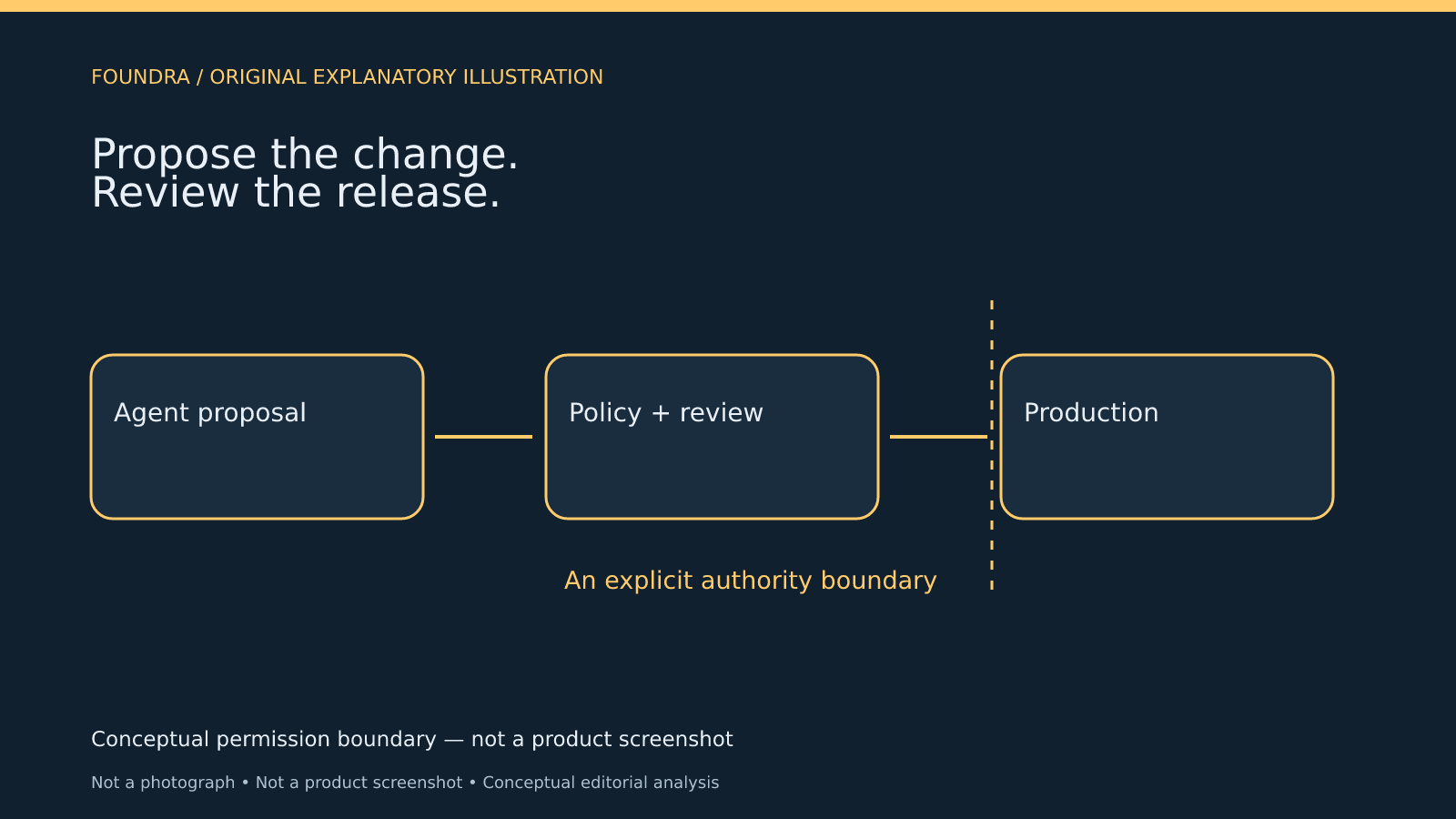
The issuer describes release stages, promotion policies, gates and jobs; Delivery works alongside existing build-and-test CI. Pulumi says agents do not change production directly: changes arrive as pull requests with deterministic plans and policy checks. This is an examination of the announced design and supporting product explanation, not a hands-on test.
The important product boundary is the merge. An existing CI system can build and test an artifact before it reaches that boundary. Delivery then addresses how a change proceeds through environments. The launch is aimed at expressing that progression, rather than assuming that passing a code test means the release is finished.
A pipeline is a description of relationships
Read a release definition as a set of relationships: this stage depends on that stage; this environment receives an artifact only after a stated condition; this job must produce a result before the next one proceeds. Code gives those relationships an inspectable representation. It does not automatically make the relationships sensible.
Take an illustrative service with staging and production environments. Its source code might be unchanged while the intended release order changes. That alteration is still consequential: it changes which result is observed before the production step. Treating the pipeline as a versioned artifact lets the team examine that change separately from the application it delivers.
This is not an assertion that every supported workflow enforces a particular order. It explains the function of the product category. The exact release definition, its dependencies and its conditions are what a team has to read. A screen showing that a release exists is less informative than the actual description of how it advances.
There is a second advantage to the representation: the same definition can be discussed by engineers and inspected by automation. That does not remove ambiguity in the underlying requirements, but it can make an ambiguous requirement visible as something the team must resolve instead of leaving it in an unwritten convention.
A release has more than one decision
Propose
An agent or engineer creates a change with an identifiable author.
Evaluate
Tests and policy checks examine what would change.
Approve
The configured process decides whether a person must sign off.
Reconcile
Operators compare the actual result with the intended change.
The return trip starts with an event
The companion Agents product gives the announcement its second direction. In Pulumi’s description, an event or schedule initiates work around running systems, and the resulting change is proposed through the code workflow. A production event becomes an input to development rather than a separate conversation that ends in an undocumented intervention.
An illustrative error alert might trigger investigation of configuration and a proposal to alter a limit. The alert, the investigation and the proposed change are three different artifacts. Preserving those relationships could help a team understand why a change exists without pretending that the alert itself proves the proposed diagnosis.
That feedback loop is useful only if it does not lose the distinction between an observation and an explanation. A symptom can have several causes. An agent’s explanation should be examined against the available records, not become the sole surviving account because it is the easiest paragraph to read.
The point here is not the generic claim that an agent needs permission. It is the product’s attempt to bring operational context back into the same reviewable representation as the release. The proposed loop changes where a team can inspect the work.
Read the result as carefully as the definition
A pipeline definition describes what ought to happen. A deployment record describes what did happen. They should not be collapsed. Even a correctly described release can encounter an interrupted connection, a delayed service response or a partial result.
Consider a deliberately interrupted release in a controlled evaluation. The deployment request is sent, but its response is lost. The team needs to inspect the running state before deciding whether another request is appropriate. That exercise examines result reconciliation, not merely whether an agent can regenerate the command.
A useful examination of this preview would therefore follow one small change all the way through: its release definition, the stage results, the actual environment and any operational event that leads to a follow-up proposal. No performance claim is needed to make that sequence worth inspecting.
Public preview supplies an opportunity to read and test the design within a constrained scope. It does not establish production reliability for every workload. Pulumi’s distinctive move is to make more of the work after the merge expressible as code, then bring the evidence from running it back into that representation.
Sources
- Pulumi — original product announcement ↗ Pulumi — original product announcement · Primary source
- GeekWire ↗ GeekWire
Have additional information? Request a correction.