Read the investor-reported case study as a test claim with undisclosed coverage, not proof that every production interaction is safe.
The financing and the example
Disseqt AI raised $8 million in a round led by Gresham House Ventures, the investor said in its November 19 announcement. Sure Valley Ventures, Delta Partners and Enterprise Ireland participated. YourStory also reports the financing and planned hiring in India. Earlier public Sifted metadata describes the same round on November 18; the investor statement is not claimed as first disclosure.
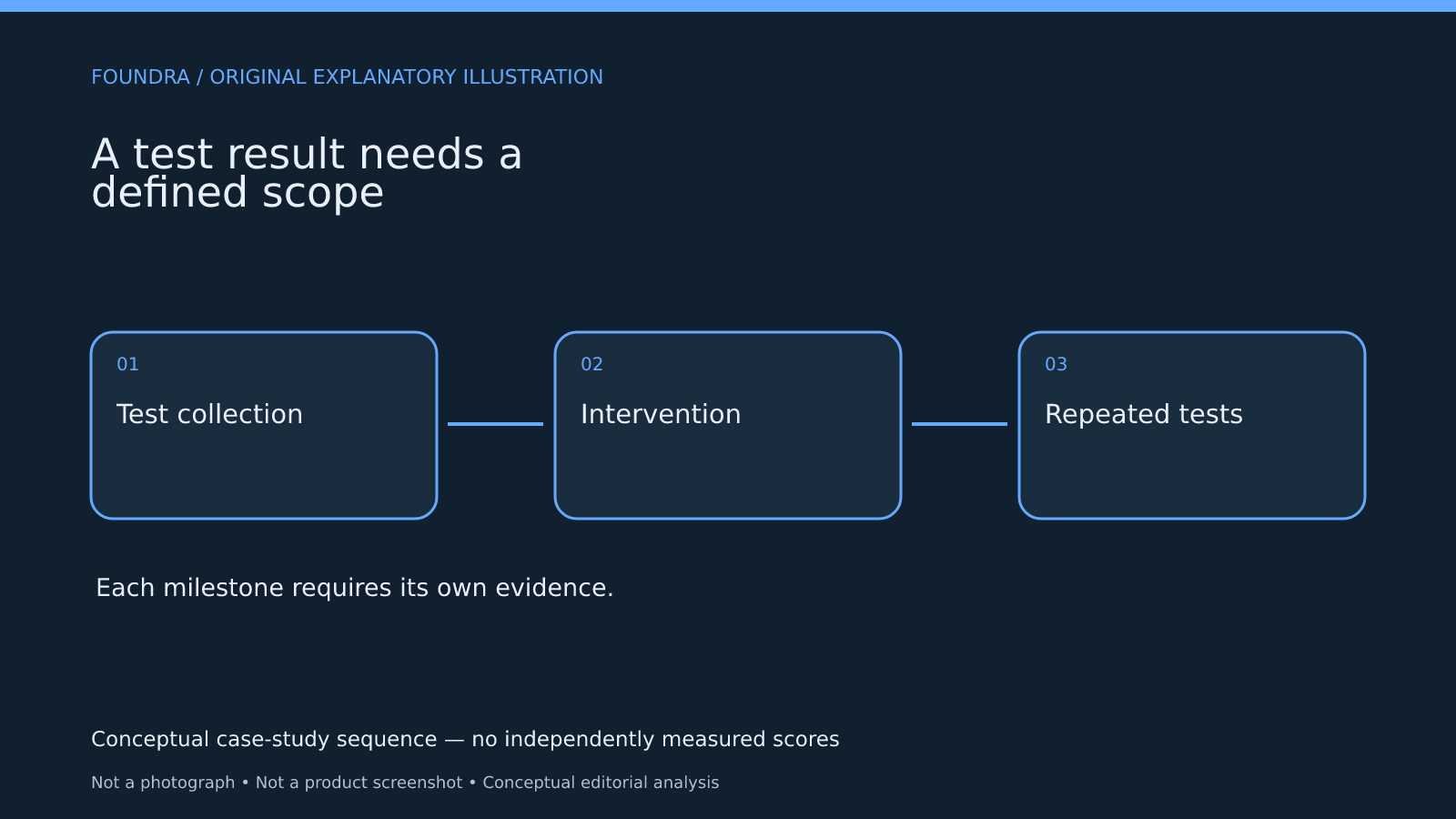
The Dublin company’s proposition combines testing, policy enforcement and monitoring for enterprise AI. The investor illustrates it with a sports-league fan-engagement agent, reporting an improvement in safe-response rate from 80% to 99% across tests covering safety, bias and privacy. Those percentages are investor-reported case-study claims, not results independently measured by Foundra.
The example is worth reading closely precisely because its apparent simplicity can hide the scope of the evidence. A percentage is a ratio. Its meaning depends on the cases counted and how the result is classified.
The test collection is part of the result
The supplied announcement does not provide the complete prompt collection, its size or the full assessment method. Without that information, readers cannot calculate how much of the agent’s potential behavior the exercise covers or reproduce the reported score.
That limitation does not make the exercise worthless. A defined collection can expose failures, and interventions can address them. It does mean the result should stay attached to the reported conditions rather than become a general claim that the agent is safe.
The investor also says no unsafe outputs were detected when the original failing tests were repeated after fixes. Retesting earlier failures answers a specific and useful question: do those failures still occur under the repeated conditions? It does not answer the different question of whether new prompts or a changed system will create new failures.
The distinction is about the reach of the evidence, not an allegation that the reported figures are false. The underlying records needed for independent authentication are not supplied, so this article neither certifies nor rejects the numerical result.
Read a case study without expanding its claim
Who reports it?
The financing announcement is from a participating investor.
What was tested?
The disclosed categories are safety, bias and privacy; complete coverage is not supplied.
What changed?
A reported safe-response rate improved within the described exercise.
What remains unknown?
New prompts, production outcomes and later model changes are not established by that figure.
What the case study leaves open
A reader would need additional evidence to connect that exercise to ongoing production behavior: the applicable system version, the relationship between test and live conditions, and a record of later changes. The number of people able to use an agent would not itself be the number of independently assessed interactions.
The financing supports Disseqt’s effort to sell assurance as an enterprise layer. The case study gives a concrete illustration of how the investor presents that proposition, but does not establish results for every customer or regulated use.
This limited-scope examination stops at what is disclosed. The next useful publication would make the test denominator and methodology inspectable. Until then, the honest description is a reported improvement within a described testing exercise—not a universal production safety verdict.
Sources
- Gresham House Ventures — participating investor announcement ↗ Gresham House Ventures — participating investor announcement · Primary source
- YourStory ↗ YourStory
Have additional information? Request a correction.