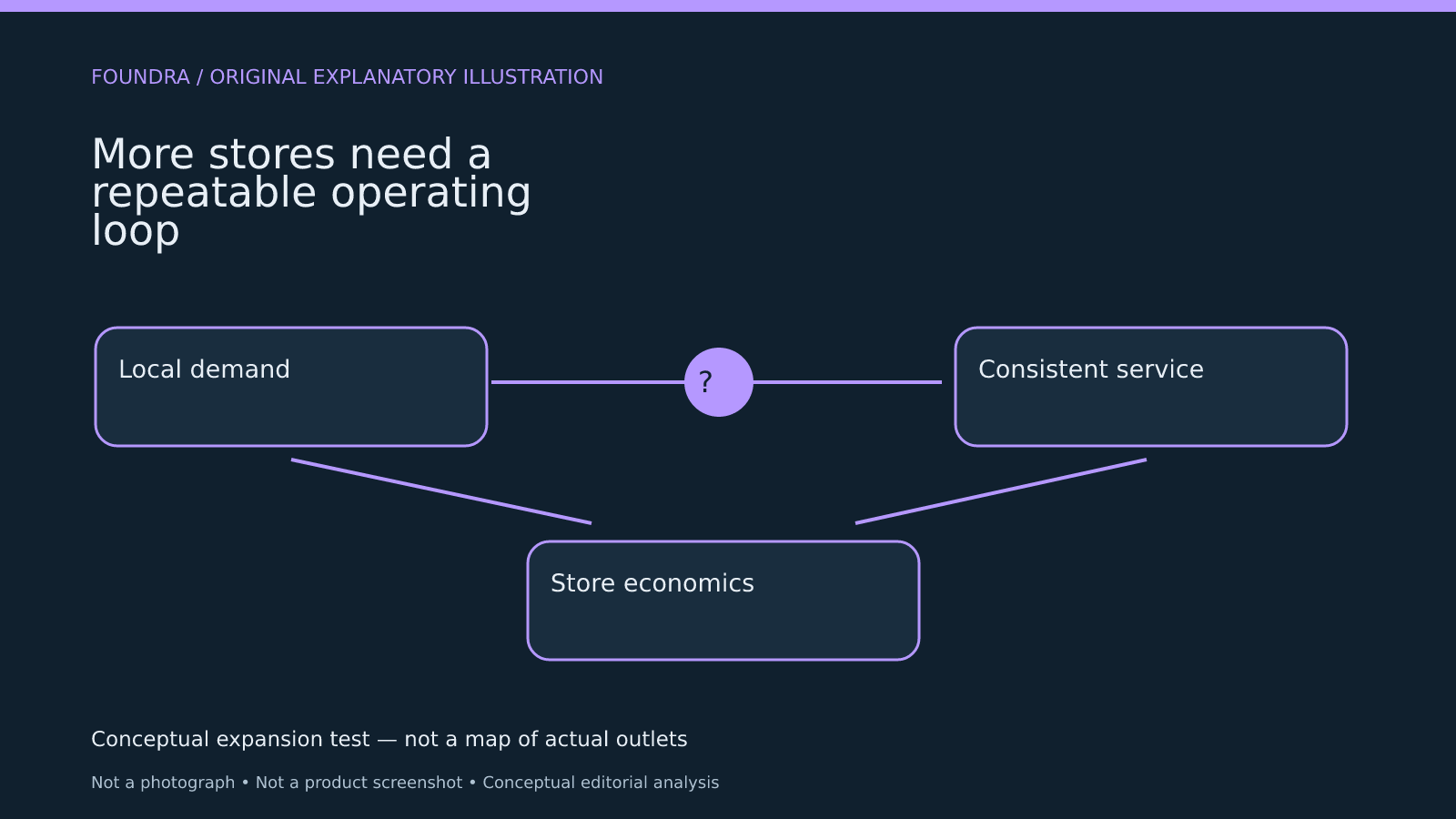
Boba Bhai’s plans combine more outlets with additional brands. Shared operations can support a new concept, but cannot establish its demand.
One company, more than one food proposition
Boba Bhai’s next phase is not only about adding outlets to the existing chain. The reported plan also includes new food brands under Boba Bhai Ventures. That makes the financing a story about what can be shared across concepts—and what each concept must earn for itself.
Inc42, Indian Startup News and YourStory reported an $18 million Series B led by Left Lane Capital on November 19, with BIG Capital and Titan Capital participating. Inc42 and Indian Startup News describe a primary investment and a small secondary component. The valuation and precise split were not disclosed.
Inc42 says the fresh capital is intended for store expansion, senior leadership and additional brands. Indian Startup News reports a target of 250–300 outlets within twelve months. That remains a target, and the secondary component means the entire transaction amount should not be counted as cash entering the business.
Both Inc42 and Indian Startup News also report that a second, Mexican-food brand has already launched a two-outlet Bengaluru pilot. Inc42 describes it as being in a trial and testing phase, with expansion dependent on consumer response. Its existence is reported; its commercial outcomes are not established by those accounts.
The shared kitchen is a business question
A multi-brand operating platform can have assets that extend beyond a single menu: purchasing relationships, preparation processes, training, location knowledge and organizational support. These are potential sources of reuse, not a claim that Boba Bhai has centralized each function in a particular way.
The appeal is that a new concept need not begin with an entirely separate organization. The risk is assuming that operational reuse means consumer demand transfers too. A customer who likes one food format has not necessarily expressed interest in another merely because both come from the same company.
Consider an illustrative second concept aimed at a different eating occasion. Its ingredients might fit an existing purchasing process, yet its peak demand could arrive at a different time or require a different preparation sequence. Reusing suppliers would not eliminate the work of understanding that occasion.
That is a more specific expansion problem than accumulating stores. The company needs to identify which functions create an advantage when shared and which need to remain distinct. A shared process that makes a new product worse is not a useful economy, even if it reduces the apparent number of teams.
This article does not report a kitchen visit, menu test or private launch roadmap. The reported Mexican-food pilot is a current starting point for the portfolio. The accounts do not supply its performance results or a complete description of how its operations are shared with the existing chain.
Read an expansion round in separate layers
Capital
Primary financing supports the company; secondary transactions provide shareholder liquidity.
Openings
A target for new outlets is not an operating store count.
Cohorts
Compare stores at similar maturity rather than only network totals.
Repeat purchase
Initial curiosity and durable demand are different signals.
Leadership is part of the expansion budget
Senior leadership appears alongside outlets and new brands in Inc42’s account of the funding priorities. It is easy to treat that as less tangible than a new location, but a broader portfolio creates more decisions about where capital, staff and management attention go.
An illustrative organization could have a growing chain and an experimental concept competing for the same support team. The unresolved question would not simply be which sells more today. It would be how to make the experiment’s cost and learning visible without weakening the existing business.
A financing gives room for those decisions; it does not supply the operating rules. Readers should not infer the company’s internal capital-allocation process or organizational chart from the public announcement. The relevant follow-up evidence would show how the existing pilot evolves, which additional concepts launch and how their progress is reported.
The primary-secondary distinction also matters here. Company capital can support the operating plan. Secondary consideration provides liquidity to existing holders. Both may be legitimate parts of a round, but combining them without qualification exaggerates the resources committed to the next business experiment.
The portfolio has to become visible
The reported outlet target offers one dated checkpoint. The already-launched Mexican-food pilot provides a different present reference point, with any further rollout still to be established. Those are different observations, and a total network count cannot by itself explain how that second brand is developing.
For a food-platform founder, the useful follow-up record would distinguish the existing chain from new concepts rather than absorb everything into one growth total. That allows readers to understand whether shared operations are supporting a new business or merely making its costs harder to see.
Boba Bhai’s round gives it capital to extend a chain and attempt a wider portfolio. The distinctive test is what travels well between brands. Purchasing or support may be reusable; the reason to buy still has to be created for each menu and occasion.
Sources
- Inc42 ↗ Inc42
- Indian Startup News ↗ Indian Startup News
- YourStory ↗ YourStory
Have additional information? Request a correction.