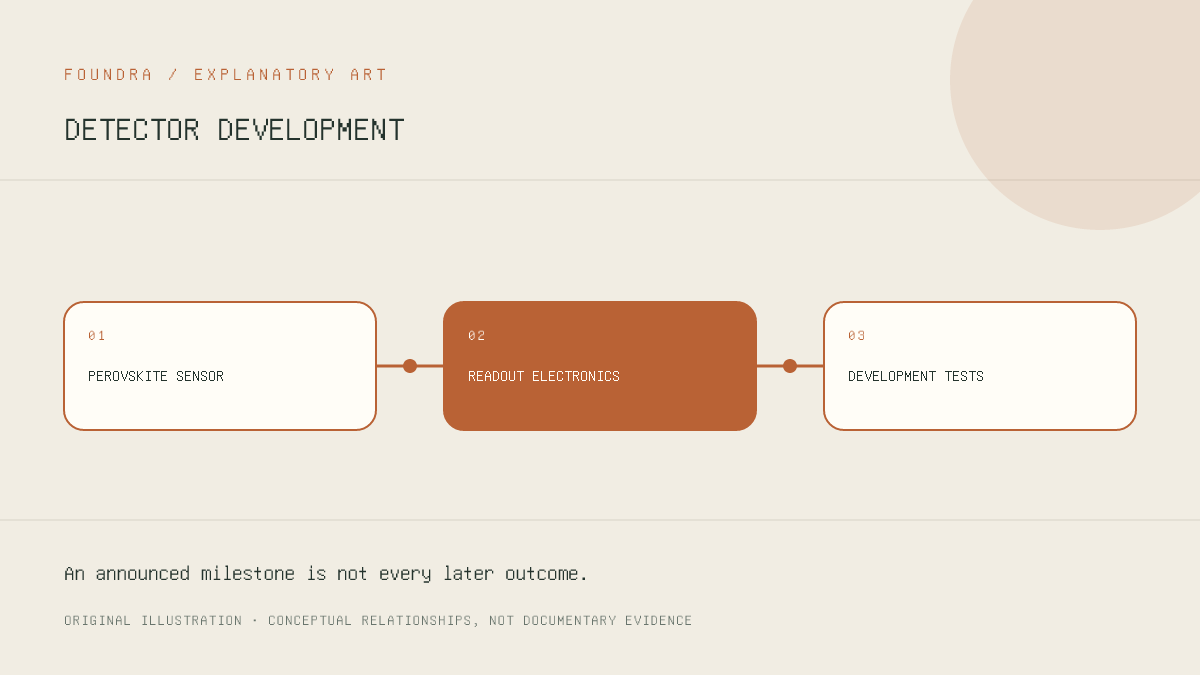
Keep three milestones separate: a research award, a working detector and a clinically deployable imaging system.
The important noun is detector
A grant for an X-ray detector is not an announcement that a hospital can buy a new scanner. That distinction matters in Clarity Sensors’ November 19 funding news. The Cambridge semiconductor company announced a £1.9 million Product Development Award from the National Institute for Health and Care Research, through its Invention for Innovation programme. The award supports PICASO, a three-year project with the Science and Technology Facilities Council’s Detector Development Group. Clarity’s announcement says the project began on October 1, 2026. The fresh development is the public announcement of the award, not the start of work or regulatory clearance. The £1.9 million is the total project award: EU-Startups reports £1.3 million allocated to Clarity, with the remainder going to STFC.
The company is developing halide-perovskite single-crystal sensors for photon-counting computed tomography. Its ambition is to make the detector material easier to manufacture, rather than to announce an already validated replacement for every component in a CT system. In this article, the manufacturing and performance descriptions are Clarity’s claims. They are not results of an independent clinical assessment by Foundra. The distinction is particularly important when a component company describes a potential benefit for patients: an attractive material-level result still needs to survive integration into the equipment that would actually be used.
Follow the funding, without changing its currency
The primary announcement denominates the new project award in pounds. EU-Startups’ report presents the £1.9 million total as roughly €2.2 million and says Clarity receives £1.3 million, or roughly €1.5 million, with the remainder allocated to STFC. These are a total and its allocation, not separate rounds. Clarity also identifies an earlier €2.5 million European Innovation Council Transition grant, announced in April 2025, which it describes as £2.1 million. Its £4 million combined figure is the company’s aggregate description of funding across the two programmes. It is not all newly announced money or a verified total of cash receipts allocated solely to Clarity.
Non-dilutive development funding asks a different question from a venture investment. It can support a defined technical programme without announcing a new equity valuation. Here, the useful question is what the funded programme is intended to produce. PICASO combines Clarity’s sensor material with readout electronics developed from STFC’s HEXITEC-MHz technology. The pairing makes the integration boundary visible: the material that responds to radiation and the electronics that read its output have to work together. A headline about the award should not erase that engineering work. The programme also plans to build and validate a complete detector module in a CT-relevant preclinical environment. That planned test makes the development scope more specific without implying a completed clinical evaluation.
Three different achievements in the detector story
Award announced
£1.9 million NIHR Product Development Award, announced November 19.
Detector integration
PICASO pairs Clarity sensors with STFC readout electronics over a three-year project.
Clinical deployment
A later hurdle; this announcement does not establish a cleared commercial scanner.
A manufacturing hypothesis still needs a system test
Clarity says it grows its perovskite sensors in days at low temperature and that initial laboratory results perform comparably with existing cadmium-telluride sensors on key detector measures. Those statements do not establish equivalent performance in clinical operation. The supplied announcement is not a complete comparative dataset: it does not give this article enough independently verifiable detail to settle questions about long-term reliability, production yield or performance across an entire installed scanner. We therefore do not turn the company’s early comparison into a claim that its technology is already clinically interchangeable.
From a sensor result to a purchasing question
An illustrative purchasing question shows why the boundary matters. A prospective equipment partner could ask whether a promising sensor is reproducible across successive manufacturing batches, whether its output remains stable in the intended operating conditions, and how it behaves with the proposed electronics. These are questions for evaluation, not allegations that Clarity has failed those tests. Similarly, a hospital’s eventual decision would concern the finished system and its permitted use, not just the growth time of the underlying crystal. The award announcement supplies a route to development, not answers to every later procurement question.
What the next announcement would need to add
The useful future evidence would narrow the gap between a component promise and a deployable product: clearly described detector results, the conditions of comparison, integration progress and the relevant pathway to clinical use. Clarity’s current announcement is consequential because it names a funded collaboration and a specific technical pairing. Its limits are equally informative. No new scanner launch, completed clinical validation or regulatory approval is established by the sources reviewed here. For readers following medical deeptech, that makes this a development milestone worth tracking on its own terms, without borrowing the certainty of a later milestone.
Sources
- £1.9 million NIHR award to develop second-generation photon-counting CT detectors with STFC - Clarity Sensors ↗ Clarity Sensors · Primary source
- UK startup Clarity Sensors receives €2.2 million NIHR award to make advanced medical imaging more accessible | EU-Startups ↗ EU-Startups
Have additional information? Request a correction.