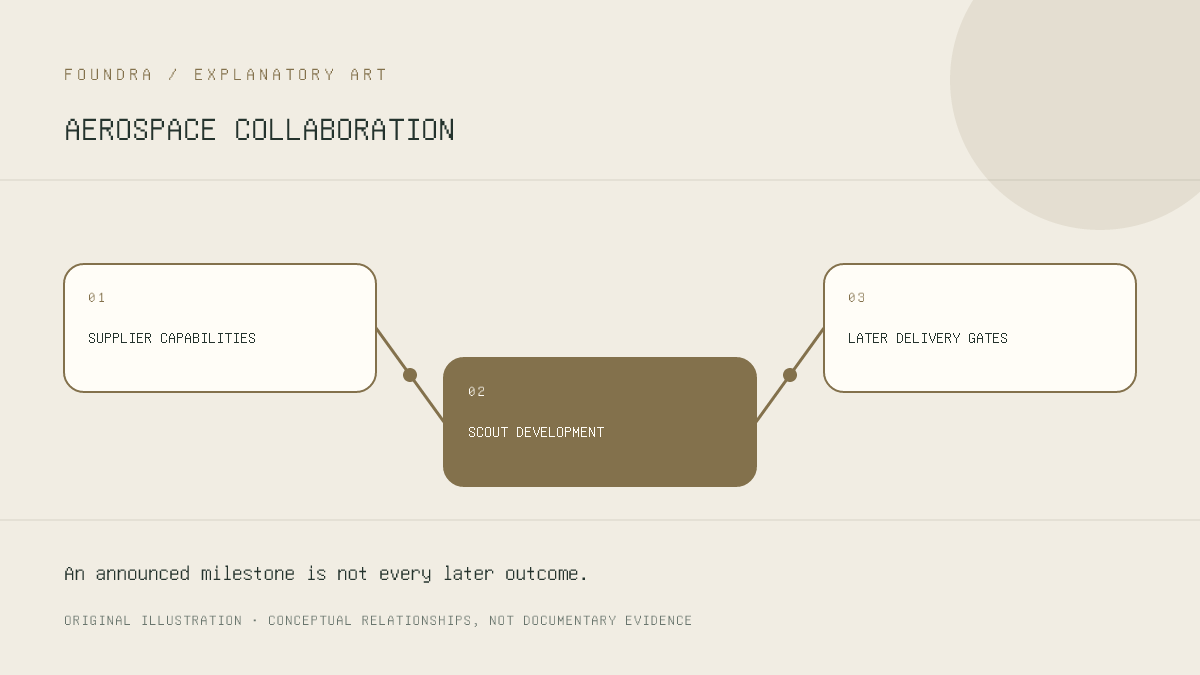
A supplier consortium can clarify a development programme without proving its eventual delivery or performance.
The consortium in one announcement
Dominion Dynamics has named twelve companies contributing to the development of Scout, its planned Autonomous Collaborative Platform. The November 20 Ottawa announcement brings aircraft suppliers and specialists into a Canadian-centred programme rather than announcing delivery of an operational aircraft. The company’s statement describes expertise spanning structures and composites, landing gear, engines, avionics, flight controls, sensors and secure communications. It also identifies flight testing, training, maintenance and long-term fleet management among the capabilities represented. Reading the roster by role gives a clearer picture of the proposed industrial effort than treating twelve partner names as twelve endorsements of a finished product. The named group also includes ITPS Canada, PV Labs and Altitude Aerospace, making the announcement more specific than a general invitation for suppliers to participate.
Propulsion and the airframe have different jobs
Pratt & Whitney Canada is one of the named partners, and Dominion issued a separate collaboration announcement about advancing Scout with the company. The consortium roster also includes Altitude Aerospace, Groupe DCM, North Aircraft Industries and RAMPF Composite Solutions. Dominion’s consortium announcement places aircraft structures and composites among the group’s capabilities. It does not specify a complete public workshare agreement for every named firm. We therefore do not infer which company will manufacture a particular component or claim that production contracts have been awarded from this roster alone.
The industrial distinction is nonetheless useful. A propulsion contribution is not an airframe contribution, and neither is identical to assembling the complete aircraft. An integrator needs the interfaces between them to be understood, not just the individual capabilities to be available. That observation explains the breadth of the announced roster without pretending to disclose Scout’s engineering design. The current statement does not give enough technical information to assess range, payload or flight performance, and no such specifications are invented here. The reported milestone is that the development partners have signed on.
What the consortium announcement establishes
Partners named
Twelve companies have signed on to contribute capabilities to the Scout programme.
Development coordination
Structures, engines, electronics and communications have to be integrated.
Later evidence
Testing, operational capability and procurement are distinct from this announcement.
Communications and sensing widen the network
Telesat, Thales Canada, PV Labs, SRC Can and HSB Solutions are also listed. The announcement describes secure communications, sensors, avionics and flight controls among the consortium’s expertise. It does not assign every capability to one supplier in the text supplied for this article. Naming the relevant companies makes the network visible while retaining that workshare limitation. Dominion says specialised suppliers from NATO countries will complement the Canadian industrial base. Canadian-centred therefore should not be rewritten as entirely Canadian-sourced, nor does participation alone establish ownership of the resulting intellectual property.
A communications link and a sensor can have very different purposes within a development programme. Bringing specialists together is consequently a coordination decision, not simply a way to enlarge a press-release list. For a reader following the industrial strategy, the informative future detail would be which responsibilities become explicit as the system takes shape. That is not a demand for the company to disclose sensitive design information. It is a way to distinguish a broad collaboration announcement from a more specific account of who is delivering what.
Testing and support belong on the same map
Top Aces and ITPS Canada round out another part of the named group. Dominion’s statement includes flight testing, training, maintenance and long-term fleet management in its description of the consortium’s capabilities. Those activities show why the supplier map extends beyond components used to construct an aircraft. A programme intended for long-term use also needs a path for learning about the system and supporting it. The announced participation is evidence of the proposed network, not evidence that Scout has completed a flight-test campaign or been accepted into operational service.
BetaKit’s account reports Dominion’s stated $50 million investment commitment to Scout. That is a company commitment, not a new government procurement payment. The company’s interest in Canadian defence needs and allied markets likewise identifies intended markets rather than completed aircraft sales. The story is strongest when those distinctions sit beside the concrete roster rather than overwhelm it. Twelve companies are now publicly attached to the development effort, across several different kinds of aerospace work. What remains to be demonstrated is how that network becomes an integrated programme, not whether a list of established suppliers sounds impressive.
Sources
- Dominion Dynamics announces a Canadian consortium to develop Scout, Canada’s first Autonomous Collaborative Platform — Dominion Dynamics ↗ Dominion Dynamics · Primary source
- Dominion Dynamics taps Canadian and NATO partners for autonomous wingman project | BetaKit ↗ BetaKit
- Dominion Dynamics and Pratt & Whitney Canada collaborate to advance Dominion Scout, Canada’s first Autonomous Collaborative Platform — Dominion Dynamics ↗ Dominion Dynamics — Pratt & Whitney Canada collaboration · Primary source
Have additional information? Request a correction.