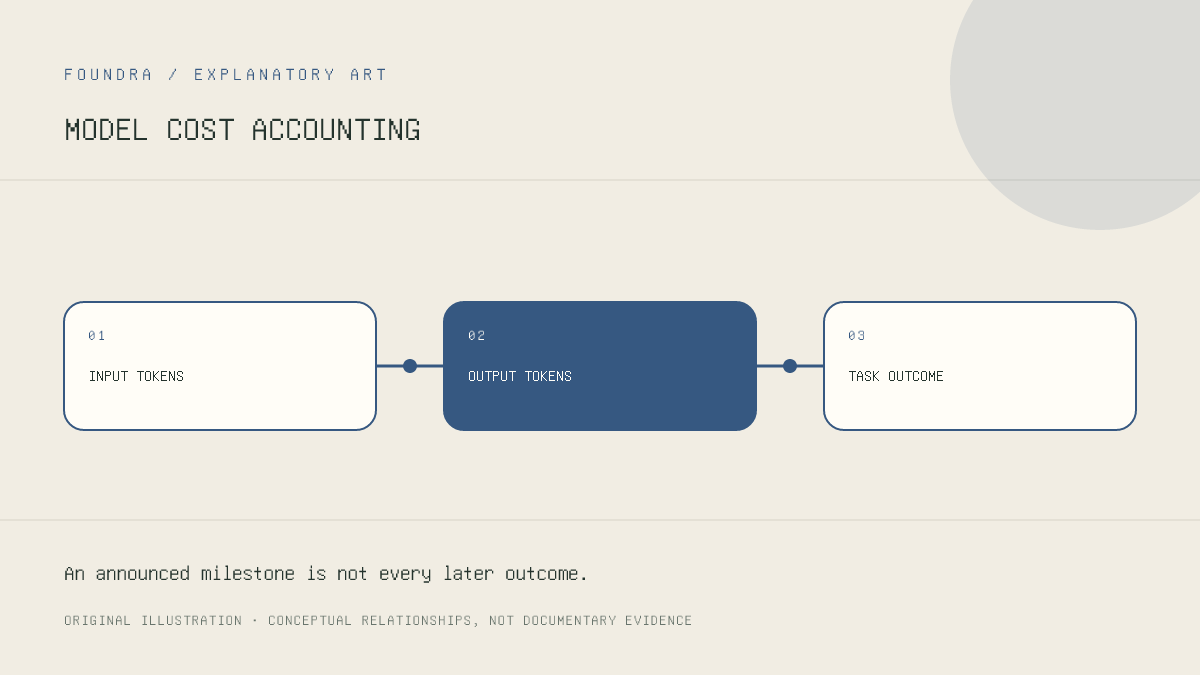
A token price helps model a bill; it does not measure the cost of a successful end-to-end task.
Start with the bill, not the leaderboard
Google’s launch announcement for Gemini 4 Neon, dated November 18, supplies a straightforward set of token rates: $3 per million input tokens, $0.15 per million cached input tokens and $15 per million output tokens. It also lists a one-million-token context window. These are source-reported product specifications and prices at announcement, not a bill from a task Foundra has run. Google India’s dated feed supplies the original release timestamp; the model is not being treated as fresh because of a later repost.
A hypothetical example shows what the rates mean without claiming performance. One million uncached input tokens and 100,000 output tokens would produce a $4.50 token subtotal at the announced input and output prices: $3 plus $1.50. That calculation excludes other costs and assumes those quantities; it is not an observed workload. If the million input tokens were eligible for the stated cached-input rate instead, that input component would be $0.15. Eligibility and actual token consumption would have to be established for a real bill rather than assumed from this example. In that eligible-cache scenario, the illustrative token subtotal would be $1.65 rather than $4.50. The output component remains $1.50 in both examples, showing why cheaper input alone does not proportionately reduce every bill.
Context capacity is not task completion
A context-window specification describes how much material can be presented within the model’s stated limit. It does not guarantee that every detail in that material will be used correctly or that a long workflow finishes without correction. Google describes Neon as supporting enterprise, analytical and scientific work and discusses inputs such as documents, spreadsheets and other media. Those are product claims in the announcement. This article does not certify the model’s behaviour on a particular organisation’s records or claim to have tested its handling of a full million-token input.
That distinction changes how a developer might compare costs. A short answer generated on the first attempt and a longer task requiring revision could consume different amounts of input and output even if their initial prompts were similar. Tool use and human supervision can also sit outside a simple token subtotal. These are general evaluation considerations, not measured shortcomings of Neon. The practical point is to define the unit being compared: a token, an attempted task and an accepted result are not the same unit. A price list answers the first question more directly than the other two.
Illustrative token bill at the announced rates
Uncached input
1 million input tokens × $3 per million = $3.
Output
100,000 output tokens × $15 per million = $1.50.
Token subtotal
$4.50 before other costs; a hypothetical quantity, not a measured task.
Successful result
Correctness, retries and supervision are not established by the token subtotal.
Ranks belong beside their conditions
Google gives several benchmark positions, including an Artificial Analysis Intelligence Index result at its xhigh thinking level, and describes internal progress on fabrication. Those statements remain attributed. The reporting package does not independently reproduce the evaluations or establish a universal ranking across all settings. A company’s description of a leaderboard can identify a reason to investigate a model without settling whether it is the best choice for every workflow. We avoid borrowing the word independent from a named external evaluation and applying it to every claim in the company announcement.
For an assessment to be useful, the model configuration and the work being attempted need to remain visible. A comparison at one reasoning setting does not automatically describe another setting’s cost or speed. Likewise, an internal fabrication result should not be rephrased as a guarantee of factual accuracy. The announced prices, context limit and claimed benchmark results describe different aspects of the product. Reading them separately is more informative than collapsing all of them into a single statement that a model is fast, cheap and dependable for any task.
A rollout has several doors
The announcement describes rollout through the Gemini API, business access and several paid consumer or development surfaces. That is the company’s availability statement, not a claim that Foundra has opened an account or tested each channel. For a prospective builder, the immediate source-supported task is to check the relevant access route and price against the intended workload. The useful launch facts are the announced model, its listed token economics and its stated context capacity. The larger workflow promises remain questions to evaluate with actual task evidence, rather than conclusions supplied by the pricing example.
Sources
- Introducing Gemini 4 Neon ↗ Google — original Gemini 4 Neon announcement · Primary source
- India Blog ↗ Google India — original dated RSS · Primary source
Have additional information? Request a correction.