Package controls and build-runner controls address different exposure points. Funding and adoption claims do not establish that either can eliminate software-supply-chain risk.
The installation happens before the finished product exists
A software package can execute in the environment used to build an application, before that application reaches customers. That is the trust problem StepSecurity is selling against: the development process itself can expose machines, credentials and build jobs, rather than merely producing code whose vulnerabilities are found later.
The company announced a $20 million Series A led by Elephant, with participation from Runtime Ventures, Inner Loop Capital and SaaS Ventures. Its original company RSS gives the funding post a November 18 publication time of 16:24:40 GMT. The article says the capital will expand protection for developer machines, package downloads, CI/CD pipelines and agent sandboxes. These are announced uses of funding, not a record of completed expansion.
A companion community registry announcement was published that morning, according to the same original feed. It describes free access to StepSecurity Secure Registry integrated with Harden-Runner. GeekWire’s November 20 report covers the financing and the product change. The original dates, rather than the later media appearance, establish the freshness of this event.
Waiting and watching are not interchangeable
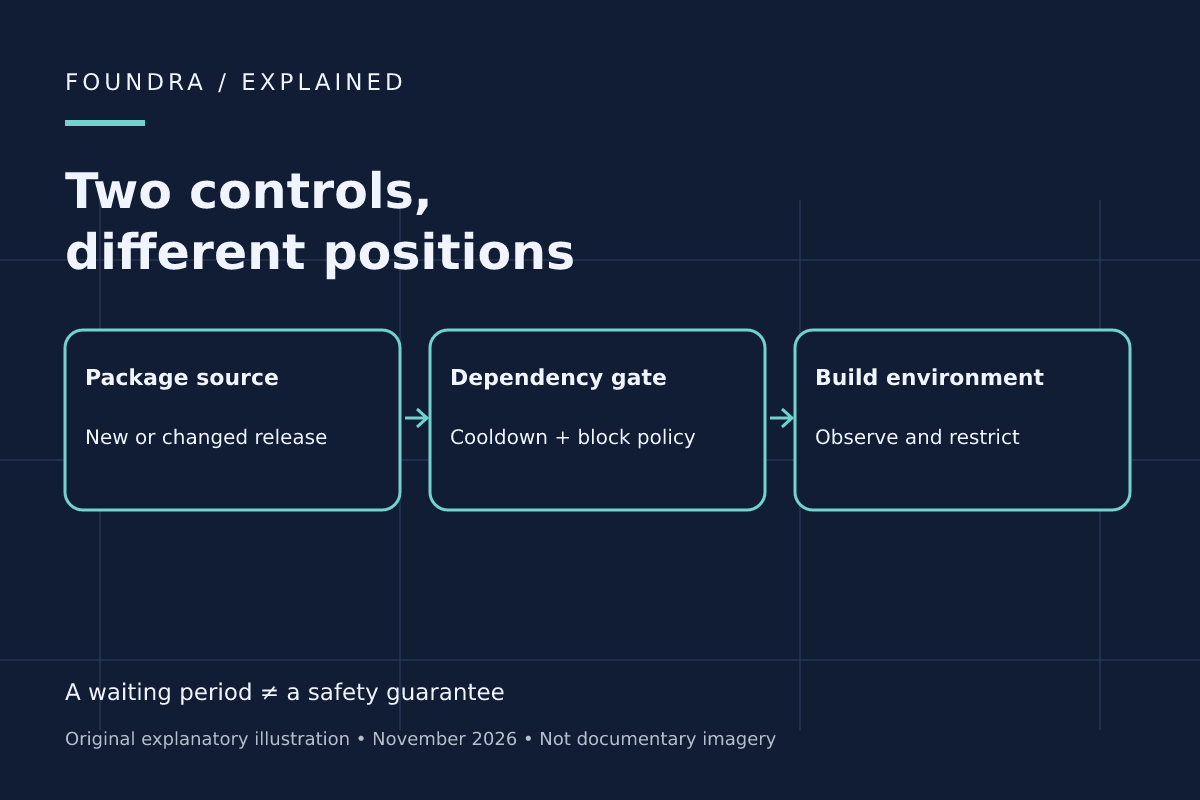
A registry policy acts at the download boundary. StepSecurity describes controls that block known compromised versions and apply a cooldown to new releases. The community tier uses a 48-hour default cooldown. The rationale is to allow time for suspicious releases to be identified before a build installs them; the passage of time does not itself inspect every line of a package.
That makes the policy different from protecting the environment in which downloaded code runs. Harden-Runner is the company’s GitHub Actions runner-protection product. A download gate asks whether a package should be admitted now. Controls around a build environment address what code can do after it is present. The two can complement each other without becoming the same security mechanism.
A hypothetical malicious release discovered one day after publication shows why a waiting period might help: a build that holds that version for two days could avoid installing it before the discovery. Change the hypothetical so discovery takes a week, and the same two-day rule offers no equivalent assurance. Neither scenario is a reported attack prevented by the new tier.
The trade-off also runs in the other direction. A delay may hold a legitimate update as well as a harmful one. Teams would have to reconcile dependency policy with urgent fixes and operational requirements. The announcement should not be read as proving that a single waiting period is optimal for every repository or every incident.
A build has more than one trust boundary
Download decision
Registry policies can hold new packages and reject known compromised versions.
Execution environment
Downloaded code may run on a developer machine or inside a build job.
Runner protection
StepSecurity describes Harden-Runner controls around that execution environment.
Residual risk
A passed waiting period is not an independent proof that code is harmless.
Free access has a defined perimeter
The company says the community registry tier is for public repositories using Harden-Runner with GitHub-hosted runners. It begins with npm support; additional ecosystems are described as future work. Those limits are important. A private repository, another runner arrangement or a different package ecosystem should not be assumed eligible merely because the product is described as free.
The pairing also means adoption is not simply a decision to use a different download endpoint. A team would need to understand the relevant runner setup, the registry’s policy behavior and what happens when a dependency is held or rejected. This is an implementation consideration derived from the described integration, not a hands-on finding about setup difficulty.
StepSecurity says more than 20,000 open-source projects use its Harden-Runner community tier. It also reports repeated fivefold annual recurring revenue growth, without providing the absolute revenue figure in the funding post. These are company-reported adoption and growth claims. They neither measure the effectiveness of the new registry tier nor establish how broadly customers enforce particular controls.
For an evaluator, the useful denominator would be the relevant build and dependency population: which jobs are protected, which downloads are governed, and which exceptions remain. A product can be installed widely while a specific control covers only part of a workflow. The reviewed sources do not provide a universal coverage measurement.
Agents inherit the build problem
The financing announcement also names agent sandboxes as an expansion area. The connection is technical rather than rhetorical. If an agent’s task leads it to download packages and execute code, those actions still cross software-supply-chain trust boundaries. Calling the initiating system an AI agent does not make the dependencies intrinsically safer.
The reviewed evidence does not establish that every announced agent protection is already available or that a registry policy can contain all agent behavior. It identifies the company’s intended direction. The immediate, narrower product development is the community registry tier and its integration with Harden-Runner.
That leaves a clear way to read the round: capital for a vendor seeking to protect more of the software-building process, alongside a specific expansion of free access. The practical test is not whether the product promises one safe supply chain. It is whether a team can identify the boundaries covered by each control—and the boundaries still left open.
Sources
- Protecting where software gets built: StepSecurity’s $20 million Series A - StepSecurity ↗ StepSecurity — original funding announcement · 2026-11-18 · Primary source
- Introducing the StepSecurity Secure Registry Community Tier, Integrated with Harden-Runner - StepSecurity ↗ StepSecurity — original product announcement · 2026-11-18 · Primary source
- StepSecurity, led by two Microsoft vets, raises $20M to defend developers’ tools from hackers – GeekWire ↗ GeekWire · 2026-11-20
Have additional information? Request a correction.