Treat the approved investment and intended supply-chain benefits as distinct from closing, wafer delivery and customer qualification.
The partner becomes a proposed investor
Cyient Semiconductors announced on November 19 that it had approved a $10 million strategic equity investment by GlobalFoundries. The original release says execution is still ahead, at a $490 million pre-money valuation and a combined $510 million post-money valuation incorporating its recent financing. The announcement establishes approval, not a completed closing.
Indian Startup News reports that the transaction uses compulsorily convertible preference shares under subscription and shareholder agreements. Foundra has not inspected those documents. The interesting industrial question is not a stake percentage inferred from approximate headline figures, but what ownership alignment can—and cannot—mean for a custom-chip business.
An equity relationship is not a wafer order
The primary release identifies larger turnkey custom ASIC capabilities, faster development and stronger wafer-supply assurance as intended benefits. These are company ambitions, not measurements of capacity or delivery already obtained.
Ownership and production obligations operate at different levels. In a hypothetical relationship, an equity investor is exposed to the fortunes of a company; a commercial supplier agrees to particular work on particular terms. The presence of both relationships would not make every future project a manufacturing commitment. That distinction is especially important when a customer needs a schedule it can plan around.
The announcement does not disclose reserved wafer quantities. It would be unsafe to infer an unlimited supply guarantee, preferential treatment for every design or a contractual production timetable. The equity link can matter without answering those project-level questions.
Four interfaces in a custom-chip relationship
Ownership
A strategic investment is approved; closing is not announced.
Specification
Customer requirements define a particular chip program.
Manufacturing
An equity link is not a disclosed wafer-volume guarantee.
Qualification
A delivered, accepted product needs its own evidence.
Where a custom design becomes a product
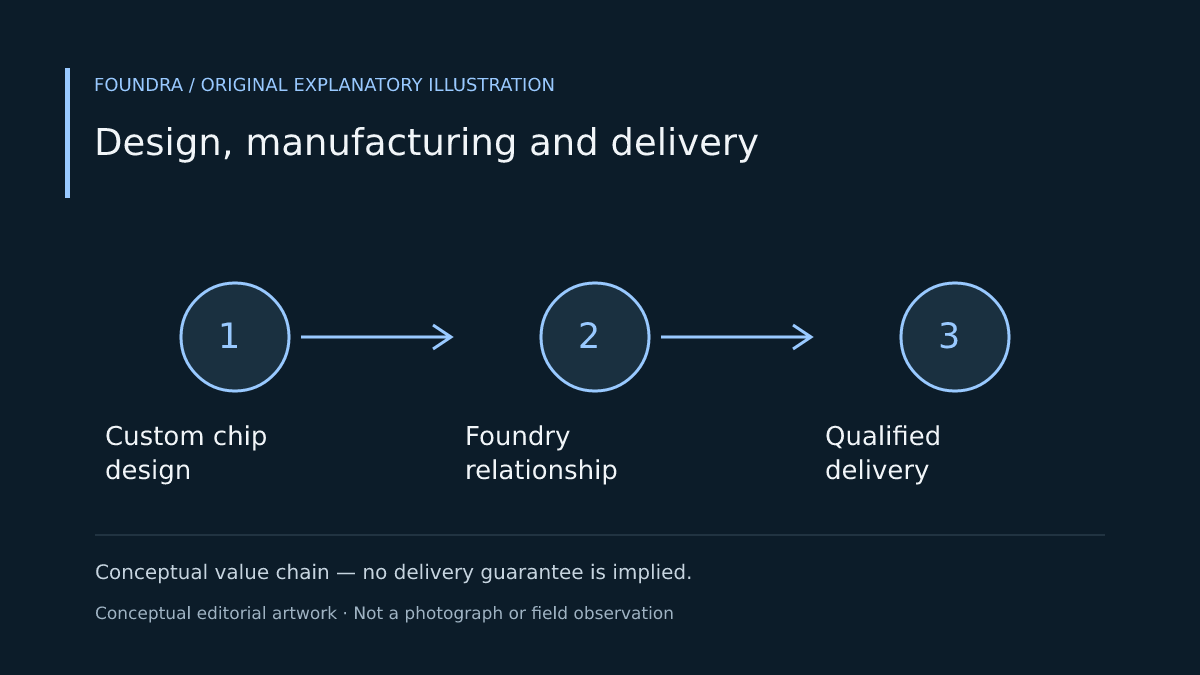
An ASIC is an application-specific integrated circuit. To understand the industrial setting, consider a hypothetical buyer that wants silicon for a particular product rather than a general-purpose processor. Defining the function would not complete the job. The design must be compatible with a manufacturing process and ultimately become something the buyer can use.
This simplified value chain contains several interfaces: specification to design, design to fabrication, and fabricated device to a qualified product. Packaging and testing sit within that path. Each interface introduces a different kind of coordination task. This is explanatory context, not a claim that Foundra has audited Cyient’s process or found a defect in it.
An investor with a role in manufacturing may potentially help connect those interfaces. Yet the public financing announcement supplies no basis for quantifying faster development, better yield or more reliable delivery. A relationship is a possible means of coordination, not a measurement of its outcome.
Two ways to read the same alignment
For the designer, a manufacturing relationship can be strategically relevant because a design is meant to become physical silicon. For the manufacturer, a design company can be strategically relevant because it participates in defining what customers want built. This is an analytical account of complementary roles, not a statement of either party’s undisclosed investment rationale.
The same alignment also raises a useful question about flexibility. In a hypothetical chip program, close coordination with one manufacturing process could be valuable, while portability to another process might matter for different reasons. No conclusion about exclusivity or portability at Cyient follows from this release; the point is that coordination and optionality are not identical goals.
A further hypothetical distinction is between reusable design work and customer-specific work. Reuse could benefit several programs, while a bespoke requirement might benefit one. The financing announcement does not divide spending between those approaches.
This perspective makes the investor’s industrial role more informative than a simplistic equation of valuation with technological quality. A financing valuation describes announced transaction terms. It does not rate a design, certify a product or reveal the economics of a customer program.
Company capital and program capital
A final distinction belongs to the entrepreneur’s budget. An equity investment supports the organization, but a particular customer design can still require its own spending, acceptance criteria and commercial agreement. The public release does not announce a new customer-program contract or give the budget of any such program.
Cyient’s approved investment is therefore a focused industrial event: a semiconductor manufacturer is named as a proposed strategic shareholder in a custom-silicon company. The deal’s execution remains future, and the intended supply-chain benefits remain intentions. The useful lesson is not that equity removes the work between design and production. It is that capital and commercial coordination can address different parts of that work.
Sources
- Cyient Semiconductors Secures Strategic Investment from GlobalFoundries ↗ Cyient Semiconductors — original release · 2026-11-19 · Primary source
- From foundry partner to shareholder: GlobalFoundries puts $10 million into Cyient Semiconductors ↗ Indian Startup News · 2026-11-20
Have additional information? Request a correction.