Funding an underwriting strategy does not establish its durability across borrowers, products or economic conditions.
The borrower is not the employment contract
A shop can have recurring customers without its owner having a salary slip. That illustrative distinction is the starting point for understanding InPrime’s latest financing, not evidence about any individual borrower. Credit designed around formal employment and credit designed around a self-employed business need not ask identical questions.
Inc42 reported on November 19 that Bengaluru-based InPrime Finserv had raised ₹101 crore in a Series B led by FMO, with existing investors Z47 and Pravega Ventures participating. Indian Startup News corroborated the round on November 20. The reports describe a completed fundraise, not a plan to seek that amount. Foundra has not independently inspected closing documents.
Inc42 says the lender intends to expand its reach and enter micro-mortgages. Indian Startup News describes its customers as including kirana owners, dairy farmers and other micro-entrepreneurs. Those details identify the product and borrower segment being discussed; they do not establish that all such customers are suitable for credit or that all intended products are already available.
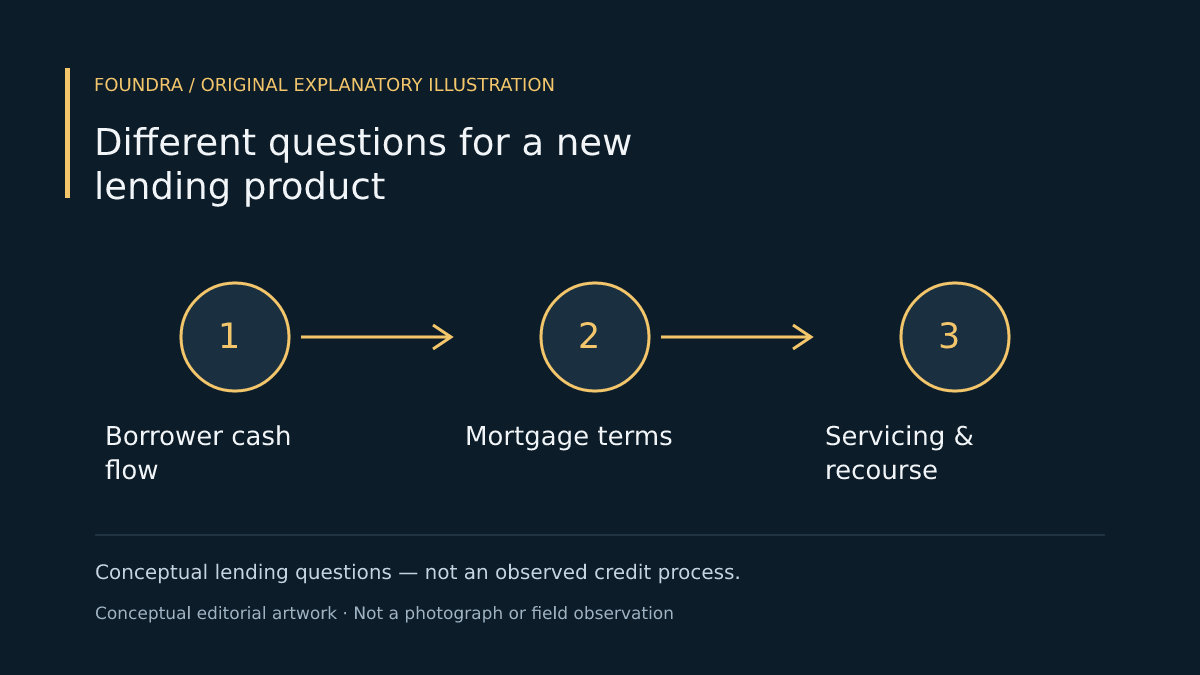
A new product changes the questions
The term micro-mortgage should not be allowed to do too much work. Neither report supplies a complete new-product contract, loan-size range, repayment schedule or collateral-enforcement process. It would therefore be premature to tell a reader exactly what borrowing against property through the new offering will cost or what obligations it will create.
The analytical issue is nevertheless concrete. A lender moving into a secured product must evaluate the proposed repayment relationship as well as the asset-related terms. Collateral does not, by itself, answer whether a repayment schedule fits the customer’s cash flow. That is a general product-design distinction, not an allegation about InPrime’s practices.
Imagine a hypothetical small-business owner with uneven monthly receipts. A repayment arrangement that looks manageable in an average month might be harder during a slow period. That example does not assert that InPrime’s customers face a particular seasonal pattern. It explains why a borrower segment cannot be reduced to one label, even when a lender believes the segment is underserved.
Three separate tests for expanded lending
Funding
The reported Series B supplies investor backing; it is not a borrower outcome.
Product
New micro-mortgage terms need a separate launch disclosure.
Quality
Repayment fit, understanding and recourse need evidence beyond AI usage.
AI activity is not a credit-quality denominator
Inc42 attributes to the company four in-house AI copilots supporting its credit team and three voice agents used in customer service. Those are descriptions of tools in use. They are not independent measurements of underwriting accuracy, borrower comprehension or the quality of disputed decisions.
A useful evaluation would distinguish a model’s assistance from the accountable decision that follows it. If a system helps organize information, a reviewer still needs to know how errors are detected and who can change a decision. If an automated voice system speaks to a customer, the customer’s ability to understand the terms matters separately from whether the call was completed. These are evaluation principles, not newly reported company policies.
The financing does not resolve those questions. Nor would a count of automated calls resolve them: volume measures activity, while suitability, understanding and recourse require different evidence. Foundra is not assigning the company a positive or negative AI-performance score.
Growth should remain legible to the customer
The practical consequence of the round is that InPrime reports new backing for a wider lending strategy. An expansion plan can be relevant even without an assurance that it will succeed. The important future disclosures would include the terms of any launched micro-mortgage offering and evidence about how it performs, rather than just the scale of distribution.
For a prospective borrower, the fundraise is not a recommendation to take a loan. Total cost, repayment obligations, security and complaint routes are more directly relevant to that decision than the prominence of the investors. This article does not assess a particular loan or provide personalized financial advice.
For founders building financial services, the lesson is less about adding AI to a pitch and more about keeping the product understandable as it grows. Investor backing, operating reach and a durable borrower relationship are related ambitions, but none is a substitute for the others. Today’s verified news is the reported financing and intended expansion. The quality of the expanded relationship will need to be assessed on its own evidence.
Sources
- InPrime Finserv Raises ₹101 Cr To Expand Lending, Enter Micro-Mortgages ↗ Inc42 · 2026-11-19
- Lender to kirana owners and dairy farmers, InPrime Finserv raises Rs 101 crore from FMO, Z47, Pravega ↗ Indian Startup News · 2026-11-20
Have additional information? Request a correction.