The signed acquisition and Intuit’s proposed investment are linked but distinct; neither proves that the transfer has already closed or that customer-facing changes have been delivered.
Read the arrows before the price
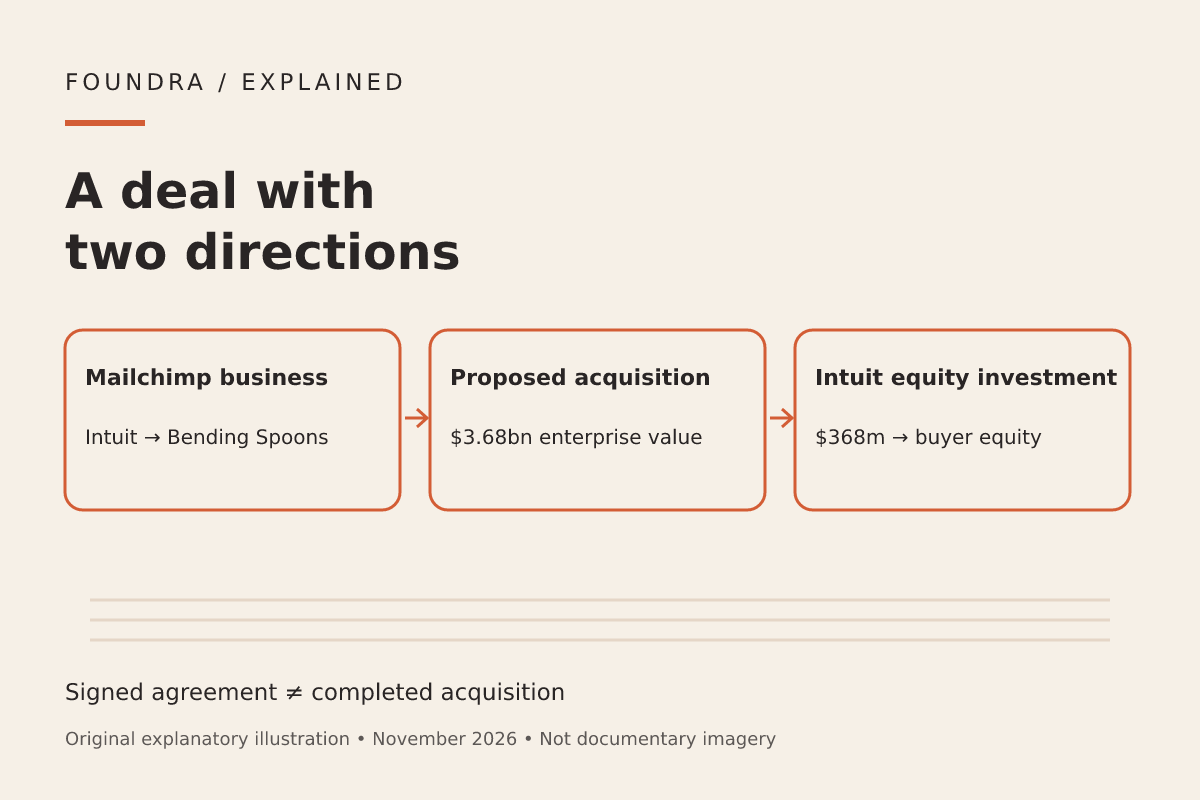
Money would move in both directions. Bending Spoons would acquire Mailchimp from Intuit, while Intuit would invest part of the proceeds in Bending Spoons itself. That is a more precise description of the announced package than simply saying the email platform has been sold for cash.
In its November 19 announcement, the purchaser says it has entered into a definitive agreement at an enterprise value of $3.68 billion. It separately specifies a $368 million investment by Intuit in newly issued Bending Spoons equity. The acquisition, including the investment, remains subject to regulatory approvals and other customary closing conditions, with closing expected in early 2027.
The distinction matters because a signed agreement is a commitment to a transaction, not evidence that ownership has transferred. TechCrunch’s November 20 account uses the language of a purchase. The original announcement supplies the narrower, controlling status: this is an agreed acquisition that still has to close. Foundra has not verified a subsequent completion announcement.
Nor should the headline enterprise value be treated as a complete cash-flow statement. Enterprise value, acquisition consideration and a seller’s ultimate retained proceeds are different concepts. The public release describes the package, but it does not supply enough detail here to reconstruct every adjustment, tax consequence or closing payment. A neat subtraction cannot substitute for those missing terms.
What the equity stake does—and does not—say
The related investment would leave Intuit with exposure to the buyer rather than exposure only to the business being transferred. Economically, that is different from receiving proceeds and having no continuing financial connection to the acquirer. It does not follow that Intuit will control Bending Spoons, retain control of Mailchimp or obtain a particular return.
The $368 million figure is one-tenth of the stated $3.68 billion enterprise value. That arithmetic can orient readers to the relative sizes of the announced components. It is not an ownership percentage: calculating a shareholding would require the equity issuance price and the relevant capitalization. Neither the amount invested nor the size of the acquisition by itself provides that denominator.
This also explains why the phrase all-cash need not contradict the linked share purchase. The purchaser describes the acquisition as all-cash and the Intuit investment as a separate use of proceeds within the package. Collapsing the two into a single stock-and-cash payment might sound simpler, but it would replace the announced legal structure with an interpretation.
For founders, the useful lesson is about transaction literacy rather than the attractiveness of this particular price. A sale can combine a business transfer with another investment, and the economic relationship can persist after control of the operating asset changes. Whether that arrangement is attractive depends on terms that the headline number cannot establish.
Reading the proposed Mailchimp transaction
Agreement signed
Bending Spoons announces a definitive agreement, not a completed transfer.
Acquisition consideration
The release describes an all-cash acquisition at $3.68 billion enterprise value.
Related investment
Intuit is to invest $368 million of its proceeds in newly issued buyer equity.
Conditions outstanding
The purchaser expects early-2027 closing, subject to approvals and customary conditions.
Customers have a different transition clock
Mailchimp users do not buy enterprise value; they buy a service that sends messages, maintains audiences and supports workflows. Their practical concerns sit on a different clock from the signing announcement. The relevant milestones would be actual closing and any subsequently announced changes to the product, contractual terms or integrations—not a prediction that a new owner must immediately alter everything.
Bending Spoons says it intends to invest substantially in the business after closing. That is an intention from the prospective owner, not verified evidence of future product quality or service levels. Similarly, reassurance about a smooth transition cannot establish that every customer’s workflow will remain unaffected. The announcement does not provide a customer-by-customer migration plan.
A proportionate response would be to preserve an inventory of important automations, data exports and connected services, then compare any actual transition notice against that inventory. This is ordinary continuity planning, not a recommendation to leave Mailchimp because of the transaction. No new outage, integration failure or mandatory migration is established by the evidence reviewed for this story.
The deal therefore has two unresolved timelines. One concerns approvals and completion; the other concerns what the platform becomes under the prospective owner. The November 19 announcement establishes the agreement and its linked investment. It does not settle the second question, and calling the first timeline finished would only obscure both.
Sources
- Bending Spoons has entered into a definitive agreement to acquire Mailchimp | Bending Spoons ↗ Bending Spoons — original purchaser announcement · 2026-11-19 · Primary source
- Bending Spoons buys Mailchimp for $3.68 billion | TechCrunch ↗ TechCrunch · 2026-11-20
Have additional information? Request a correction.