Deere announces the acquisition as completed; promised agronomic and economic benefits still require evidence beyond the transaction and product descriptions.
A camera is only the beginning
A count of fruit on a tree is information. Deciding what to do with that tree is a different problem. John Deere’s acquisition of Orchard Robotics, which operates as Orchard AI, puts those two tasks inside a closer corporate relationship: crop measurement from the startup, alongside the equipment maker’s precision-agriculture capabilities.
Deere’s November 19 acquisition announcement describes the San Francisco company as a provider of plant-level intelligence for high-value crops. It announces an acquisition, rather than a pending agreement subject to future closing. GeekWire’s November 20 report also describes the company as acquired and says the terms were not disclosed. No transaction price is established in the reviewed evidence.
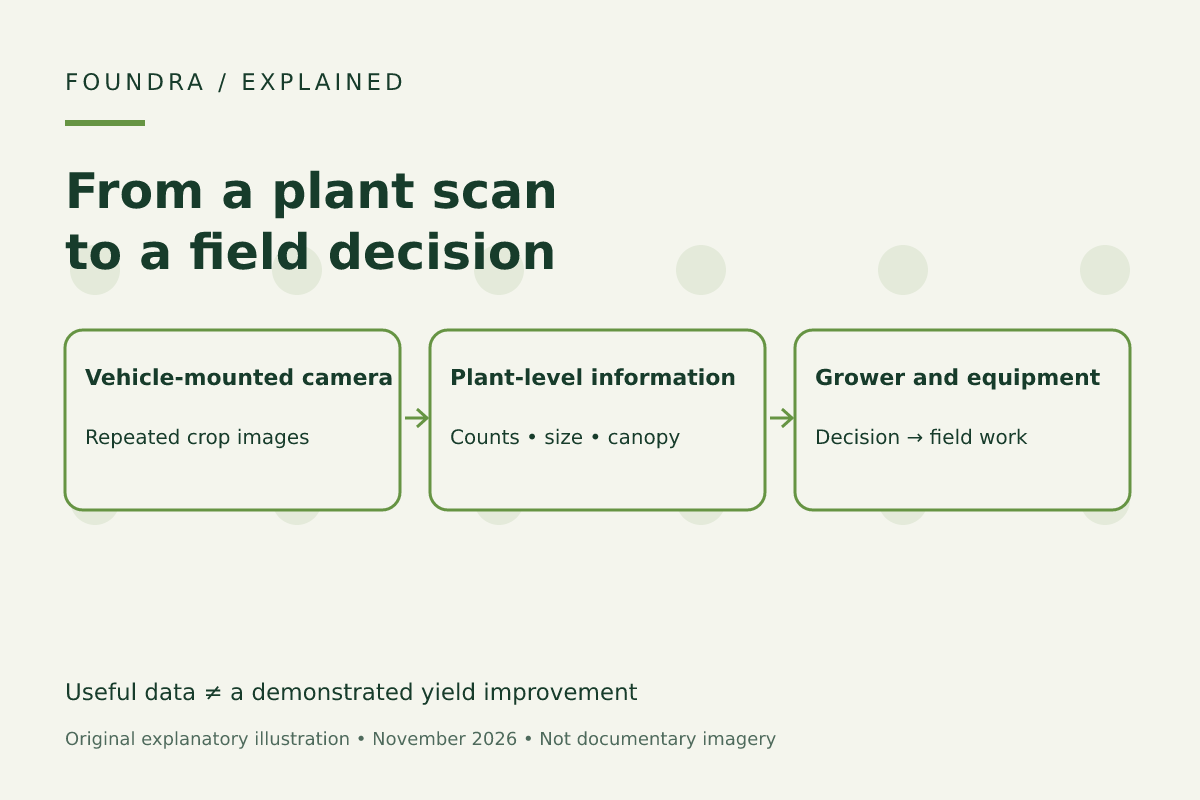
The product starts with vehicle-mounted cameras. Deere says repeated passes capture images of individual trees, vines or plants, and that Orchard’s FruitScope software makes the resulting crop information usable to growers. The listed outputs include fruit counts, size and color data, canopy measurements and yield estimates. These are the manufacturer’s descriptions, not measurements from a Foundra test.
Measurements must survive the decision window
The appeal is not simply collecting more images. It is making a distinction inside a farm that would otherwise be difficult to see or act on. If two areas need different treatment, plant-level information could help identify that difference. But finer resolution is valuable only when it changes a decision that someone can actually execute.
Deere’s release discusses uses in thinning, crop treatments and harvest timing. It also offers an example in which bloom information informs a spray prescription, with recommendations delivered to a mobile device or an in-cab G5 display. Those examples describe the intended connection between crop data and work. They do not establish that every crop type, orchard or existing machine already supports an identical end-to-end workflow.
Timing is a central constraint in that connection. A crop estimate that arrives after the relevant management window can be accurate yet unhelpful. Conversely, a timely signal that is badly calibrated can encourage the wrong intervention. The product examination therefore has to consider freshness and uncertainty together, rather than treating a dense map as a self-evident result.
That is analysis of the workflow, not a finding that Orchard’s system is inaccurate or late. The reviewed announcement does not supply a cross-farm validation study, quantified error ranges or comparable results across different growing conditions. It would be inappropriate to infer either failure or universal reliability from their absence.
Where crop intelligence has to remain useful
Observe
Deere describes vehicle-mounted cameras gathering repeated plant-level images.
Interpret
Its release describes counts, size, color, canopy measurements and yield estimates.
Prioritize
A grower must determine whether the information changes a relevant crop-management decision.
Act and check
Work has to be executed in time; benefits would require measured operational and crop outcomes.
The value chain has another handoff
Putting sensing and machinery under one owner could reduce organizational distance between a diagnosis and an action. That is the strategic logic of this acquisition. Yet common ownership is not the same as proven interoperability. A useful connection would still have to preserve the meaning of the crop data when it moves into a recommendation, a work plan and an equipment interface.
Consider a hypothetical prescription for one part of an orchard. The location must correspond to the correct area, the recommendation must remain applicable when the crew or equipment reaches it, and the work performed must match the intended intervention. This is an explanatory example, not a reported Orchard deployment or a claim about Deere’s current automation.
The grower also needs a way to distinguish what the system observed from what it inferred. A fruit count, a yield estimate and a suggested action are not interchangeable outputs. Each has a different evidentiary burden. Software that presents them clearly would make it easier to question an estimate without discarding the underlying observations.
Deere says it wants to preserve Orchard’s innovation speed and customer relationships while bringing its scale and capabilities. That states the acquirer’s intent. Whether integration preserves those strengths, and whether customers gain useful functionality from it, can only be assessed through subsequent product and operating evidence.
What would make the acquisition matter in an orchard
The strongest evaluation would follow a particular crop-management decision from scan to outcome. It would ask what changed in the work, whether the recommendation arrived in time and whether the result justified the resources required to obtain it. That would be more informative than an undifferentiated claim that AI improves farming.
The evidence reviewed here establishes an acquisition and a described technical pathway. It does not establish a yield increase, a reduction in chemical use or a farm-level return on investment attributable to the combined business. Those remain possible objectives, not demonstrated benefits of the transaction.
For the startup sector, the development illustrates an exit in which plant-level software intelligence is being brought closer to the machinery used to act on it. For growers, the meaningful finish line is less abstract: a better-supported decision, completed while it still matters. The acquisition can create an opportunity to pursue that finish line; it cannot count as having crossed it.
Sources
- John Deere Acquires Orchard AI | John Deere US ↗ John Deere — original acquisition announcement · 2026-11-19 · Primary source
- John Deere acquires Orchard Robotics, an AI farming startup with Seattle ties – GeekWire ↗ GeekWire · 2026-11-20
Have additional information? Request a correction.