A funding commitment, installed capacity and material actually recovered require different kinds of evidence.
A daily measure beside an annual measure
The Private Infrastructure Development Group announced on November 19 that its InfraCo project-development solution had committed ₹110 crore, approximately $11.7 million, in equity to NEPRA – Let’s Recycle. Inc42 corroborated the announcement. The investor uses committed, and Foundra has not independently verified the disbursement schedule.
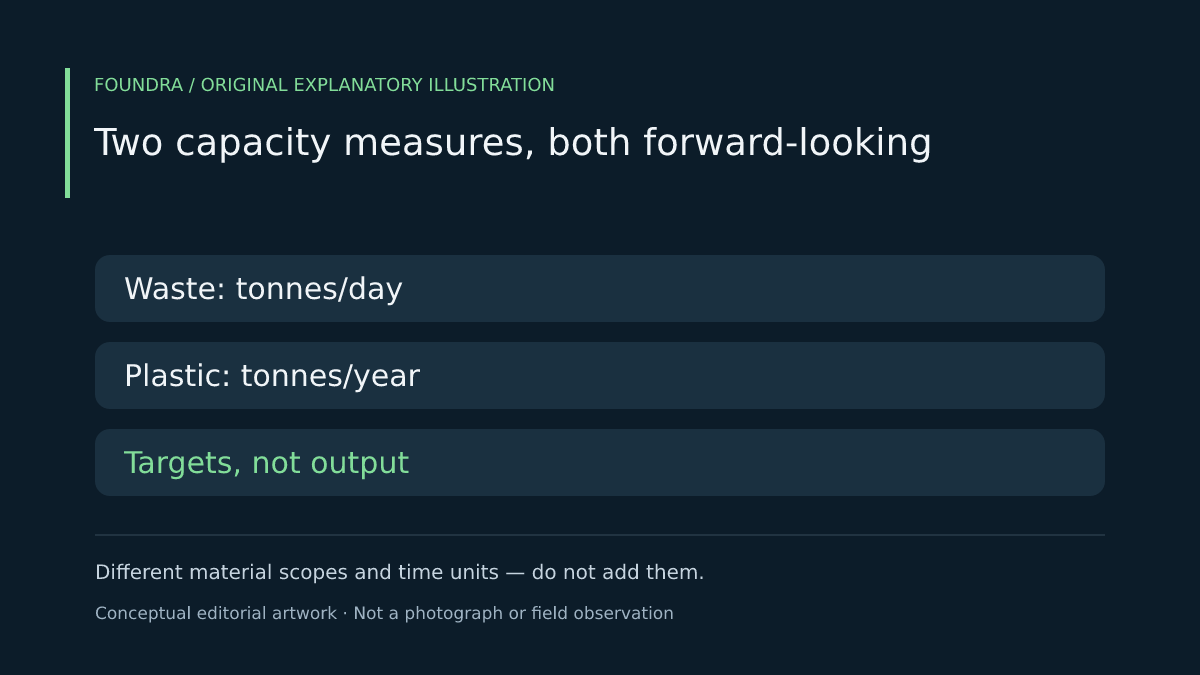
Two expansion targets explain the industrial purpose. The release describes waste-processing capacity rising from about 900 to 1,880 tonnes per day, and plastics-recycling capacity from 6.2 to approximately 18 kilotonnes per year. Both are planned capacities, not newly measured output. The first covers waste processing; the second covers plastics recycling.
What the ratios actually say
Using the disclosed figures, 1,880 divided by 900 is about 2.09. That is a little more than twice the stated daily processing base. Eighteen divided by 6.2 is about 2.90, or nearly three times the stated annual plastics-recycling base. These are Foundra’s calculations from the investor’s figures, not independently measured growth rates.
The comparison tells the reader which stated capability is planned to grow proportionately faster. It does not tell the reader that plastic will account for a particular share of all waste handled. The material scopes and the time units differ, and the release does not supply the complete relationship between the two operations.
Subtraction gives another way to read the plan: 980 additional tonnes per day of waste-processing capacity and 11.8 additional kilotonnes per year of plastics-recycling capacity. These are calculated target increments, not material already processed or recovered.
That limitation is easy to lose if both figures are turned into one impressive-looking total. Annual recycling capacity cannot simply be added to daily waste-processing capacity. Even converting the units into the same time period would not establish that the material scopes were comparable.
Do not collapse these five measures
Equity
₹110 crore is committed by the investor.
Daily processing
The stated plan is about 900 to 1,880 tonnes of waste per day.
Annual recycling
The stated plan is 6.2 to approximately 18 kilotonnes of plastic per year.
Actual throughput
No matched operating measurements are supplied.
Environmental effect
No quantified baseline comparison is established.
Installed, used, recovered
Capacity is an ability to process under a stated definition; throughput is material actually moving through an operation. The announced targets describe the former. To discuss the latter, an account would need operating measurements over a defined period. Foundra has not visited a facility or inspected those records.
There is another distinction downstream. In an illustrative recovery facility, mixed material accepted, material separated, material suitable for recycling and material finally sold could be different quantities. These are conceptual stages, not observations of NEPRA’s output. Keeping them separate prevents a planned processing rate from becoming a claim of verified resource recovery.
The sequence also explains why utilization is not supplied by a nameplate number. Dividing measured throughput by comparable capacity could be useful if both measurements shared scope and time period. No such matched data is provided in this announcement, so this article does not calculate a utilization rate.
Not all of the investment is a machine
The primary release says the commitment supports new material recovery facilities, more plastic recycling, stronger existing operations and working capital. It does not provide a complete allocation among those uses. A specific amount for an individual site or equipment order cannot responsibly be derived from the headline commitment.
Working capital and installed equipment answer different operational questions. In a hypothetical facility business, equipment creates the ability to process material, while ongoing resources support operations as commercial payments arrive and expenses fall due. That illustration explains the distinction; it is not a description of NEPRA’s undisclosed cash cycle.
Similarly, an equity commitment is not a waste-supply contract or an agreement to buy recovered output. Those relationships would need their own evidence before supporting a revenue forecast. Investment can finance capability without establishing how fully it will be used.
What the numbers do not measure
The targets do not quantify emissions avoided, disposal reduced or resources saved. A responsible environmental comparison would need a suitable baseline and evidence about what happens to the material. This article does not manufacture either. Recycling-related capacity is the subject, not a verified environmental impact score.
The useful achievement of the disclosure is more modest and more checkable: it puts two clearly different capacities beside an investor commitment and identifies intended operating uses. Readers can retain both the units and the planned status. When actual capacity or output is reported later, that precision will make a meaningful comparison possible without having first overstated today’s figures.
Sources
- PIDG invests USD 11.7 million in NEPRA-Let's Recycle, India’s largest dry waste recycling company - ↗ PIDG — original investor release · 2026-11-19 · Primary source
- NEPRA Raises ₹110 Cr To Expand Plastic Recycling Capacity ↗ Inc42 · 2026-11-19
Have additional information? Request a correction.