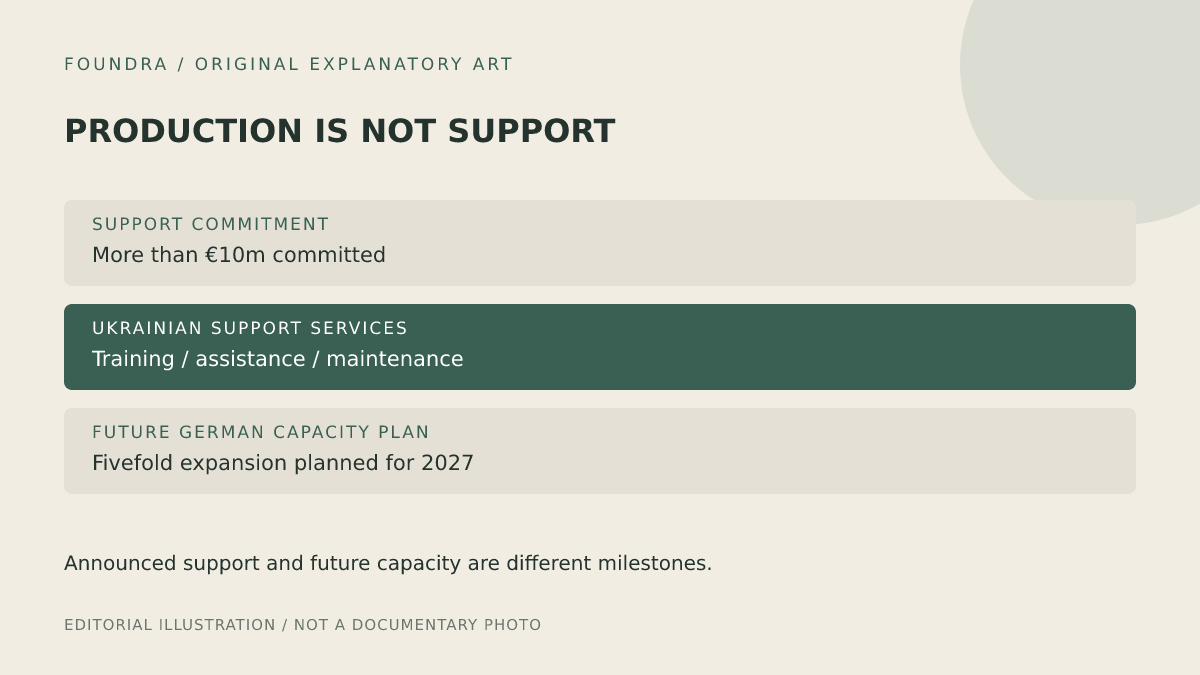
A production ramp and the services that sustain its output are different milestones. This commitment addresses the latter.
The work after manufacturing
For an industrial startup, making a product and sustaining it after delivery are separate businesses. A production line can turn out more units without making the customer better equipped to train people, obtain assistance or maintain equipment. Quantum Systems’ latest Ukraine announcement is best read through that distinction: the money described in the release is directed toward support capacity, rather than presented as another venture funding round.
In its November 19 release, Quantum Systems says it and Frontline Robotics will commit more than €10 million to strengthen long-term support for unmanned systems in Ukraine. The stated programme covers operator training, a dedicated support line and local maintenance. These are announced commitments; the release does not establish that every service has already been built or that the full amount has already been spent.
The systems at issue are developed by Frontline Robotics and manufactured in Germany by the partners’ joint venture, Quantum Frontline Industries, or QFI. That cross-border division of responsibilities makes the support programme an industrial-development story as well as a defence-technology announcement. Foundra has not independently inspected the factories, service infrastructure or equipment in use.
A sequence, not one completed milestone
The company places the programme within an existing partnership. According to the release, QFI was established in December 2025 and began German production of Frontline Robotics’ Linza 3.0 drone in February 2026. It describes an initial contract for delivery of 10,000 Linza systems as approaching completion. That phrasing matters: it is not confirmation that all deliveries have been completed.
The same announcement says the venture has secured a larger follow-on contract with the National Guard of Ukraine for 2027, covering Linza and Zoom drones. It also sets out a plan to expand production capacity fivefold in 2027. Contract status, delivery status and future capacity should not be collapsed into a single statement that production has already multiplied.
EU-Startups’ coverage provides a secondary account of the commitment, but the company announcement remains the primary evidence for the programme’s scope and chronology. Neither account supplies a breakdown assigning the announced amount among training, support-line operations and maintenance. A reader cannot use the headline figure to calculate the size of any one component.
Three distinct commitments in the announcement
Manufacturing
QFI manufactures Ukrainian-developed systems in Germany; the release describes an initial delivery contract approaching completion.
Support programme
The more-than-€10 million commitment covers training, a support line and local maintenance in Ukraine.
Next production step
A fivefold capacity expansion is planned for 2027, not described as already installed.
What the support budget does—and does not—tell investors
As analysis, the useful question is how a supplier connects output growth with the obligations that follow it. If a manufacturer expands deliveries, a support team may face more requests even when the hardware itself is unchanged. A programme that anticipates those needs could make a ramp more credible, but credibility is not the same as proof of execution. The release does not provide service-response measurements or maintenance outcomes.
The announcement also leaves the programme’s financing mechanics undescribed. A commitment to spend on support is not automatically a new external equity investment, a grant received or revenue booked. Without a disclosed allocation and payment schedule, treating the amount as an immediate cash inflow would change the meaning of the source. The industrial promise is specific; the financial accounting is not.
For a hypothetical supplier in a similar position, useful follow-up disclosures would separate contracted work, delivered equipment, installed production capacity and support readiness. Those categories answer different questions. A contract can indicate demand, while installed capacity addresses the ability to meet it; support readiness concerns the customer’s ability to sustain the delivered product. This is a framework for reading later evidence, not a claim that QFI has failed any of those tests.
The next evidence should concern execution
The strongest part of this announcement is its explicit separation of German manufacturing from services in Ukraine. That allows readers to identify what the additional commitment is intended to accomplish without assuming an unspecified new factory or a completed production increase. It also offers a clearer basis for later scrutiny than a headline that treats every promised euro as a delivered capability.
A subsequent report could substantiate milestones such as completion of the initial delivery contract, establishment of the promised services or progress against the 2027 capacity plan. Until such evidence is available, the accurate description is narrower: the partners have announced a support commitment and described a future production ramp. Their relationship is moving beyond making systems; how far the support infrastructure has actually progressed remains an open reporting question.
Sources
- Industrial commitment and support programme ↗ Quantum Systems · Primary source
- Coverage of the support commitment ↗ EU-Startups
Have additional information? Request a correction.