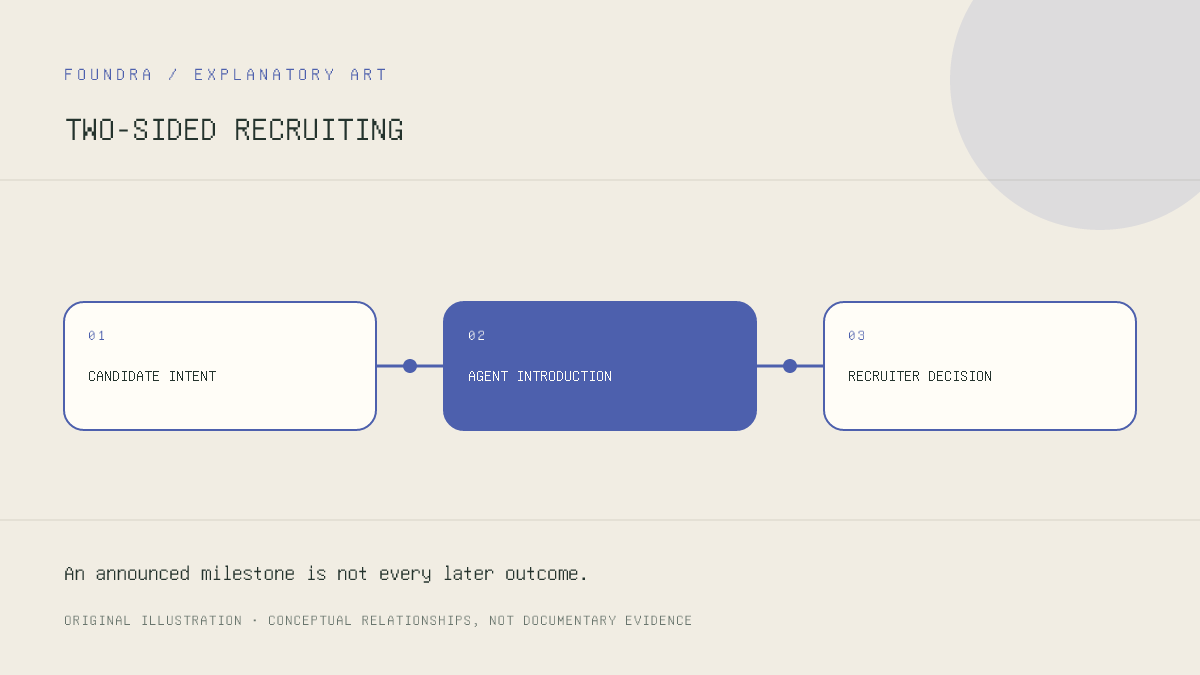
A recruiting introduction, an interview and a hire are separate outcomes—and need separate denominators.
Not just a faster application button
The most interesting part of Archer’s $10 million financing announcement is the proposed role of the agent, not the funding number. In Mark Chaffey’s announcement on November 20, the company describes a product that takes preferences from candidates and requirements from recruiters, then represents each side to the other. Volition Capital led the financing, with support from AVP. Archer comes from hackajob, whose earlier focus was technology hiring. The current pitch is broader: use an AI agent to arrange useful introductions rather than simply increase the volume of applications or recruiter messages.
Who is the agent representing?
That positioning creates a practical comparison. A candidate-facing tool can optimise for getting its user considered. An employer-facing tool can optimise for producing a shortlist. A product serving both sides has to make the relationship between those objectives intelligible. This is our analysis of the design problem, not evidence of a conflict at Archer. The company says every hiring decision remains with the recruiter. That is an important boundary in the announced product, although it does not by itself explain every decision made earlier in the matching process.
Where the proposed agent sits in hiring
Candidate preferences
The company says candidates describe the roles they want.
Recruiter requirements
Recruiters describe the people they are seeking.
Agent introduction
Archer proposes matches between the two sides.
Hiring decision
The company says the recruiter retains the hiring decision.
Volume has a denominator problem
Chaffey says more than 700,000 candidates signed up over the preceding 12 months and that Archer makes 10,000 introductions a week. These are company-reported figures, not independently audited findings in this article. They measure participation and activity, not completed hiring outcomes. A person can sign up without being hired; an introduction can be appropriate without resulting in an interview. Keeping those distinctions visible makes the figures more useful. It avoids turning a product’s account of its own momentum into a stronger claim about results for every user.
The announcement also gives performance comparisons, including a higher interview-conversion rate for some introductions. We do not reproduce those comparisons as settled benchmarks. To evaluate such a claim, a buyer would need to know which introductions were counted, the period observed, how the baseline was chosen and which candidates or employers were included. A comparison can be genuinely informative while still being too narrowly specified to apply elsewhere. The supplied source does not establish a universal improvement for all recruiting teams, nor does it show how every group of applicants fares.
Three buyers’ questions, not three promises
For candidates, a useful question is whether the agent understands preferences as constraints rather than loose keywords. A hypothetical applicant might care more about location or the kind of work than about a familiar job title. For recruiters, the parallel question is whether a requirement is essential, negotiable or simply copied from an older role description. For both, an explanation of why an introduction was proposed could be more useful than a numerical match score on its own. These are evaluation questions; Foundra has not run a hands-on assessment of Archer.
A second question concerns correction. If a candidate’s circumstances change or a recruiter updates the role, how does that information affect later suggestions? A third concerns accountability: who can inspect and challenge the information behind a recommendation? The November announcement does not supply a full answer to each of these questions. They matter because a two-sided agent is being asked to mediate a relationship, not merely generate text. The funding news supports examining that product choice without assuming either that the system is fair by design or that it necessarily creates an unfair outcome.
The roadmap is still a roadmap
EU-Startups’ financing report places the new round alongside Archer’s earlier financing history. The founder’s primary announcement describes a candidate launch in January and general release of Archer OS in the first quarter of 2027, with planned use inside tools recruiters already work in. Those are future milestones, not products this article has verified as generally available today. The $10 million round gives the team resources to pursue its two-sided design. Whether that design produces better matches should be judged later by clearly defined outcomes, not by treating the number of introductions as a substitute for the quality of the resulting decisions. The named intended work environments include Slack and Teams; their mention describes the roadmap, not a verified integration test.
Sources
- Archer raises $10m to make AI work for both sides of hiring ↗ Archer — Mark Chaffey · Primary source
- London-based Archer raises €9.1 million to deploy AI recruiting agents for employers and job seekers | EU-Startups ↗ EU-Startups
Have additional information? Request a correction.