An appointment funnel needs clear measures and patient control, not just more automated messages.
The drop-off is the product premise
Wilco is building around a specific business problem: people contact a clinic but do not necessarily reach an appointment. The Madrid startup announced €2.5 million in financing led by Samaipata, with ABAC Nest Ventures and other investors participating. The Europa Press account carried by Forbes España on November 19 describes the round as closed and attributes the news to a company statement. EU-Startups reported the financing the following day. Wilco’s website links to the Forbes account. This reporting package establishes a financing announcement and a proposed workflow, not independent measurement of what happens to every patient who uses it.
The startup describes AI voice and messaging agents that contact and follow up with prospective patients. The distinction between administration and care matters immediately. Arranging an appointment is not diagnosing a condition, and improving a clinic’s commercial conversion rate is not the same as improving a clinical outcome. This article does not infer that the agents give medical advice or establish a treatment benefit. It examines the source-described administrative use case. Any stronger claim would require evidence beyond a financing announcement and the company’s presentation of its product.
One funnel, several possible explanations
The analytical appeal of the product is straightforward: an enquiry can be lost through an incomplete exchange rather than an explicit refusal to attend. But a missed appointment path can also reflect a person’s preferences, timing or decision not to proceed. Those are illustrative possibilities, not findings about Wilco’s customers. The product question is therefore not simply how many more messages an agent can send. It is whether the follow-up is useful and understandable to the recipient, and whether the resulting workflow preserves the difference between a person asking for information and a person choosing an appointment.
A hypothetical clinic could count every contacted lead as an engagement, while another counts only people who attend a consultation. The two measures could produce very different impressions of the same campaign. A useful evaluation would define the starting population, the follow-up period and the final outcome before comparing results. The sources reviewed here do not provide an independent dataset of that kind. We therefore avoid adopting broad company marketing figures as general facts about clinic performance. The funding story can remain useful without converting a sales claim into a universal benchmark.
Commercial follow-up is not clinical decision-making
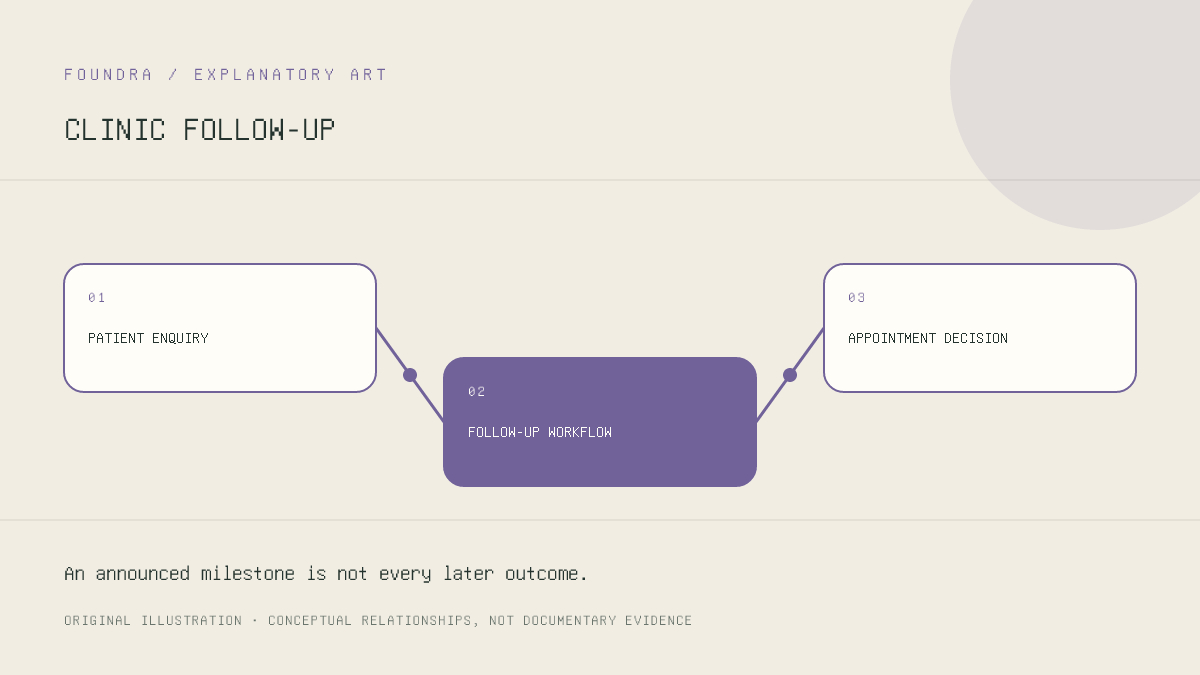
Enquiry
A prospective patient contacts a clinic.
Follow-up
Wilco describes voice and messaging agents that continue the conversation.
Appointment
Attending a consultation is a separate outcome from receiving a message.
Care outcome
Clinical benefit is not established by the funding announcement.
Expansion means more than another channel
The November 19 report says Wilco intends to strengthen engineering, deployment and sales, with expansion beyond its current market. Those are plans supported by the financing, not evidence that all planned markets are already served. Deployment is an important word in this context. A follow-up agent must fit the clinic’s actual process for handling enquiries and appointments. This article does not establish a particular integration architecture or claim that every clinic uses the same software. Rather, it identifies the boundary at which a general-purpose conversational capability becomes a specific operating workflow.
The recipient needs a clear boundary
There is also a basic communication question: how does a person know who is contacting them and what will happen to the information they provide? Consent, control and escalation are useful topics for a buyer’s assessment, not assurances supplied by the funding round. A prospective clinic could ask how recipients stop messages, reach a person or correct an error. Foundra has not tested those functions and does not certify the product’s compliance. They are questions that follow from the announced use case, particularly because the conversation occurs around healthcare even when its immediate purpose is administrative.
The financed task is specific enough to examine
Wilco’s pitch is more concrete than a promise to automate an entire clinic. It focuses on the interval between an enquiry and the next action. That makes it possible to ask for precise evidence later: what was followed up, what the recipient chose and how much work the clinic still performed. The €2.5 million round supplies resources to pursue that workflow. It does not prove better care, universal conversion improvement or completed international expansion. The story’s value lies in keeping the small operational target visible, rather than allowing an AI label or a funding total to stand in for the results that would make the product useful.
Sources
- La 'startup' Wilco levanta una ronda de 2,5 millones liderada por Samaipata - Forbes España ↗ Forbes España / Europa Press
- Madrid-based Wilco secures €2.5 million to scale its AI patient follow-up platform across Europe | EU-Startups ↗ EU-Startups
- Wilco | AI patient follow-up for healthcare clinics ↗ Wilco — official product website · Primary source
Have additional information? Request a correction.