A substitute heat source can test part of a system without demonstrating the fueled system as a whole.
Follow the heat, not the product name
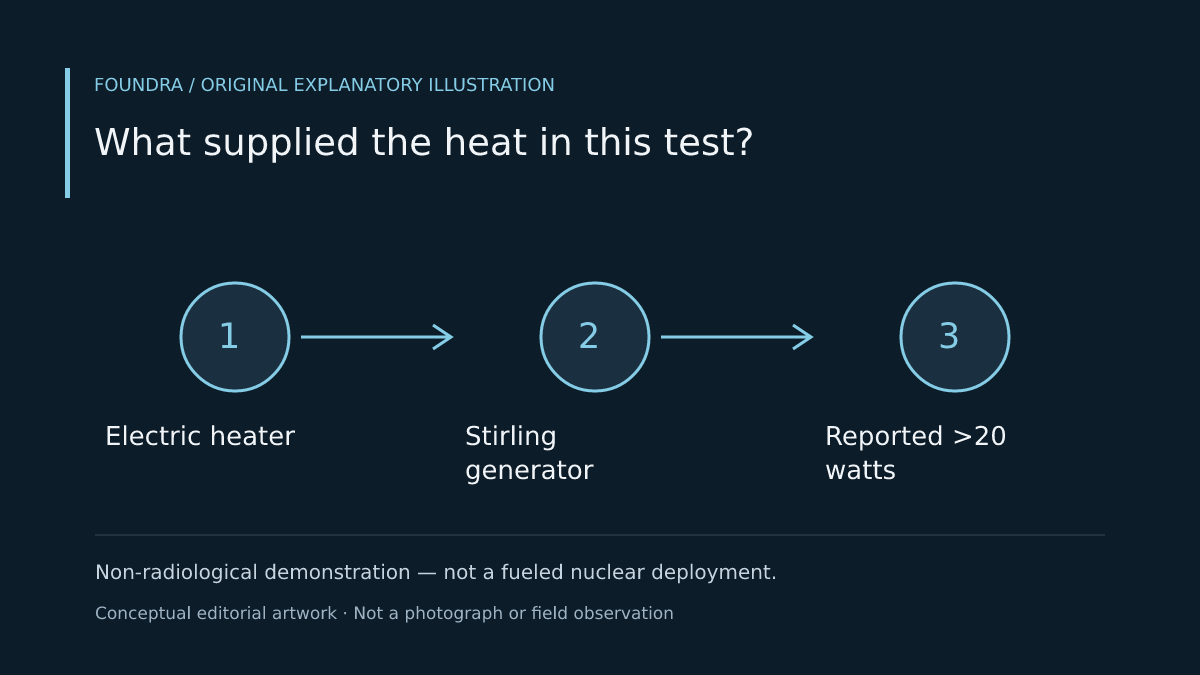
Zeno Power’s future maritime product is described as a nuclear battery. Its November 19 demonstration announcement describes something narrower: an electrically heated Stirling generator operating for two weeks in a controlled maritime setting in Washington state. The company reports more than 20 watts of electrical output and recovery of the system afterward. GeekWire corroborated the announcement.
The important detail is the electric heating element. It stood in for a radioisotope heat source, making the demonstration non-radiological. Foundra did not witness the trial or inspect its instrument records; duration, output and recovery remain company-reported. The test was not an operational deployment of the fueled nuclear system.
Source and converter are separate jobs
The primary release explains that a Stirling engine converts heat into electricity by cycling gas through heating and cooling phases. For the purpose of reading this announcement, the useful separation is between the device supplying heat and the device converting that heat into electrical power.
The electric heater supplied the first role in this test. The Stirling generator performed the conversion role. The planned future system would use a different heat source. That distinction lets a reader understand why a test can be relevant to a product whose final source was absent without treating the substitute as equivalent to the final arrangement.
This is a simplified functional description, not a complete engineering assessment. It does not establish the engine’s efficiency, thermal losses or a performance comparison with another conversion technology. Those would require measurements and conditions not supplied in the reviewed announcement.
One test configuration and three limits
Heat input
An electric heater replaces the intended radioisotope source in this test.
Conversion
The Stirling generator converts heat into electricity.
Measurement
More than 20 watts is reported, without a complete independent operating profile.
Roadmap
Radiological testing and a 2027 fueled deployment remain future steps.
What can be learned from a substitute?
In an illustrative development program, substituting one input can allow other parts of a system to be examined earlier. An engineer might want to learn whether a converter can operate with its surrounding equipment before introducing the final source. That example explains a development strategy; it does not assign undocumented objectives or results to Zeno.
The inference must stop at the tested configuration. Evidence about one configuration cannot automatically answer every question about another. A substitute could preserve a relevant function while differing in other properties. This article does not assert that the electric heater reproduced every property of the intended radioisotope system.
That is the central distinction between a component question and a whole-system question. Whether the converter produces power under the reported trial conditions is one question. Whether the intended final system meets an operational requirement is another. Both matter, but they are not interchangeable measures of completion.
Twenty watts needs its context
More than 20 watts is the company’s reported output for the demonstration, not a universal product specification. The reviewed evidence does not supply a full operating profile for an independent comparison. Foundra does not extrapolate the number into years of uninterrupted service or an energy total for the two-week test.
Such an extrapolation would require knowing how output varied over time and what was included in the measurement. Multiplying a headline output by a reported duration would look precise while making assumptions the announcement has not established. This is a limit on the calculation, not a claim that the company’s instruments were inaccurate.
Watts describe a rate of power; an energy total requires that rate over time. The release’s headline output is therefore not enough to establish a complete energy yield for the trial.
The roadmap still contains a different system
Zeno’s release says it is moving toward a radiological demonstration in a controlled tank and plans its first operational seabed deployment of a fueled maritime system for 2027. Those are future steps, not results delivered by this electric-heater test.
A prospective user would need to assess the actual final configuration and applicable operating requirements. This article does not establish a regulatory approval, give a safety assurance or make a climate-impact claim. Its category is startup technology development, and the cover depicts a functional explanation, not a photographed seabed deployment.
The milestone can stand on its stated configuration. Zeno reports an electrically heated generator that operated in water and was recovered. Keeping that configuration in view makes the development story easier to follow: the demonstrated converter is relevant to the ambition, while the fueled system remains a distinct part of the roadmap.
Sources
- Zeno Power Advances Maritime Nuclear Battery Development with Electrically Heated Open Water Demonstration ↗ Zeno Power — original release · 2026-11-19 · Primary source
- Zeno Power makes progress on underwater power system – GeekWire ↗ GeekWire · 2026-11-19
Have additional information? Request a correction.