Everful’s financing is announced; its AI and growth claims remain company-attributed, and the operational model needs to be judged beyond the catalog.
The buyer has three routes into the catalog
Everful’s new Series A is financing more than a way to browse goods. Its original company release describes three purchasing modes: wholesale, dropshipping and customization, with the startup undertaking fulfilment. Those modes put different jobs around the same product catalog. The analytical interest is how one operating service connects them, rather than whether a new search box can display more products.
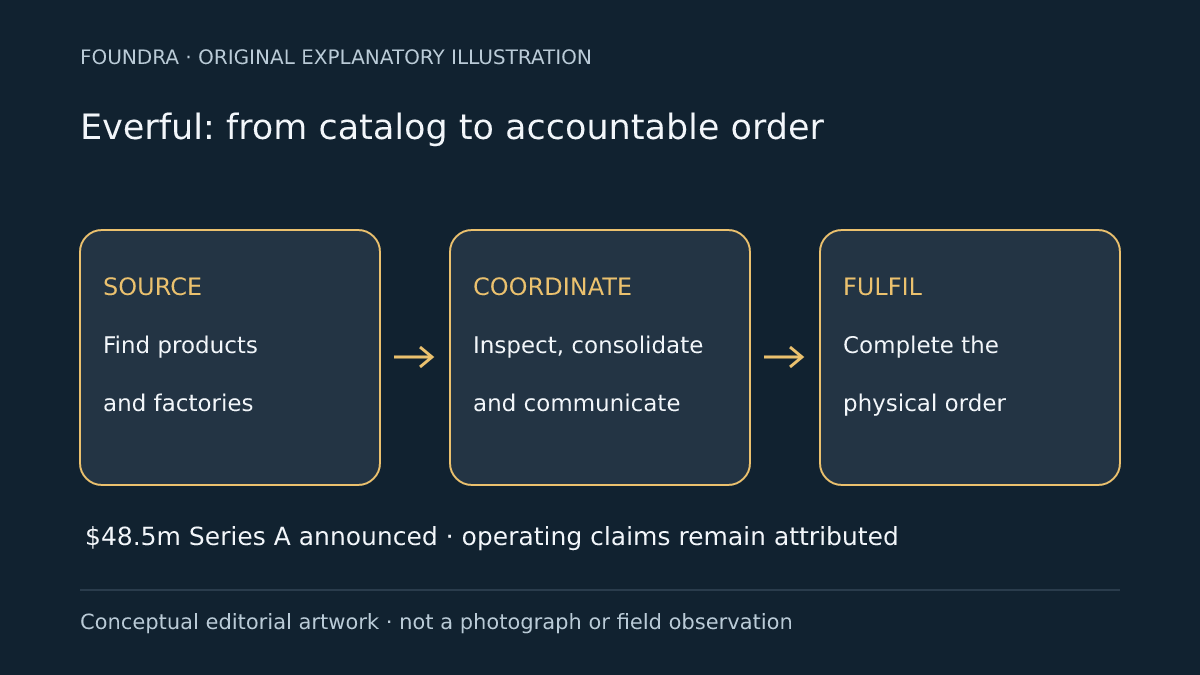
The financing is $48.5 million, led by Vertex Ventures Southeast Asia & India and January Capital, with existing investors Square Peg and Lightspeed participating. The original release is datelined San Francisco, November 19, and appears on Vertex’s November 20 page. The event date and that page’s posting date are therefore kept separate.
A marketplace comparison without the exclusivity claim
TechCrunch’s November 19 report places Everful beside Alibaba’s supplier connections and Faire’s wholesale purchasing from brands. It reports that Everful’s founders emphasize taking responsibility for the sourcing process. But the same report notes that peers also offer services such as inspections, logistics and AI-powered sourcing. The evidence does not support a categorical claim that only Everful can do these jobs.
The comparison is better understood as a question of packaging and responsibility. A directory can make suppliers discoverable. A transaction service can organize a purchase. A managed workflow can coordinate additional work around it. These are analytical descriptions of different service layers, not claims that any named competitor lacks a particular capability.
This distinction helps avoid an easy category error: the presence of an AI agent does not identify the business model. Software may be a component of a catalog, a marketplace or an operating service. What the buyer is asked to do, and what the provider undertakes, can be more informative than the label attached to the software.
The sourcing model, separated into obligations
Discovery
The company describes AI agents identifying products and factories.
Execution
Everful says it handles communications, inspections and fulfilment.
Evaluation
Buyers would need evidence on quality, timing and remedies, not catalog size alone.
The three modes are not one purchasing decision
Wholesale buying, dropshipping and customization are different choices even when offered through one interface. They differ in the work a buyer is seeking from the service. This article does not infer Everful’s contractual allocation of inventory ownership, liability or payment timing; those terms are not supplied in the reviewed sources.
From a product-examination perspective, the useful point is the separation of decisions. Choosing a product is one decision. Choosing a purchasing mode is another. The service around that choice still has to translate a buyer’s requirements into an order that can be carried out. Combining the interface does not erase the differences among those requirements.
Everful says its agents identify products and factories and manage order communications, while inspections supply quality data. The release presents these activities as connected to a model of supply and demand. They are company descriptions of the system, not functions tested by Foundra.
Where the new capital is intended to go
The company says the round will deepen its United States and European presence and develop agents and fulfilment infrastructure. It identifies the United States as its largest market. The plan combines geographic reach, software and operations; it is not described as an exclusively software-development budget.
That combination is meaningful for how the company should be classified. If a service undertakes fulfilment, its product includes work outside the interface. A software-only description would omit part of what the release says the company offers. Equally, calling the company an ordinary catalog would omit its stated coordination role.
Read the scale figures in their own units
The release reports more than 5 million pieces shipped monthly and customers in over 60 countries. It also says Everful is on track to reach $100 million in annualized revenue by year-end. Those quantities are company-attributed. The last is a forward-looking annualized target, not verified full-year revenue.
Pieces shipped, customers’ country coverage and annualized revenue measure different things. None can be converted into the others without additional information about orders, pricing and timing. Keeping their units visible is more useful than combining them into an unsupported claim about market share or profitability.
A service identity, not an AI-only identity
Everful’s financing gives its sourcing proposition a new capital milestone. The distinctive business question is the allocation of work between buyer, software and operating service. AI is part of the company’s stated answer, but the buying modes and fulfilment responsibilities explain the proposition more clearly than the agent label alone. That is the competitive frame the announcement actually supplies.
Sources
- Everful Raises $48.5 Million Series A to Build the AI Infrastructure Layer for Global Commerce | Vertex Ventures SEA ↗ Vertex Ventures SEA & India — original Everful release · 2026-11-20 · Primary source
- Former Alibaba exec's Everful raises $48.5M to connect retailers with Chinese factories | TechCrunch ↗ TechCrunch — Everful financing report · 2026-11-19
Have additional information? Request a correction.