The proposed deal brings model adaptation and inference into a security platform’s orbit; buyers still need evidence of isolation, portability and effective controls.
An agreement, not an integration
Palo Alto Networks is proposing to move closer to the machinery that creates and runs enterprise AI. Its November 18 announcement describes a definitive agreement to acquire Applied Compute, a platform for post-training and inference of open-weight models. That is a different position from merely watching the traffic around somebody else’s AI application.
The issuer describes an all-stock transaction valued at $4.5 billion, subject to adjustments and customary closing conditions, including regulatory clearance. It expects closing in its fiscal third quarter of 2027. Applied Compute co-founder Yash Patil would become co-chief AI officer after closing. These are agreement terms and future plans, not a completed acquisition or an already-delivered combined product.
The announcement’s strategic premise is that businesses will use a mixture of open-weight and closed models. That is Palo Alto’s thesis, not a forecast this publication can certify. The useful question is what changes when a security supplier also owns part of the model-development and serving workflow.
A perimeter cannot answer every model question
Consider a hypothetical enterprise assistant that reads internal documents and drafts a customer response. A network control can restrict its connections. An identity system can decide which account invokes it. Neither fact alone establishes whether the model was adapted using data the business was entitled to use, whether an evaluation covers the relevant failure, or whether a later model update changes the answer.
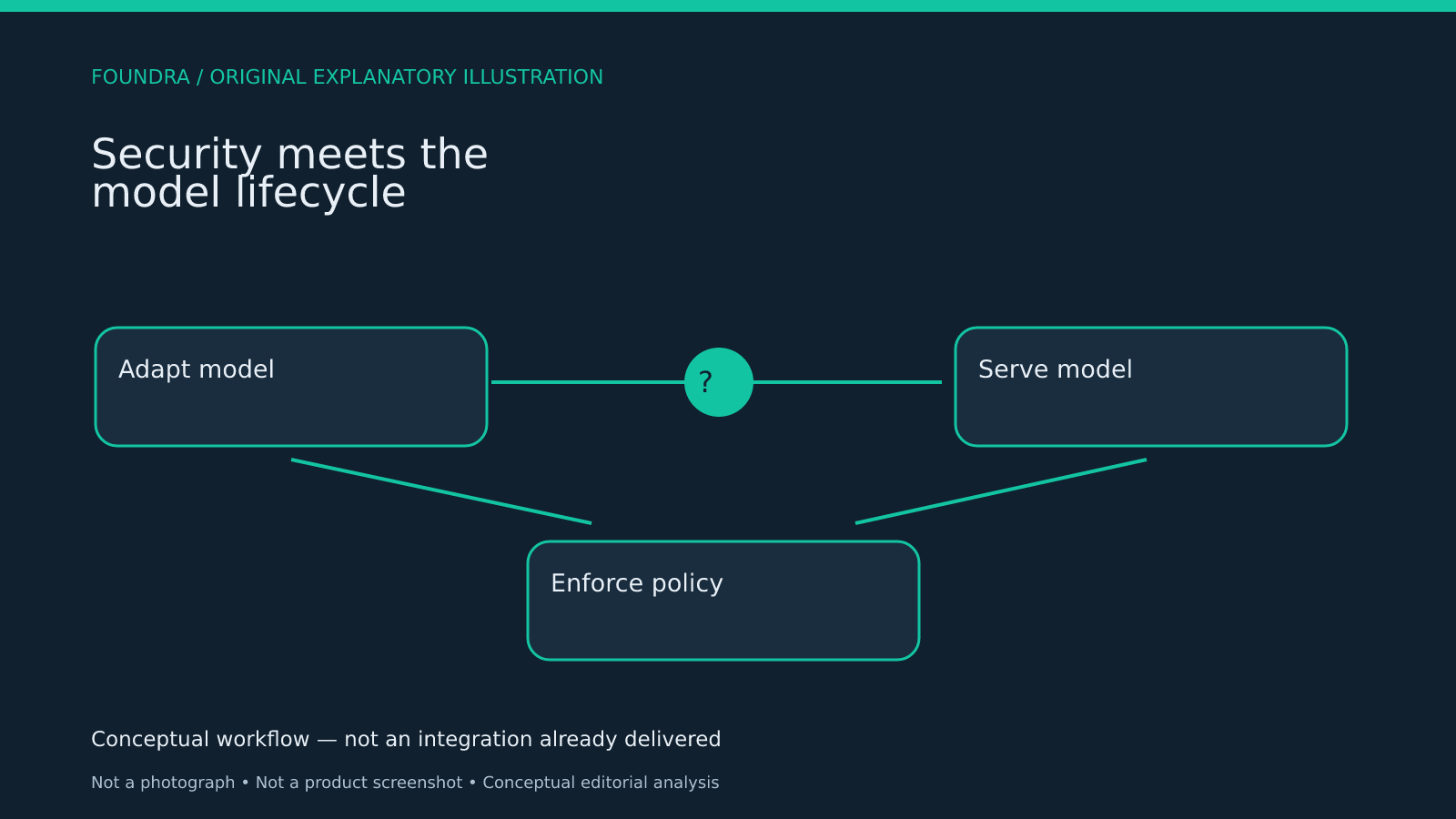
Putting controls nearer to adaptation and inference could make some of those questions easier to connect. A version identifier could link a serving endpoint to an approved model artifact. A policy decision could be retained alongside the request that triggered it. This is an architectural possibility, not evidence that Applied Compute or the proposed combination implements every control in that example.
The distinction matters commercially. A buyer seeking a safer chatbot may need an application-level restriction, not an entire model platform. A company operating proprietary models may need much more: data permissions, reproducible evaluation, deployment boundaries and a way to stop the system. The two customers should not be sold the same answer simply because both use AI.
Three questions for a secured model workflow
Adaptation
Which training data, model versions and permissions can be used?
Inference
Where does the model run, and who can call it?
Accountability
Can an operator trace a decision and revoke access?
Control has to survive a change of supplier
There is a tension in bringing more of the workflow into one platform. A shared system can reduce the number of handoffs between teams, but it can also concentrate dependencies. If an enterprise cannot export its evaluation records or reconstruct the policy attached to a model version, integration may become a form of operational lock-in.
A serious procurement exercise would therefore ask for demonstrations rather than accept the vocabulary of secure AI. Can a model be moved to another permitted environment without losing its audit history? Can an administrator distinguish a training-data decision from a runtime access decision? What happens to credentials when a model endpoint is retired? These are tests a buyer can specify; they are not reported shortcomings of either company.
Open weights also should not be confused with unlimited rights or automatic inspectability. A model’s licence, the rights attached to its inputs, and the behavior of an application built around it are separate questions. Owning a serving platform does not remove the need to answer them separately.
For a founder selling into enterprises, the practical implication is to preserve evidence at the seams. Document which organization controls each artifact and which records travel with it. That work remains useful whether a customer ultimately chooses an integrated security platform or combines several providers.
The next milestone is evidence, not the price tag
The proposed consideration puts a large number on the transaction, but it does not measure the eventual security improvement. An acquisition valuation is a negotiated economic term; a security outcome requires a defined threat, an effective control and evidence that the control works under the relevant conditions.
Between signing and closing, customers should distinguish existing services from integration promises. After any closing, they should look for specific documentation on responsibilities, supported deployment environments and migration arrangements. A familiar brand cannot substitute for that information.
The interesting move is the attempted joining of model operations and security operations. Whether it becomes a useful enterprise product will depend less on calling every model secure than on making its permissions, lineage and failure boundaries legible.
Sources
- Palo Alto Networks — original investor release ↗ Palo Alto Networks — original investor release · Primary source
Have additional information? Request a correction.