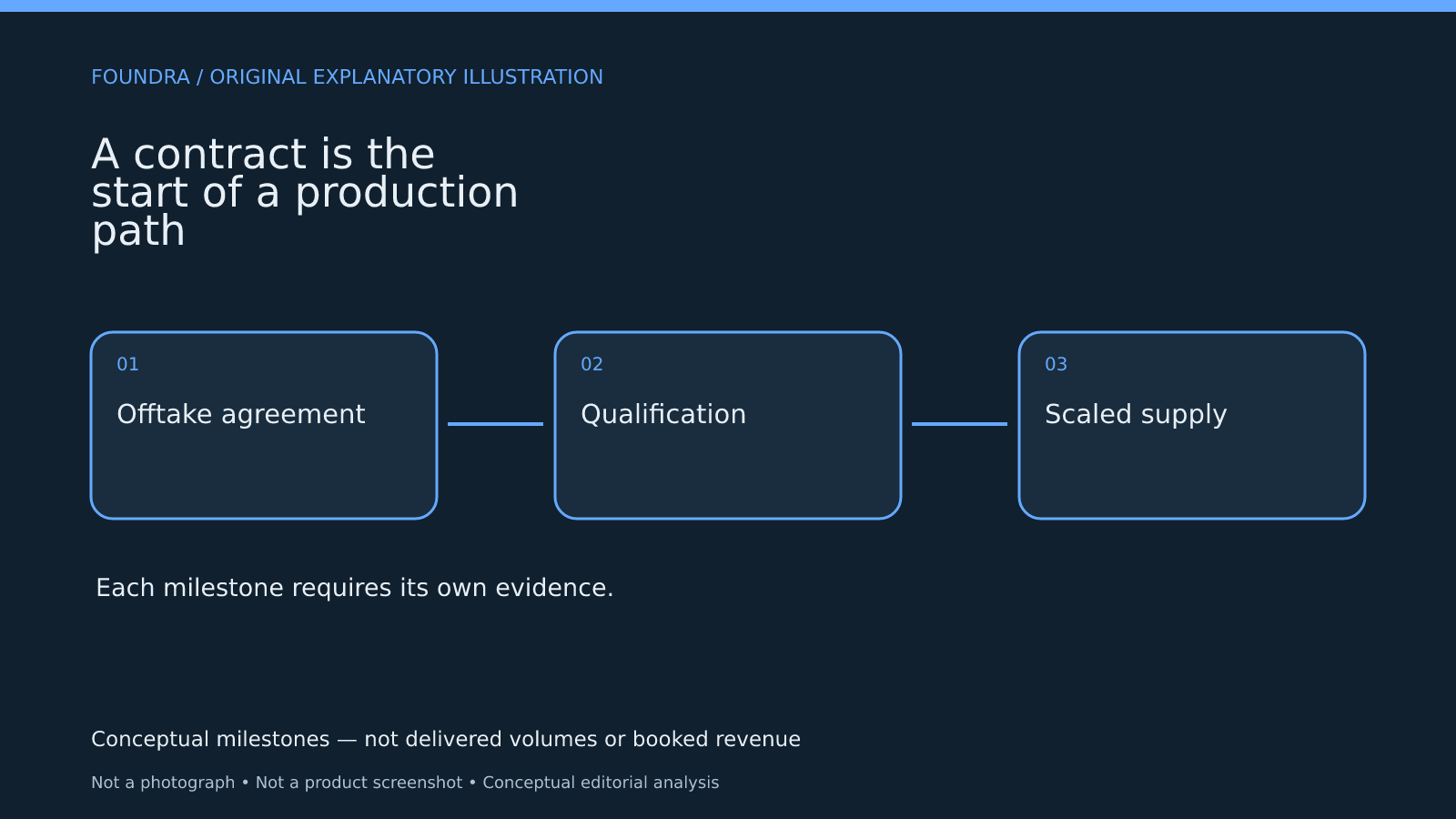
Read potential offtake, production qualification and recognized revenue as different milestones when assessing a materials startup.
The factory sits between the announcement and the outcome
A battery-materials startup can sign a significant customer agreement before the agreement becomes significant delivered production. That gap is the most important part of Sila’s November 18 announcement, not an inconvenient footnote to its dollar figure.
Sila announced a commercial offtake agreement with Panasonic Energy Corporation of North America. The company describes a multi-year relationship with the potential for more than $1 billion of offtake over time, supplying its Titan Silicon silicon-carbon anode material from Moses Lake, Washington. Its release also says the plant will be ready to supply strategic customers once qualified. The potential value is therefore not booked revenue, and the announcement is not proof of completed qualification.
GeekWire’s reporting places the agreement in the context of a planned plant expansion. It reports that the facility is still scaling production. That independently reported operational context matters more to the next stage of the business than treating the maximum commercial potential as money already earned.
Why a materials customer is buying a process, too
In a materials business, the product a customer evaluates is inseparable from the process that repeatedly makes it. A promising sample answers one question: can the material perform in the conditions tested? Commercial supply asks another: can a production line keep delivering material that meets the required specification?
An illustrative qualification exercise might examine how batches vary, how defects are detected and how an unexpected result is traced back through the process. Those are general manufacturing considerations, not a description of Panasonic’s private requirements. The underlying logic is that consistency must be demonstrated at the scale at which the customer intends to buy.
That is why an offtake relationship can be strategically important without proving immediate revenue. It provides a commercial destination for production, while leaving work to be done on the route. Investors should ask which obligations are firm, which depend on qualification and how the parties handle volume changes. The public announcement does not disclose enough contract detail to answer all those questions.
The same caution applies to claims about battery performance. A materials supplier’s description of its technology does not establish the performance of every cell that might eventually use it. Cell design, integration and testing are separate layers. This article does not report an independent battery test or certify an energy-density improvement.
Do not collapse these milestones
Commercial agreement
A customer relationship and terms for future supply.
Qualification
Evidence that material meets the customer’s requirements.
Production and delivery
Material actually made and supplied at the agreed standard.
Revenue
Accounting recognition is not established by a headline contract value.
Expansion creates dependencies in both directions
The commercial logic runs in two directions. A customer wants confidence that supply can scale. A manufacturer wants enough demand visibility to justify additional capacity. An agreement can help connect those needs, but a public statement about potential value cannot reveal how much capacity is economically safe to build.
Imagine a hypothetical expansion in which equipment arrives before a customer’s qualification is finished. The company could have installed capacity without saleable output for that customer. Reverse the sequence, and a qualified product might still wait for enough manufacturing capacity. Neither scenario is asserted here; they show why sequencing is a business issue rather than just a construction detail.
Sila estimates that scaling to meet this and other commercial commitments would add approximately 500 manufacturing and construction jobs. That is a company estimate tied to future activity, not a count of positions already created. Combining temporary construction work and manufacturing roles also makes a single headline number an imperfect description of the long-term workforce.
For founders in industrial technology, the lesson is not to avoid ambitious agreements. It is to disclose the milestones that make them meaningful. A customer announcement becomes more useful when readers can tell what has been signed, what has been qualified and what is actually being supplied.
Watch the conversion, not just the commitment
The next evidence worth watching is concrete: qualification milestones the parties choose to disclose, expansion progress, production at specification and deliveries. Each tells a different part of the story, and none should be silently replaced by the contract’s potential lifetime value.
The agreement gives Sila a substantial commercial reference point. Its industrial significance will emerge through the conversion of that relationship into dependable material supply. Until then, the billion-dollar potential is best read as an opportunity with execution conditions, not as a finished manufacturing result.
Sources
- Sila — original announcement ↗ Sila — original announcement · Primary source
- GeekWire ↗ GeekWire
Have additional information? Request a correction.