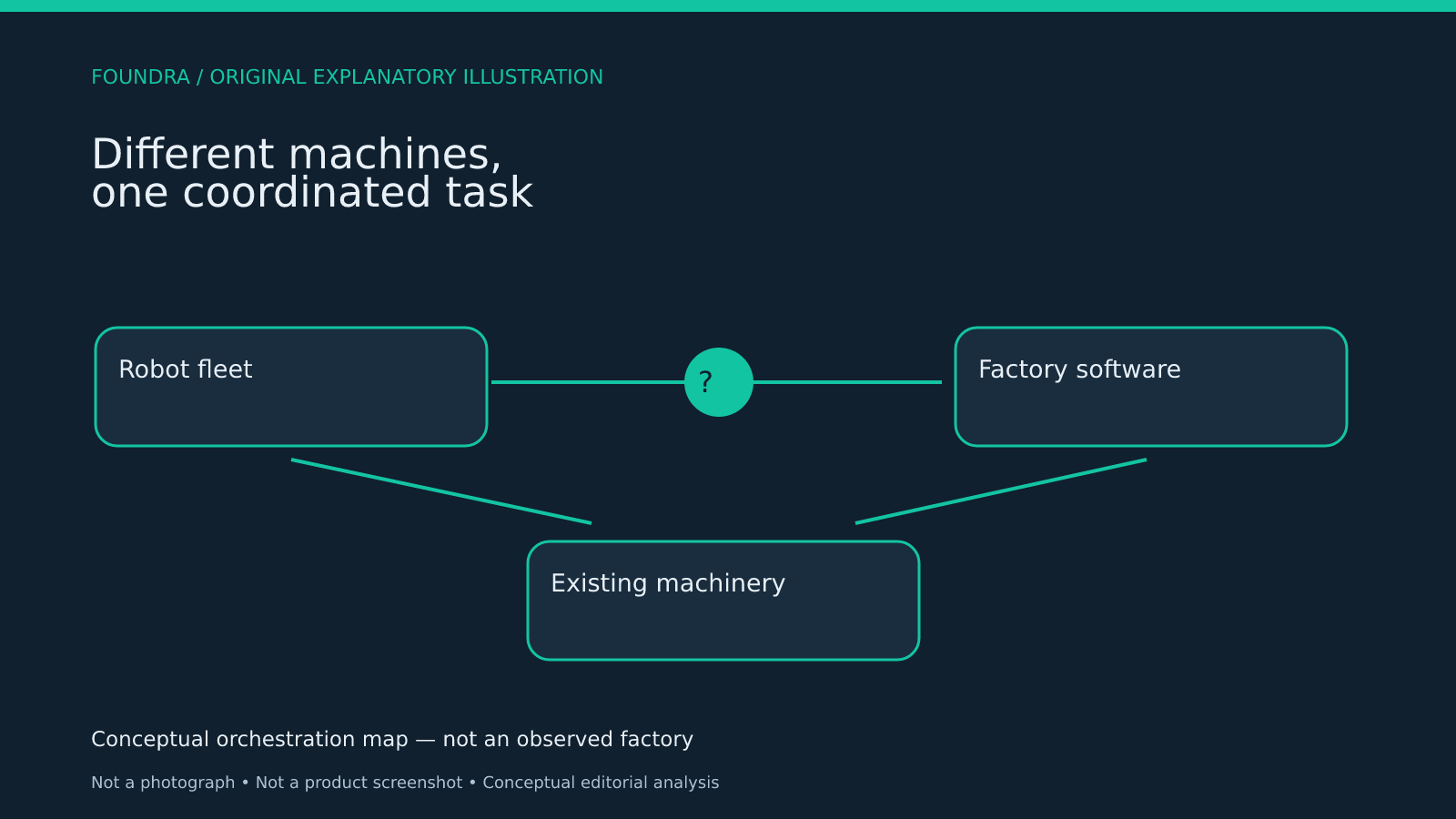
Factory orchestration should be judged by integration, failure recovery and task completion—not the number of robots attached to a dashboard.
The interface is the investment thesis
A mobile robot can move a load without making the rest of a factory coordinated. The work around it still includes deciding where the load belongs, whether the destination is ready and which system records completion. Botsync’s new financing is aimed at that connective layer.
In a November 18 founder announcement, Botsync says it raised $11 million in a round led by IvyCap Ventures, taking total capital raised above $20 million. Its product approach combines SyncOS and its MAG autonomous mobile robots. The company describes SyncOS as a vendor-agnostic platform connecting equipment and enterprise systems. Those are the company’s stated capabilities, not a factory inspection or an independent interoperability test.
Inc42 independently reports the financing and plans to expand engineering and project-delivery teams in India. It also reports investment in the platform and robots. The story therefore spans industrial software and physical deployment, rather than fitting neatly into either a hardware round or a conventional SaaS expansion.
A command sent is not a job completed
An orchestration product has to distinguish intention from result. Telling a robot to move material is an instruction. Knowing that the material reached the correct destination in a usable state is an outcome. A dashboard that confuses the two can make a connected facility look more orderly than it is.
Imagine a hypothetical production task that depends on a conveyor, a mobile robot and a receiving station. The robot might be ready while the receiving station is not. A useful coordinating system needs a way to understand that dependency, not merely a connection to each device. It also needs a response when the status supplied by one device is stale.
This example is not a reported Botsync deployment. It identifies the sort of evidence a manufacturer can request when evaluating a claim of vendor-agnostic automation: a representative task, a deliberately unavailable component and a clear record of what the software does next.
The commercial challenge follows the technical one. If every new deployment needs substantial custom work to reconcile equipment semantics, revenue can grow while the cost of delivery remains stubbornly project-specific. That is a possible business-model risk to investigate, not a disclosed financial result for Botsync.
What a connected factory task must resolve
Assign
Decide which permitted machine can perform the requested work.
Coordinate
Manage the dependencies between equipment and software.
Recover
Stop, reassign or escalate when a task cannot finish safely.
Record
Retain evidence of actual completion, not just a dispatched command.
Integration includes a responsibility boundary
Factories do not just contain different protocols. They contain different maintenance responsibilities, operating rules and levels of confidence in sensor data. Connecting machines should not imply that all machines can be controlled with the same authority or that every status message deserves the same trust.
A buyer could ask who is allowed to change a workflow, how those changes are tested and whether the system can fall back to a defined safe state. It could also ask which vendor is responsible when a coordinated task fails across an interface. A useful answer needs to be specific enough to survive an incident, not just a sales presentation.
The company’s announced interest in predictive capabilities should be evaluated with the same discipline. Predicting a problem is different from deciding which action is safe in response. An early warning may be valuable even when a person must choose the intervention. Automatic intervention needs its own evidence and permission boundary.
For industrial founders, this is an argument for making the limits of integration visible. A product that clearly states which equipment, workflows and failure modes it supports can be easier to evaluate than one that implies universal compatibility.
Follow the repeatability
Botsync’s financing announcement provides resources for the next stage; it does not establish how repeatable that stage will be. The meaningful evidence would include whether the same product can support multiple deployments without hiding an ever-growing amount of bespoke engineering.
Manufacturers assessing the system should look beyond a count of connected devices. Ask what tasks finish, how failures are reconciled and what work remains for local operators. A factory can have more automation and still need a person to bridge every awkward handoff.
The round’s distinctive bet is that those handoffs can become a product. Its value will be clearest not when every machine appears on one screen, but when a coordinated task remains understandable after something goes wrong.
Sources
- Botsync — original founder announcement ↗ Botsync — original founder announcement · Primary source
- Inc42 ↗ Inc42
Have additional information? Request a correction.