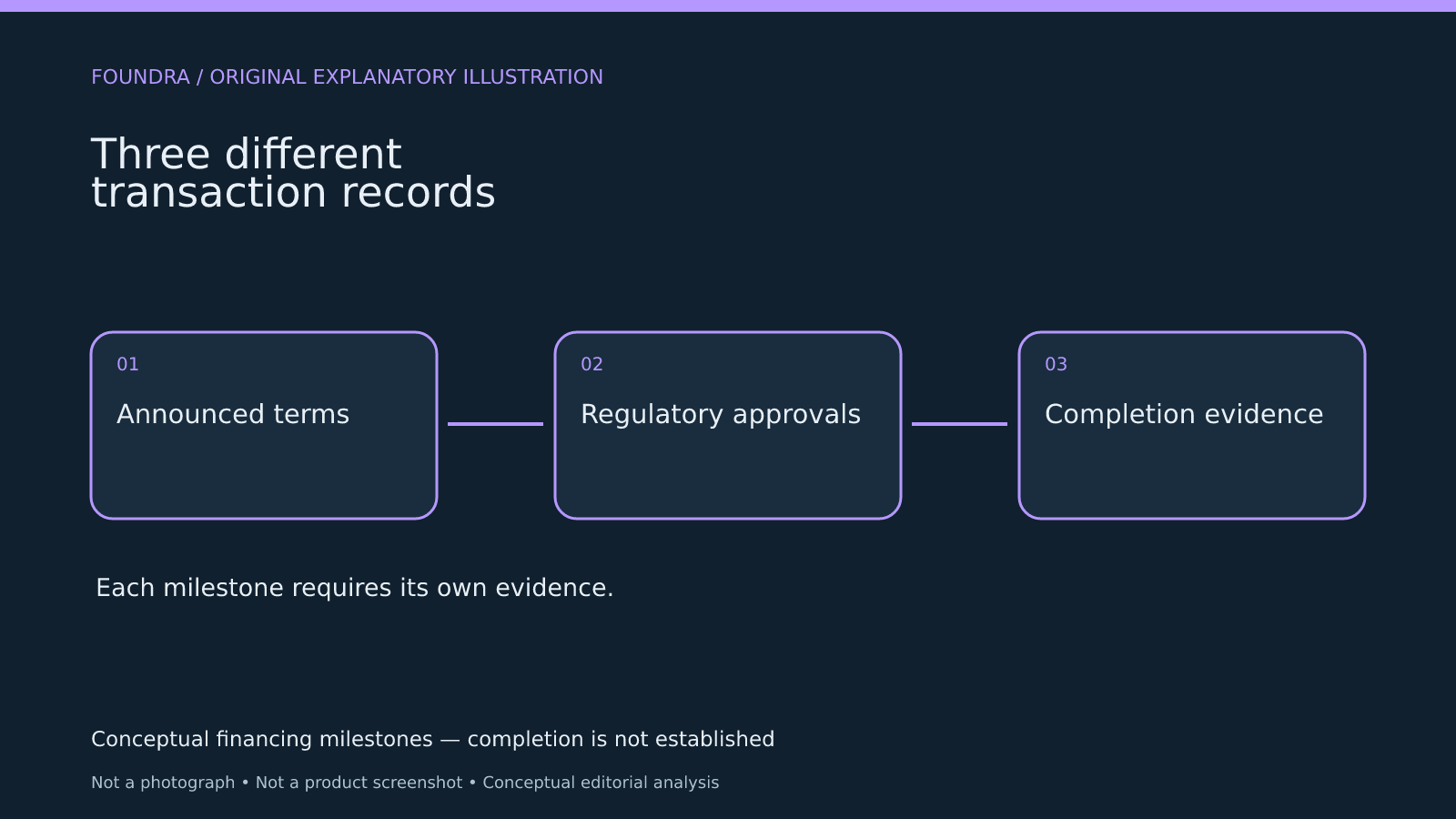
The announced financing terms describe different things: consideration, valuation, cumulative funding and a condition to completion. Keep each attached to its own evidence.
The announcement has a condition
Payhawk announced a $280 million Series C round on November 18. Growth Equity at Goldman Sachs Alternatives leads the transaction, which the issuer describes as all-equity and valuing the company at $2 billion. The same release says the transaction remains subject to standard regulatory approvals.
That qualification is not an editorial inference. It is a stated condition in the primary announcement, and it prevents the round from being reported here as an unconditional completed financing. The issuer also gives a total-funding figure above $515 million. None of those numbers establishes the company’s present bank balance.
The clearest way to read the announcement is to keep four records separate: the announced round, the valuation, cumulative capital raised and the evidence of completion. A large headline becomes less informative when those records are merged.
“All-equity” describes the capital instrument
Equity participation is different from a lending facility. That is the distinction supported by Payhawk’s description of this round. It should not be expanded into a claim about every other instrument, obligation or funding arrangement the company may have.
Nor does the phrase reveal all the terms within the equity transaction. Readers should not infer a particular share class, liquidation preference, voting arrangement or investor protection. Those matters require transaction documents or a specific disclosure; the public excerpt does not provide them.
For a founder comparing this announcement with another financing, the useful first step is to compare like with like. A package containing debt and equity should not be placed beside an all-equity round as though the capital carried identical obligations. That comparison can be made without assuming that one structure is universally better.
The round amount also should not be used to calculate dilution from the valuation alone. The release’s stated $2 billion valuation is a financing reference point. It does not disclose enough of the capitalization and transaction structure to reconstruct an ownership change.
The numbers and the qualification
$280 million
Announced Series C amount, described by the issuer as all-equity.
$2 billion
Stated financing valuation, not revenue or cash.
More than $515 million
Issuer’s announced cumulative funding figure; not a current cash balance.
Approvals outstanding
The issuer says standard regulatory approvals remain required.
Valuation is a price reference, not an operating result
A valuation expresses the economic reference point assigned to the company in the announced transaction. Revenue expresses business activity over a period under an accounting basis. Cash is a balance at a point in time. These quantities can all be relevant to a company, but they answer different questions.
The distinction is especially important when a financing announcement also describes a product ambition. Payhawk says it wants to build a broader finance operating system involving agents, payments and enterprise controls. The announced valuation is not an independent measurement of how well that operating system performs.
It would be equally incorrect to read the round size as a guarantee of a certain number of months of runway. Such an estimate would require current cash, spending and the timing of financing proceeds, among other evidence. Those records are not supplied here.
This is a transaction reading, not a verdict on the business. The announcement establishes that a substantial financing has been agreed and publicly described with an approval condition. It does not supply a substitute income statement or a customer-outcome study.
Cumulative funding is a historical sum
The issuer’s above-$515-million funding figure is another measure that can be misunderstood. Capital raised across rounds can have financed spending over time. It is not automatically still held as cash, and it is not an annual measure of business performance.
A reader can use cumulative funding as context for the financing history without treating it as money available for the next product plan. Any attempt to calculate available resources needs a current financial record rather than the sum of announcement amounts.
The completion question remains separate from both valuation and funding history. The next confirming evidence would resolve the disclosed approvals and establish the transaction’s actual status. This article does not speculate about which regulator is involved or when a decision will arrive.
Until then, the accurate formulation is straightforward: Payhawk has announced a $280 million all-equity Series C at a stated $2 billion valuation, subject to standard regulatory approvals. Preserving that final clause is part of reporting the terms, not diminishing the scale of the deal.
Sources
- Payhawk — original financing announcement ↗ Payhawk — original financing announcement · Primary source
- TechCrunch ↗ TechCrunch
Have additional information? Request a correction.