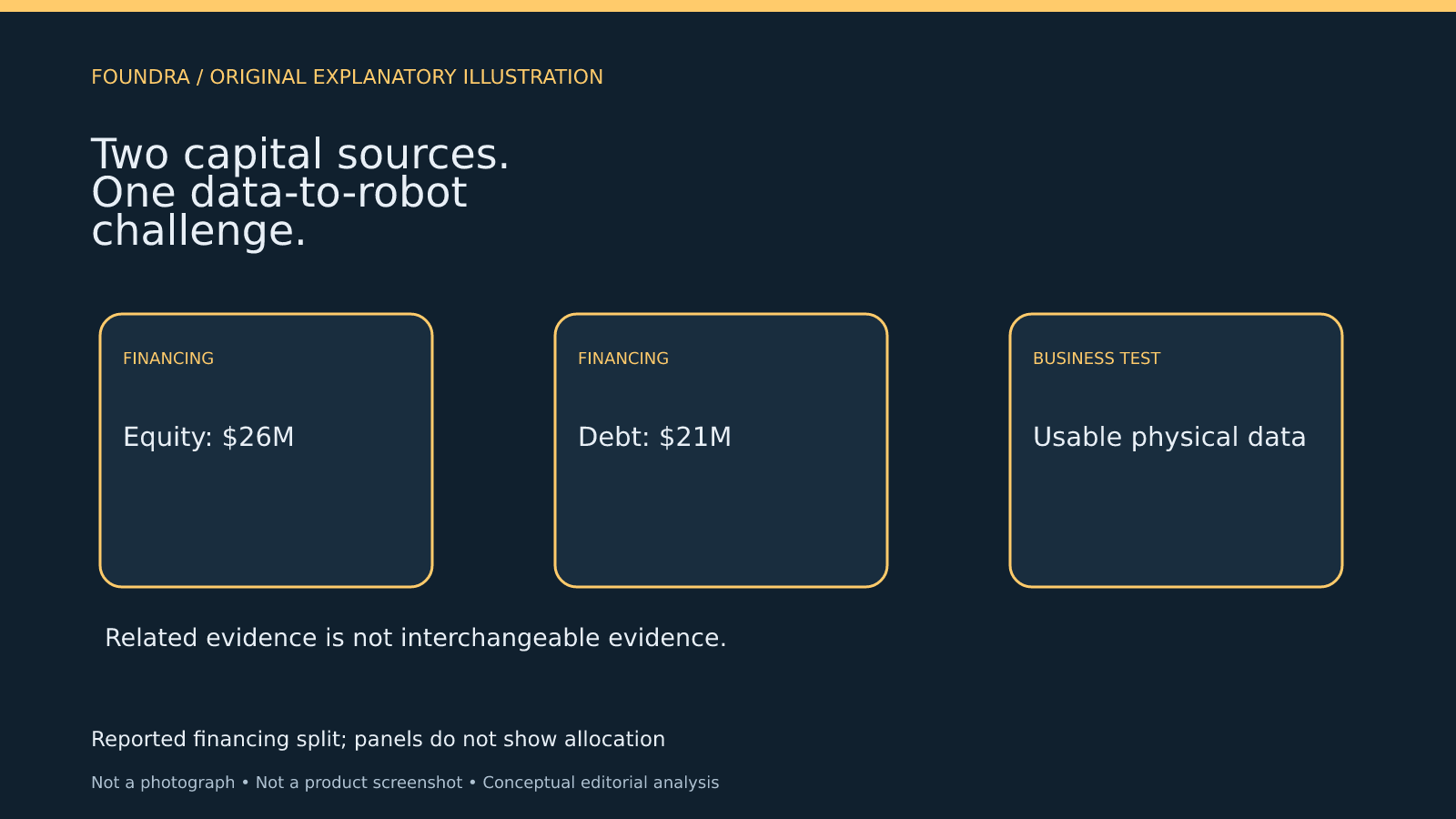
Assess the equity and debt separately, then ask whether collected physical data is usable, permitted and repeatable—not merely plentiful.
Start with the split
Humyn Labs’ financing headline is $47 million, but the package is not $47 million of equity. Inc42’s November 18 reporting and YourStory’s November 19 account agree on $26 million of Series A equity and $21 million of venture debt. Accel led the equity component; Lighthouse Canton led the debt component, with Trifecta Capital participating in the debt.
The reports describe a physical-AI business that captures how people perform physical tasks for use in robot-related data and deployment work. YourStory says the company plans deployment-readiness infrastructure in Brazil, South Korea and India, alongside research and market expansion. Those are reported plans, not facilities this publication has visited or verified as operational.
Keeping the capital categories separate changes the reading of the announcement. Equity and debt can both fund expansion, but they do not place the same obligations on a business. The public reporting does not supply the debt’s detailed terms, so the financing cannot be reduced to an estimate of free runway.
Recording an action is not the same as understanding it
A video or sensor record of a physical task can contain more information than a robot-training system can use. The useful data depends on what is captured, how the action is represented and which surrounding conditions are retained. A large collection is not automatically a coherent training set.
Consider an illustrative task in which a person picks an object from a shelf. A recording might show the visible movement while leaving out the reason the person chose one grip, the weight they felt or the obstacle just outside the camera’s view. A training use needs to account for those missing variables rather than assume that a detailed-looking record is a complete description.
This is general analysis of the business problem, not a finding about Humyn’s capture devices. It suggests what customers can ask to see: a defined task, documentation of collection conditions, a statement of what the data represents and evidence that it is useful for the intended model.
Rights belong in the same evaluation. Permission to record a person is not necessarily permission for every downstream training use or redistribution. A buyer needs to know which uses are authorized and whether restrictions remain attached when data is processed into a different form.
A physical-data business has several gates
Capture
Record a defined human task under a known collection process.
Rights and quality
Establish permission, usable context and consistent labeling.
Training use
Determine whether the data helps a specific model or task.
Deployment evidence
Test the resulting system separately in its intended setting.
Debt makes repeatability an economic question
An equity investor can participate in a long development trajectory. Debt introduces contractual obligations whose timing and structure matter. Without the terms, readers should not assume a particular repayment schedule, security package or interest rate for Humyn’s financing.
The general business question is whether the funded activity becomes repeatable enough to support its cost structure. If each customer needs a wholly new collection process, growth could require continuing operational expansion. If useful datasets or infrastructure can be reused within their permitted scope, the economic pattern could be different. Neither outcome is established by this announcement.
A revenue rate is not a repayment record
Customer revenue claims also require care. An annualized measure extrapolates a current rate; it is not the same as revenue earned across a completed year. This article does not rely on reported annualized-revenue marketing claims to infer profitability, cash generation or the ability to service debt.
For a founder reading the financing as a precedent, the capital mix should therefore prompt questions rather than provide a universal recipe. What assets or recurring activity are being financed? How does spending precede customer receipts? What happens if a deployment milestone moves? The answers depend on the actual business and financing documents.
The proof should cross the whole chain
The most useful future evidence would connect collection to an identified training use and then to a defined deployment outcome. A data supplier can demonstrate high-quality capture without proving that every downstream robot will work reliably. A robotics customer can show one improved task without proving general physical competence.
The reporting establishes a substantial equity-and-debt package and an expansion agenda. It does not establish a universal solution to physical intelligence. Humyn’s opportunity is to make the path from human task to usable robot evidence clearer—and its financing should be read with the same precision.
Sources
- Inc42 ↗ Inc42
- YourStory ↗ YourStory
Have additional information? Request a correction.