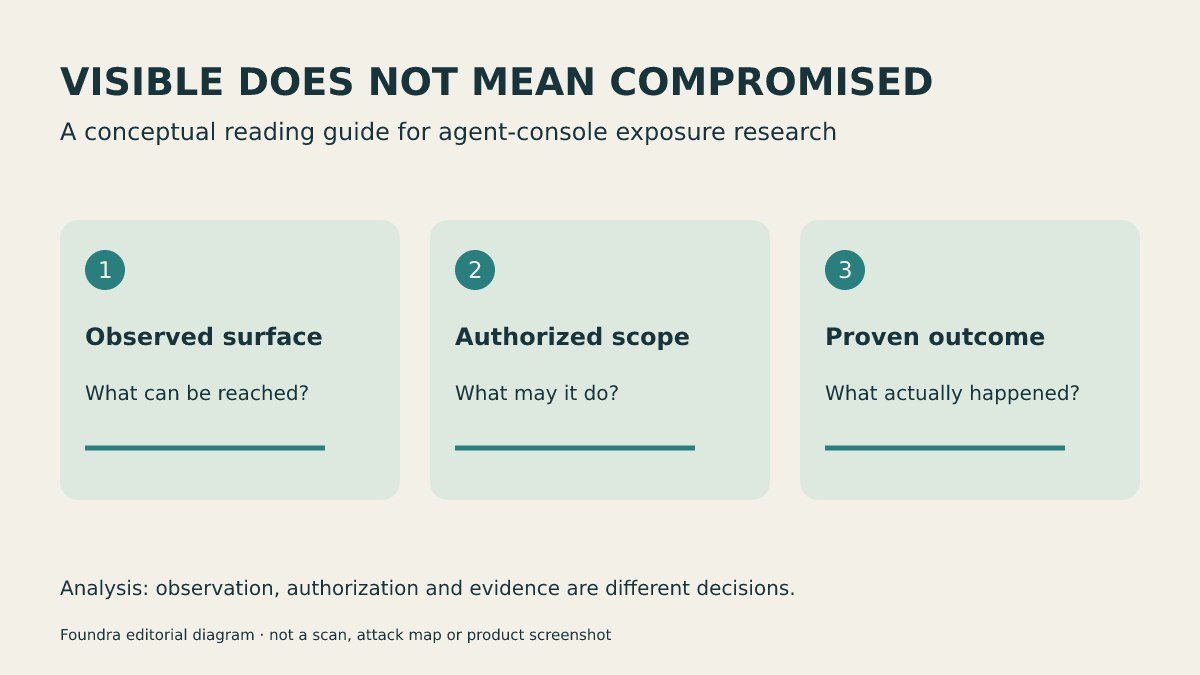
Treat a reachable agent console as a governance question: identify its owner, authorization boundary and access controls before interpreting a scan as evidence of an incident.
The number measures a surface, not an outcome
A console visible on the public internet is an observation. A successful intrusion is a different claim. The November 5 Censys report on ARTEX makes that distinction especially important as AI agents move from answering questions to operating tools. Founders buying security products, or building agents themselves, should resist the temptation to turn a large scan result into a much larger story about proven autonomous attacks.
Censys says that, as of November 4, it observed 1,465 hosts running exposed ARTEX consoles. It also says about 650 were concentrated in two blocks with identical configurations, leaving roughly 815 distinct-looking deployments. These are the researcher’s measurements and interpretation, not an independently repeated Foundra scan. Neither number is a count of affected customers, unique companies or successful breaches.
The research describes ARTEX as an LLM-driven penetration-testing framework. It says the console need not be publicly accessible, so the visible population does not represent every installation. That limitation cuts both ways: the scan can miss private deployments, while similar-looking public hosts do not automatically represent different operators. The useful finding is a management surface that deserves investigation, not a complete map of the product’s users.
A legitimate testing tool still needs an authorization boundary
In Censys’s account, users define tasks and agents plan and execute work through tools. That description makes ARTEX relevant to an emerging product category, but it does not demonstrate that every deployment is malicious. Authorized security testing and unauthorized intrusion can involve some of the same capabilities. Purpose, permission and the actual actions taken remain essential distinctions.
The November 6 TechCrunch report discusses the same exposure research and earlier reports linking ARTEX to malicious activity. Those earlier campaigns are context, not new incidents announced by this article. Nor does association with a tool show that every visible instance participated in them. Foundra has not contacted exposed hosts, accessed their directories or examined customer information; the account here is limited to the published research and reporting.
For a hypothetical SaaS team, the first response would be an internal inventory: which approved services can launch tasks, who owns them and what systems they may reach? That is a proposed governance exercise, not a report that a particular company has performed one. A product’s ability to carry out a sequence of steps does not itself answer whether those steps are permitted.
An exposure finding is the start of a review, not an incident verdict
Observe
Record the reachable service; do not count a host as a victim.
Establish authority
Ask who owns the deployment and which actions are authorized.
Verify outcomes
Use separately established evidence before asserting a compromise.
Three questions a buyer can put in the demo
First, separate reachability from authority. Ask how the management interface is authenticated and how a task’s scope is enforced after the agent begins acting. A convincing demonstration would show a prohibited operation being refused, not just an approved operation succeeding. This is an editorial evaluation proposal; the source material does not establish how well any vendor would pass it.
Second, examine the transition from a generated plan to an external action. A buyer could request a readable record linking the task, approved target, tool invocation and result. That record would make review possible without treating fluent explanations as evidence that a boundary held. The point is not to prescribe one universal architecture, but to make the authorization decision inspectable.
Third, ask what happens when access is withdrawn. In a hypothetical offboarding or incident-response scenario, the team should be able to identify the relevant deployment and stop its authority to operate. A dashboard that shows historical activity would not, on its own, demonstrate that active tasks or credentials had been revoked. These are separate acceptance questions, and claims about either require their own evidence.
The responsible headline stops short of a breach tally
There is a commercial lesson here for security startups as well as customers. An exposure measurement can be useful without being dressed up as a universal incident statistic. Clear definitions let a customer decide whether to investigate its inventory, review a deployment configuration or ask a vendor for a better control demonstration. Confusing hosts with victims instead creates urgency around an unproven denominator.
Censys’s findings deserve attention precisely within those limits. They are a dated account of publicly reachable infrastructure, accompanied by the researcher’s caveats and background reporting. They do not settle the number of operators, the intent of every deployment or the success rate of AI-assisted attacks. For an agent product, the next meaningful proof is not a bigger count on a slide. It is evidence that the authority to act can be understood, bounded and withdrawn.
Sources
- Censys: ARTEX research report, original researcher measurements ↗ Censys: ARTEX research report, original researcher measurements · 2026-11-05T21:38:21+00:00 · Primary source
- TechCrunch: November 6 report on exposed ARTEX systems ↗ TechCrunch: November 6 report on exposed ARTEX systems · 2026-11-06T18:44:38+00:00
Have additional information? Request a correction.