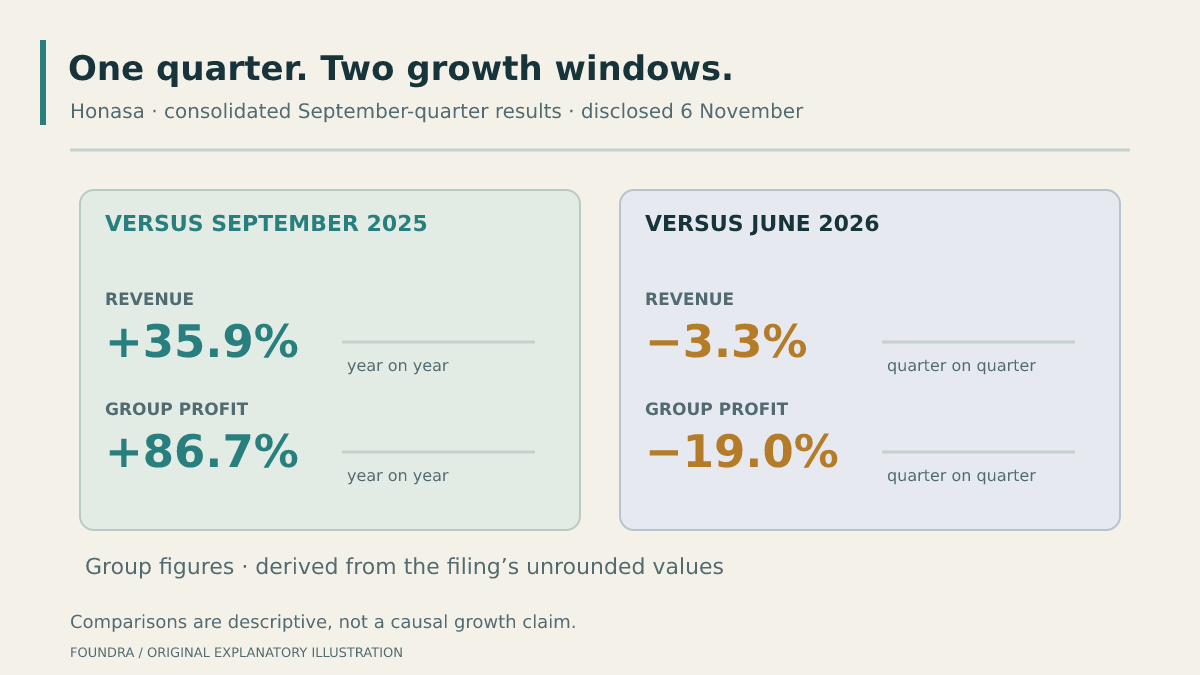
A strong annual comparison and a weaker sequential quarter can coexist; neither alone proves a lasting change in demand or earnings quality.
Two windows on the same business
Honasa Consumer’s September quarter looks substantially stronger than the corresponding quarter a year earlier. It also looks weaker than the quarter immediately before it. There is no contradiction: the comparisons answer different questions, and selecting only one would give readers an incomplete picture of the newly disclosed results.
Honasa’s November 6 board filing reports consolidated revenue from operations of ₹731.19 crore for the quarter ended September 30, 2026, compared with ₹538.06 crore a year earlier. Consolidated profit after tax was ₹73.25 crore against ₹39.23 crore. The figures are converted from the filing’s rupee-million units and rounded to two decimal places.
Those underlying values imply approximately 35.9% revenue growth and 86.7% profit growth year on year. Against June 2026, however, revenue fell about 3.3% from ₹755.95 crore and profit fell about 19.0% from ₹90.45 crore. These are Foundra’s arithmetic comparisons of the disclosed group figures, not management guidance for the next quarter.
Why the annual comparison matters
Comparing September with September is a useful first check because it holds the position in the calendar constant. It does not remove every difference in the business, but it avoids presenting the change between two different quarters as though the timing of demand, campaigns and shipments could not matter. The larger annual revenue base is an observed financial result, not merely a sales target.
The profit increase is proportionately larger than the revenue increase. That deserves examination, but it does not establish a single cause. The statement contains costs, other income, financing expenses and taxes as well as sales. A claim that one initiative caused the improvement would need evidence linking that initiative to the relevant changes, which these comparisons alone do not supply.
For founders of consumer businesses, the analytical lesson is to separate the result from the explanation. A higher profit margin is measurable. A conclusion that distribution has permanently become more efficient, or that customers now have a stronger preference for the brand, is a different claim. It should not be inferred simply because the profit growth number is impressive.
Same quarter, two comparison windows
Annual revenue
₹731.19 crore versus ₹538.06 crore: approximately +35.9%.
Annual group profit
₹73.25 crore versus ₹39.23 crore: approximately +86.7%.
Sequential revenue
Versus June revenue of ₹755.95 crore: approximately −3.3%.
Sequential group profit
Versus June group profit of ₹90.45 crore: approximately −19.0%.
June is not an inconvenient footnote
The sequential declines do not cancel the annual improvement. They do limit what can be said about a steadily accelerating business. September’s reported sales and profit are below June’s; an account of uninterrupted quarter-by-quarter expansion would therefore be wrong for these figures. Readers should not have to reconstruct that distinction from a growth headline.
A founder making inventory or hiring decisions would need more than either comparison. Hypothetically, a weaker sequential quarter could reflect shipment timing, channel inventory, a change in promotion or end-customer demand. The statement does not identify which explanation accounts for the decline. Those possibilities are questions for further evidence, not a list of events Foundra knows occurred.
The practical response is to keep both windows visible. A year-on-year comparison can describe the distance traveled since the previous September, while the June comparison flags a more recent change. Using them together is more informative than trying to declare one the “real” growth rate and discarding the other.
What belongs in the profit number
The group profit figure also needs a precise label. In September, the filing records ₹73.25 crore of total consolidated profit after tax, of which about ₹73.10 crore is attributable to owners of the company; the balance belongs to non-controlling interests. These are closely related numbers, not interchangeable descriptions. This article uses the total consolidated figure consistently for its growth comparisons.
The company’s results presentation reports an EBITDA margin of 12.7%, compared with 8.9% a year earlier. That is a company-reported operating measure, distinct from profit after tax and from cash generated in the period. Its improvement is useful additional context, but it should not be described as money available to distribute or spend.
Honasa’s consolidated filing is marked unaudited and includes a limited-review report. It is not an annual audit opinion. The filing provides a defined financial disclosure that can support the comparisons here; it does not independently validate a broader claim about brand strength, product quality or the durability of future margins.
A better question for the next disclosure
The next useful test is whether the business can sustain improved economics across more than one reporting window. That requires subsequent evidence, not a forecast dressed as a fact. Revenue, profitability, working capital and the timing of collections can move differently; a future assessment should examine them together rather than following only the fastest-growing line.
For now, the supported conclusion is specific. Honasa disclosed a much better September quarter than a year earlier and a softer quarter than June. Keeping both statements in the same account is not pessimism. It is the minimum needed to avoid turning a legitimate annual improvement into an unsupported story of continuous acceleration.
Sources
- Honasa Consumer — November 6 board outcome and consolidated financial results ↗ Honasa Consumer — November 6 board outcome and consolidated financial results · Primary source
- Honasa Consumer — Q2 and H1 FY27 results presentation ↗ Honasa Consumer — Q2 and H1 FY27 results presentation · Primary source
Have additional information? Request a correction.