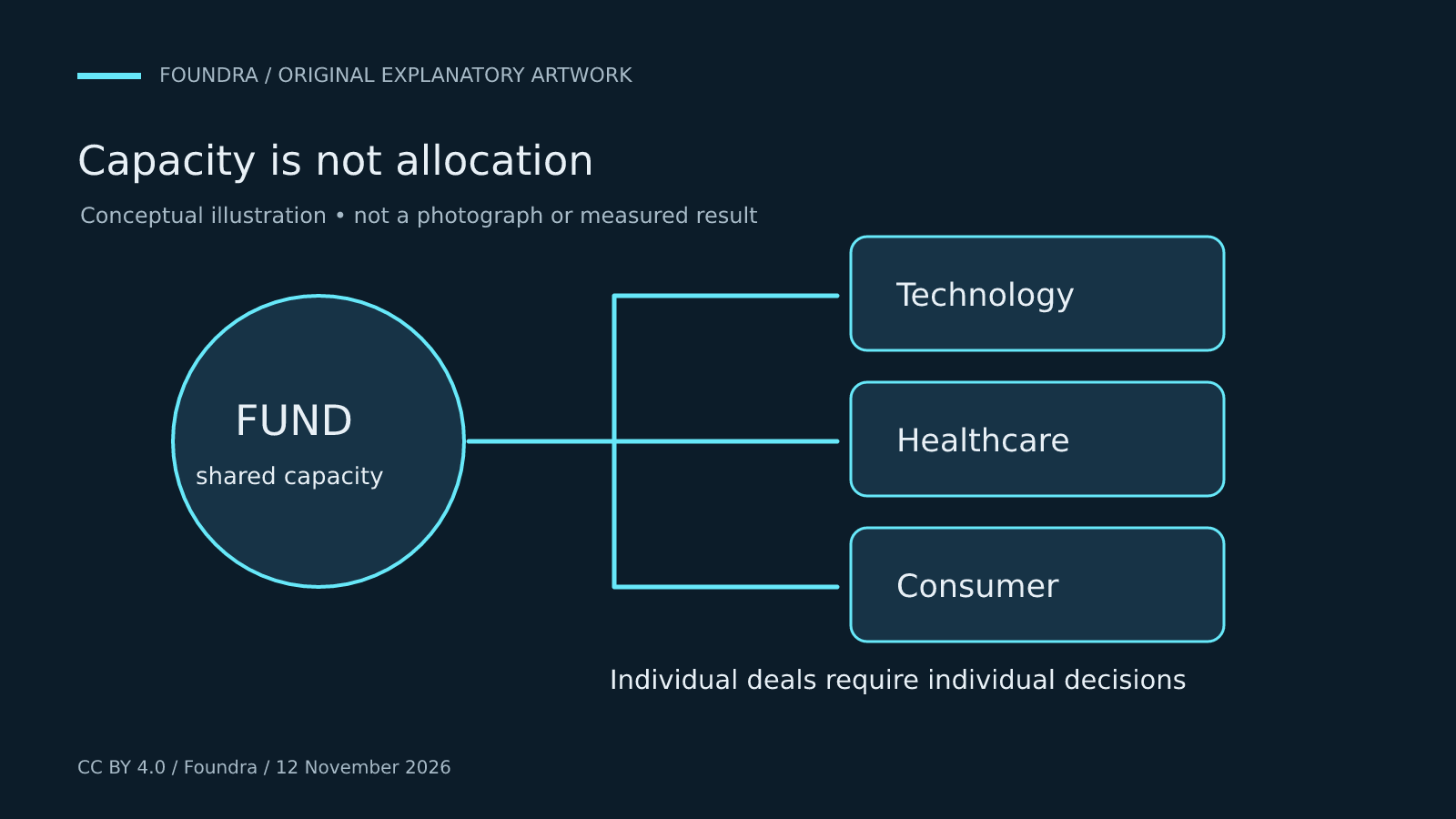
A larger multistage fund can support different financing needs, but its headline size is not an allocation to any one country, sector or startup.
India inside a global mandate
For an Indian founder, the useful part of a global fund announcement is not simply its headline size. It is whether the mandate includes the company’s market and stage—and whether that mandate translates into an appropriate financing decision. Norwest’s new vehicle gives those questions a fresh, substantial backdrop.
On November 12, Norwest announced Norwest 18, a $4 billion vehicle that it describes as its largest, continuing a strategy combining venture investment with growth equity. Its announcement identifies technology, healthcare and consumer as the core sectors and says the fund brings total capital under management to $18 billion.
YourStory’s contemporaneous account identifies the United States, India and Israel as markets within the fund’s remit. Neither source supplies a country-by-country allocation. A $4 billion global vehicle should therefore not be reported as $4 billion earmarked for Indian startups, nor as evidence that a particular Indian company has secured money.
The geographical inclusion is relevant; the absence of an allocation is relevant too. They describe different layers of the announcement. Keeping both visible makes the development useful without turning a global capital pool into an unsupported forecast about local funding.
Continuity is the product being offered
Norwest’s announcement spends considerable space describing relationships with founders through leadership changes, market expansion and potential acquisitions. Those are the firm’s descriptions of its role, not independently established outcomes for every portfolio company. Still, they explain the strategic proposition behind a multistage vehicle: an investor can remain relevant as a business’s financing needs change.
For a young company, the immediate question may be whether a product deserves a larger experiment. For a later-stage company, it may be whether an established distribution model can travel to another market. Capital used for those purposes carries different expectations about uncertainty, time and execution. Putting both within a broad mandate does not make the expectations interchangeable.
The advantage, in principle, is a longer relationship rather than a guaranteed next round. A founder can test that proposition by asking who makes follow-on decisions, what evidence is required and whether different teams assess early and later investments. These are diligence questions prompted by the fund’s structure, not claims that Norwest follows a particular internal process.
Fund capacity is not a company allocation
Mandate
Technology, healthcare and consumer across venture and growth equity.
Investment decision
A company must fit the strategy and pass its own diligence.
Company financing
Terms and deployment become specific only at the deal level.
What India should—and should not—read into the announcement
India is part of the reported geographic remit, making this relevant beyond the US venture market. But a global fund announcement cannot establish how readily an Indian company will secure financing. Nor does it resolve differences between a consumer business building distribution, a healthcare company navigating evidence requirements and a software company selling to enterprise customers.
The three-sector mandate also resists a simple reading of the fund as a referendum on one technology cycle. Norwest describes opportunities around AI while retaining healthcare and consumer within the vehicle. That is evidence of the stated mandate, not proof of future portfolio diversification or returns. The eventual mix will be visible only through investments and later disclosures.
An entrepreneur evaluating the firm can therefore separate three questions: does the business fit the mandate; does the investor understand its current operating problem; and are the proposed financing terms appropriate? A favourable answer to the first does not settle the other two. Fund size is useful context, but it is not a substitute for company-level diligence.
A mandate, not a market recovery statistic
This edition treats November 12 as the announcement date of Norwest 18. It does not present the vehicle as a planned startup raise, invent a deployment timetable or infer a particular company’s funding from its existence. The primary announcement describes a new fund; the secondary report characterises it as closed. Those statements should not be stretched into evidence that capital has already reached new portfolio companies.
The strongest reading is narrower and more useful: Norwest is committing to a broad investment platform with capacity to operate across company stages. For founders, the next meaningful development is not a still-larger headline. It is a decision showing how the mandate meets a specific business, on specific terms, at the moment that business actually needs it.
Sources
- Norwest — original Norwest 18 announcement ↗ Norwest — original Norwest 18 announcement · Primary source
- YourStory ↗ YourStory
Have additional information? Request a correction.