An executive appointment is a change in accountability, not evidence that enterprise AI has already delivered reliable outcomes.
The appointment reaches beyond the sales desk
The job description is the revealing part. Sarvam announced on November 9 that Sashikumar Sreedharan is joining as president and chief business officer, as well as a member of its board. In the company’s account, his remit includes enterprise and government business, developers and partners, but also finance, marketing, forward deployed engineering, service delivery and commercial operations. That puts several parts of an AI customer’s experience inside one executive mandate.
Sarvam says Sreedharan most recently led Google Cloud in India and previously ran Microsoft India’s enterprise business for more than five years. Those are the company’s descriptions of his background, not credentials independently supplied by Foundra. The announcement also says more than 100 enterprises and government institutions are building with its offering. That is an attributed adoption statement: it does not disclose contract values, recurring revenue, production workload counts or independently measured customer outcomes.
The distinction matters because an enterprise AI relationship can be commercially active without being operationally mature. A buyer might be experimenting, integrating a limited workflow or running a service at scale; those are different states. Sarvam’s appointment establishes who will lead the next commercial phase. It does not, by itself, establish which state every customer has reached. Reading a leadership announcement as a performance report would put more weight on it than the evidence supports.
Engineering and service enter the commercial remit
The scope creates a useful distinction between selling AI and taking responsibility for its operation. Forward deployed engineering and service delivery are explicitly included in the announced mandate, rather than left outside the commercial description. That is an organizational choice reported by the company. It does not tell us how much work is standardized, how much is customer-specific or how responsibilities are delegated below the new president.
For buyers, the practical question is whether the same promise survives the handoff from a sales discussion to an implementation and then to support. A broader remit could make conflicts easier to resolve, but concentration also requires delegation. Neither coordination nor effective delegation can be inferred from the appointment alone. They are operating questions to put to the company about a particular deployment.
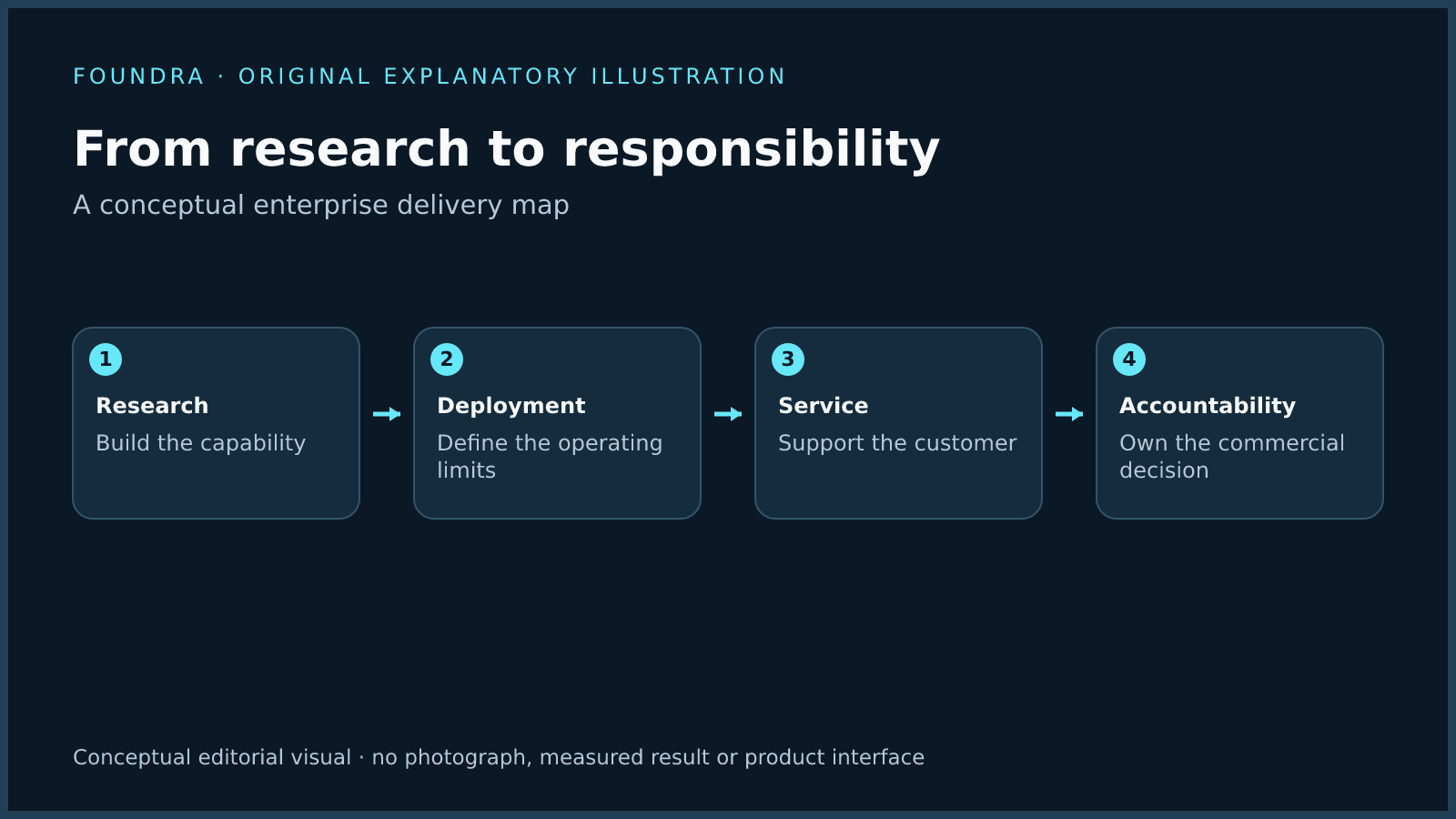
From research to responsibility — editorial conceptual explanation
Research
Build the capability
Deployment
Define the operating limits
Service
Support the customer
Accountability
Own the commercial decision
Ownership has to mean something operational
Sarvam’s announcement argues that enterprises should own their AI and retain the data, models, agents and resulting value within the enterprise. That is the company’s position. It is not a verified description of every deployment architecture or a guarantee that every customer contract delivers the same rights. A buyer would still need to inspect the particular arrangement, including access controls, permitted uses, export options and responsibility for model updates.
Sarvam’s stated enterprise-ownership position is a starting point for a contract discussion, not the contract itself. A buyer would still need to establish access, permitted use and responsibility for updates in its own arrangement. The appointment provides a public commercial point of responsibility for that conversation.
Sources
- Sarvam — Sashikumar Sreedharan appointment ↗ Sarvam — Sashikumar Sreedharan appointment · 2026-11-09 · Primary source
- YourStory — Sarvam leadership report ↗ YourStory — Sarvam leadership report · 2026-11-09
Have additional information? Request a correction.