The announced expansion concerns protective account settings; it does not establish perfect age detection or a uniform industry-wide identity system.
Instagram now; Facebook continues; Threads is planned
Meta’s November 9 announcement describes three different rollout states. It says the AI technology used to identify suspected teens on Instagram—even accounts with adult birthdays—is expanding globally. The aim is to place those users into Teen Account protections. It says the Facebook rollout continues, while a similar global launch on Threads is planned for later this year. A single headline about a global expansion should not erase those differences.
The company describes Teen Account limits concerning contact, content and time on its apps. It does not provide a country-by-country completion record or an independent error-rate evaluation in this announcement. Foundra has not tested individual accounts. Global expansion is the announced scope of the Instagram change, not a finding that every account worldwide has been classified correctly or that every resulting interaction is safe.
What a protective classification means
The product distinction is between an age estimate and the experience assigned after that estimate. A declared birthday is one account attribute. A protective setting is a platform decision. If a person enters an adult birthday but is placed into a teen experience, the system has not turned a probability into a verified identity; it has acted on its assessment. This is analysis of the announced purpose, not a description of Meta’s proprietary model.
That distinction determines how an error should be discussed. A mistakenly restricted adult is not thereby proved to be a teen. A teen missed by the system does not become an adult. Product evaluation needs to examine both directions of error and the consequences of each. The expansion’s size cannot supply the missing measurements. Nor should correction be treated as an incidental feature: it is part of making a consequential classification usable over time.
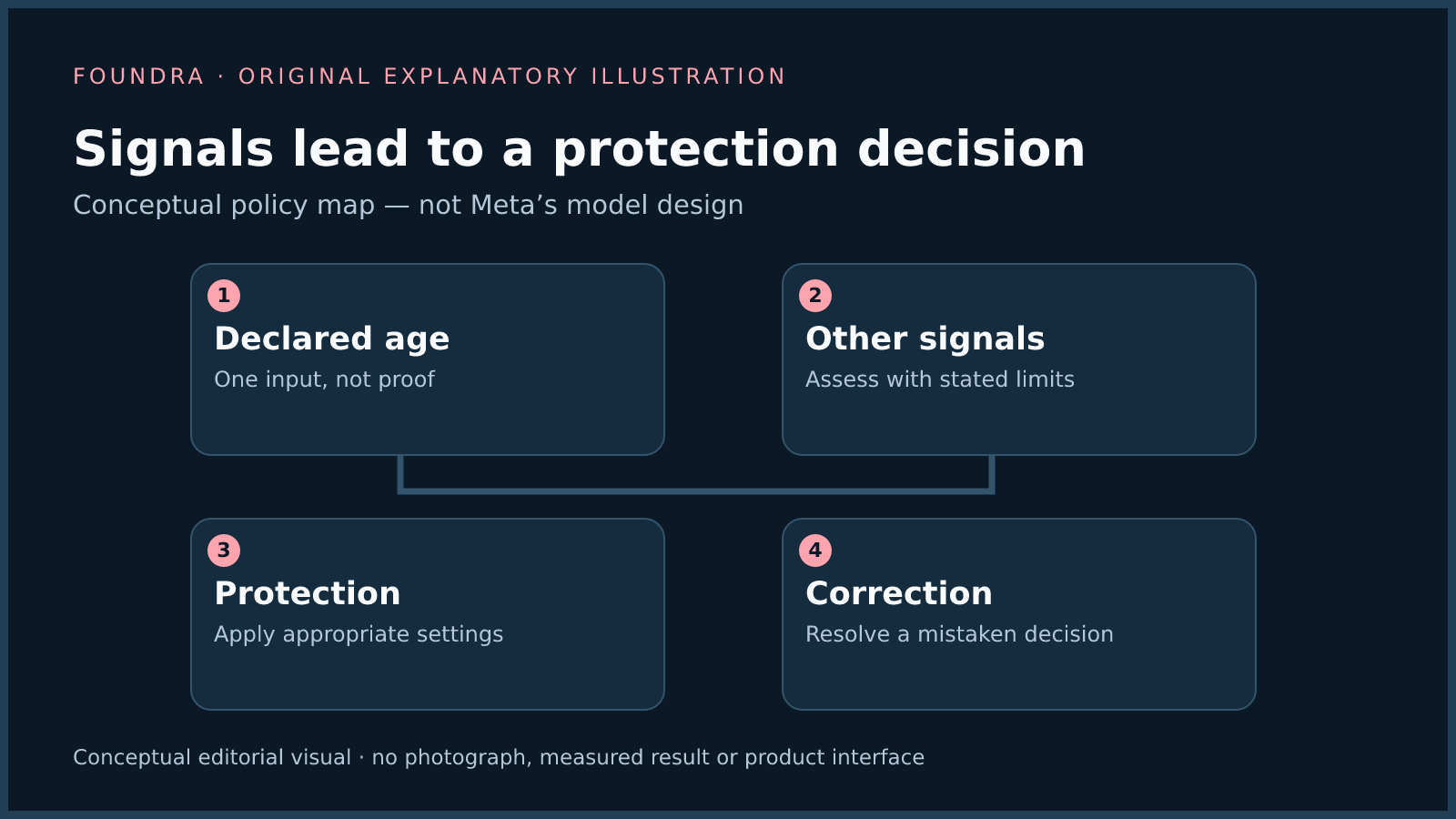
Signals lead to a protection decision — editorial conceptual explanation
Declared age
One input, not proof
Other signals
Assess with stated limits
Protection
Apply appropriate settings
Correction
Resolve a mistaken decision
Australia adds a device-level input
Meta says it has begun voluntarily using Apple’s age-range signal in Australia. It describes an optional parent setup process in which an app store can confirm an age range and share it with a developer. The signal is another input in Meta’s account, not a mandatory global system announced for every app. The company argues that optional collection, sharing and use lead to inconsistent protections. That is its assessment and policy position.
Moving an input to the device level changes where information originates, but does not eliminate decisions for the receiving service. The service still needs a policy for each age range, missing information and later correction. An age range is also not necessarily an exact birth date. Treating all these concepts as interchangeable would obscure the product’s actual purpose and the information it uses. No Foundra claim about Apple’s implementation extends beyond the process described in this announcement.
The policy argument is a different layer
Meta calls for app-store age-verification and parental-consent requirements and describes further work under its agreement with 52 attorneys general. Those are, respectively, a policy preference and the company’s account of commitments. They do not establish that the proposed policy is enacted everywhere or that its preferred approach is objectively the most privacy-preserving option in every circumstance. The release’s normative argument should not be reported as a settled technical finding.
The practical consequence for consumer-product builders is to keep three layers legible: the signal obtained, the protective action taken and the rule that authorizes that action. One cannot substitute for the others. An app-store input may help a platform make a decision; a platform still owns the experience it supplies. A regulatory requirement may define an obligation; it does not itself supply an accurate classifier. This is a product-governance framework rather than legal advice.
Read the change at the right scale
The announcement is significant because Meta is widening an existing protective mechanism, rather than merely changing a sign-up form. Its scope is also bounded: Instagram’s global expansion, Facebook’s continuing rollout, a Threads plan and voluntary Australian device-signal use are separate developments. Keeping them separate gives parents and product teams a clearer account of what has actually been announced. The central question is not whether an age field exists, but how information becomes a protective decision and how that decision can remain accountable.
Sources
- Meta — global Teen Account protections announcement ↗ Meta — global Teen Account protections announcement · 2026-11-09 · Primary source
- Meta Newsroom — dated official feed ↗ Meta Newsroom — dated official feed · 2026-11-09 · Primary source
- The Verge — Instagram age-estimation report ↗ The Verge — Instagram age-estimation report · 2026-11-09
Have additional information? Request a correction.