New financing supports a deployment plan; it does not turn a planned constellation into an operating source of imagery.
The first satellite is still ahead
Marble Imaging’s financing announcement sits between two states that should not be collapsed. The company says its first satellite is fully funded and has completed pre-flight testing. It is scheduled to launch in early 2027. That is a statement about preparation and a future schedule, not an announcement that the satellite is already in orbit or delivering imagery. The distinction is central to what the new money is intended to support.
In the announcement indexed by Marble on November 9, the company reports an additional €6 million led by Cherry Ventures, extending an initial €5.3 million seed round led by High-Tech Gründerfonds. These are issuer-reported financing facts. The company says the new funding accelerates its constellation plans, with a goal of 30 satellites by 2030. A goal describes the intended destination; it does not establish the financing, launch dates or operating status of every satellite required to reach it.
Owning a sensor and supplying an answer are different businesses
Marble describes two connected activities: building a very-high-resolution satellite constellation and developing an AI-powered analytics platform for multi-source data. Its stated satellite design includes sub-meter visible and near-infrared imagery as well as short-wave infrared data. Those are design descriptions. Foundra has not inspected satellite test results, verified delivered resolution or independently assessed the analytics product. The company’s claims about the combination should be read with that limitation in view.
An illustrative customer question shows why the two activities cannot simply be treated as one. A buyer might want to know whether a particular infrastructure site has changed. A satellite image is an input to that decision. The buyer would still need an appropriate observation, usable data and an interpretation whose limitations are understood. This is a hypothetical example, not an account of a Marble customer or a claim that the planned constellation provides any particular service level.
The useful product may therefore be defined by access and accountability rather than by the existence of a sensor alone. Who receives the data, under what contract, on what schedule, and with what explanation of uncertainty? A provider can own hardware without answering all those questions. Conversely, a software service can combine data from several sources without owning every sensor. Marble’s plan connects the layers, but the financing announcement does not prove that the whole chain has reached operating maturity.
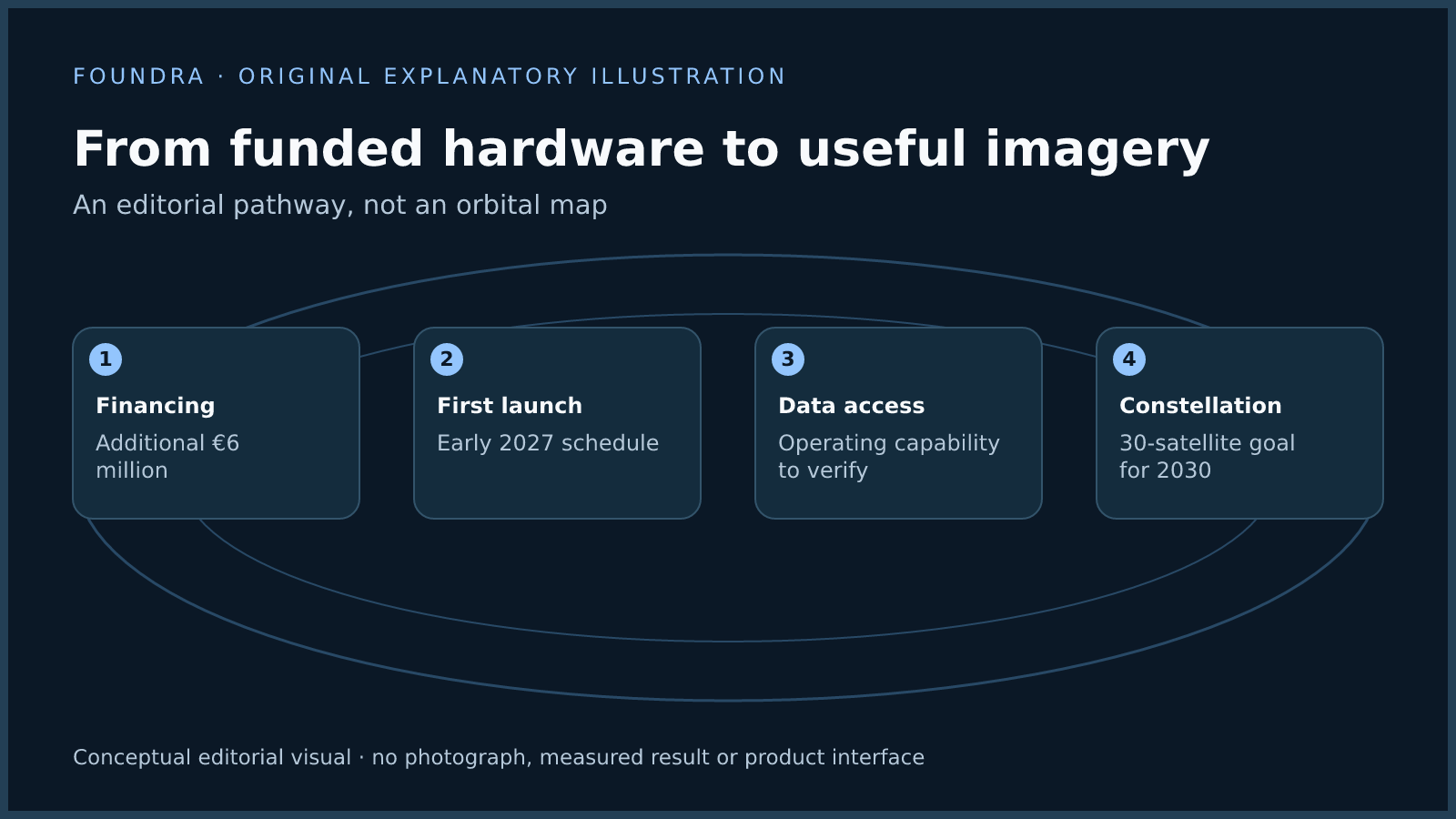
From funded hardware to useful imagery — editorial conceptual explanation
Financing
Additional €6 million
First launch
Early 2027 schedule
Data access
Operating capability to verify
Constellation
30-satellite goal for 2030
A European capability is not automatically a guarantee
The company frames its work as an answer to Europe’s dependence on non-European imagery providers. That is Marble’s strategic argument. It should not be expanded into an independently established claim that every European customer lacks access, that a particular supplier has interrupted a particular contract, or that Marble can already eliminate such risks. Its own constellation remains a development program. The broader independence argument must be tested against actual access arrangements, not only the location of the company.
Our analysis is that several kinds of dependency can exist together. A hypothetical imagery buyer could care about contractual control, data handling and the ability to obtain an observation when needed. A change in one dependency does not necessarily remove the others. For example, a stronger contract does not by itself create more observations, and more observations do not by themselves make an interpretation dependable. These are distinct questions for procurement rather than promises established by a funding round.
That is why the 2030 target should remain visibly a target. A constellation requires successive transitions from planned hardware to launched systems to useful service. The announcement gives an initial launch schedule and a long-term ambition; it does not give enough evidence to calculate future coverage, revisit performance, availability or customer savings. Foundra does not turn the proposed satellite count into a service forecast.
Watch the transition, not just the total
The next meaningful chapter would document the first satellite’s actual launch and subsequent operating capability. Later updates would need to distinguish additional funding, contracted launches and satellites delivering usable data. Each changes a different part of the plan. Marble’s new financing is therefore a real development with a bounded meaning: more capital for the path ahead. The story becomes stronger when the company can show how that capital changes access to useful imagery, not merely the size of the constellation it hopes to build.
Sources
- Marble Imaging — additional financing announcement ↗ Marble Imaging — additional financing announcement · 2026-11-09 · Primary source
- Marble Imaging — dated news index ↗ Marble Imaging — dated news index · 2026-11-09 · Primary source
- EU-Startups — Marble financing report ↗ EU-Startups — Marble financing report · 2026-11-09
Have additional information? Request a correction.