Security and memory design describe different priorities; issuer performance claims are not a substitute for testing the intended workload.
A new system is not necessarily a new chip generation
Which constraint comes first: protecting data while it is processed, or giving a workload more memory and compute in a package? Google’s original November 9 announcement places those questions behind TPU 8tx and TPU 8i Max, two additions to its eighth-generation TPU portfolio. The company explicitly distinguishes a new chip from a new system assembled around silicon, packaging, networking and other infrastructure. That distinction is more useful than treating every announced configuration as a separate semiconductor generation.
Google describes TPU 8tx as built on the same silicon as TPU 8t, paired with fifth-generation AMD EPYC CPU hosts and configured for confidential inference. It describes TPU 8i Max as combining two TPU 8i chips in one package, with twice the compute, SRAM and high-bandwidth-memory bandwidth of TPU 8i. These are the company’s architectural descriptions and comparisons. Foundra has not tested either system or independently verified its performance.
The original Google announcement is dated November 9. This account uses that page for the event date and does not infer pricing, general availability or completed customer deployment merely from the introduction of the configurations. The product names belong to one portfolio, but the intended constraints differ: sensitive processing for 8tx and concentrated compute and memory resources for 8i Max.
Confidentiality answers one class of question
TPU 8tx changes the system around training-generation silicon. Google pairs TPU 8t silicon with fifth-generation AMD EPYC CPU hosts and describes hardware-level protection for sensitive data and model weights during use. It also says the system adopts the low-latency Boardfly network associated with its reasoning configuration. Those details make 8tx a concrete configuration, not merely a security label placed on a generic accelerator. They remain issuer descriptions, not an independent architecture or security audit.
Our analysis is that security claims should be translated into a defined threat model. What is being protected, from whom, in which state and under which assumptions? A hardware feature can address part of that model without covering every access path or application mistake. This is an evaluation framework, not a report of a defect in Google’s product. The announcement does not support a conclusion that any customer using TPU 8tx is automatically compliant with a particular law or immune to data exposure.
That also changes the performance comparison. A buyer choosing a sensitive workload may care about meeting a protection requirement before comparing throughput. A faster configuration that does not meet the requirement is not an equivalent alternative. Conversely, a buyer without that requirement should not assume the security-oriented configuration is automatically its best choice. The appropriate comparison depends on the job the infrastructure must do.
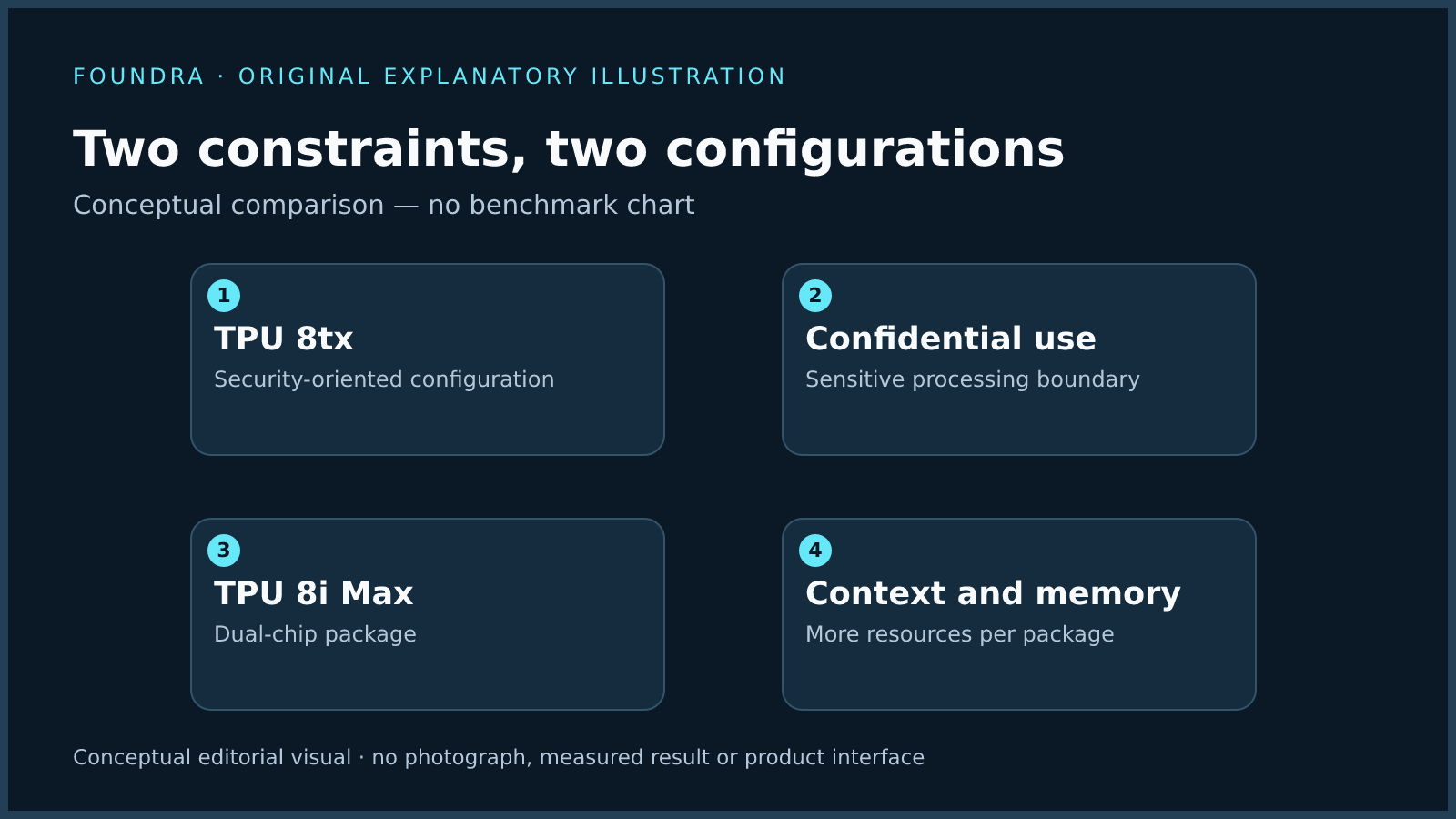
Two constraints, two configurations — editorial conceptual explanation
TPU 8tx
Security-oriented configuration
Confidential use
Sensitive processing boundary
TPU 8i Max
Dual-chip package
Context and memory
More resources per package
More resources do not establish a universal result
The package-resource comparison is not an application benchmark. A workload constrained by another component need not translate the increased resources into the same proportional gain. Google’s announcement does not supply Foundra with customer-specific latency, pricing or energy measurements from which to calculate a universal result. The useful distinction is between what the company says it changed in the package and what a particular application would deliver on the complete system.
The software route is another dimension
The original announcement also points to previously open-sourced TorchTPU and a new TPU agent suite in preview. Google says PyTorch code and Hugging Face models can run natively on TPUs and describes tools intended to help with onboarding and optimization. These are attributed compatibility and tooling claims. Foundra has not run that software, and preview should not be rewritten as general availability.
Software compatibility is a different axis from either hardware confidentiality or package resources. A developer needs an execution route for its actual model and operations, not just a supported framework name. This is an analytical distinction, rather than a report that a particular model failed. The architecture comparison does not answer every software question, and the software claim does not establish a security boundary. Keeping those dimensions separate makes the portfolio more intelligible.
A portfolio, not a universal ranking
The chip-versus-system distinction explains why Google can introduce configurations for different constraints within one generation. For a buyer, the practical sequence is to identify the required protection boundary, the resource constraint and the software route, then compare an actual service offering. That is a decision framework, not a Foundra benchmark or purchase recommendation. TPU 8tx and TPU 8i Max answer different design questions; neither is established here as the best accelerator for every workload.
Sources
- Google — original TPU 8tx and TPU 8i Max announcement ↗ Google — original TPU 8tx and TPU 8i Max announcement · 2026-11-09 · Primary source
Have additional information? Request a correction.