The round is closed according to Nominal; the engineering benefits of its proposed intelligence platform still need workload-specific proof.
Capital for the infrastructure beneath the model
Nominal’s November 9 announcement describes a $240 million Series C at a $3 billion valuation, led by Lightspeed Venture Partners and co-led by Insight Partners. The company says it raised the money; this is not presented as a planned financing or an open fundraising target. The release does not supply a capitalization table or specify the valuation’s pre-money or post-money basis, so it cannot support a reliable calculation of the stake sold.
The product argument is more interesting than a simple claim that hardware engineers need AI. Nominal describes an intelligence platform connecting physical control, engineering data, models and applications. It presents the round as a way to build on its existing test-data work. The distinction is between a model that responds to a question and a system that can reach the relevant engineering evidence. The announcement describes that ambition; Foundra has not tested the platform or measured its performance.
Hardware creates a useful constraint on the discussion. In a hypothetical test, an engineer might receive an unexpected temperature reading. An assistant can generate several plausible explanations without knowing which sensor was used, how it was calibrated or what configuration the machine was in. The output may be fluent and still be useless for deciding whether the machine should run again. The missing ingredient is not necessarily a larger model; it may be the missing context.
The expensive part can be the connection
Nominal’s own platform description emphasizes links to equipment, common structure for engineering data and an intelligence layer that can work with context and tools. These are product claims and design descriptions, not independent proof that every supported system connects cleanly. A buyer should distinguish a demonstrated integration from an intended integration, and a recorded measurement from an interpretation generated after the fact. Those distinctions are especially important when software influences a physical decision. Our analysis is that the connection has value only if it preserves meaning. Combining two files is not the same as establishing that they describe comparable tests. A configuration change, a different operating condition or an incomplete record may undermine the comparison. In an illustrative workflow, the assistant should be able to point an engineer back to the specific measurements and conditions it used. Otherwise, convenience may come at the expense of an auditable decision trail.
That suggests a practical product examination rather than a broad benchmark contest. Give the system a bounded investigation with known inputs, require it to identify missing information and compare its proposed explanation with the evidence. Then repeat the exercise after changing one important condition. These are hypothetical procurement tests, not tests Foundra conducted. They ask whether the software handles uncertainty and context, rather than merely whether it produces an impressive demonstration.
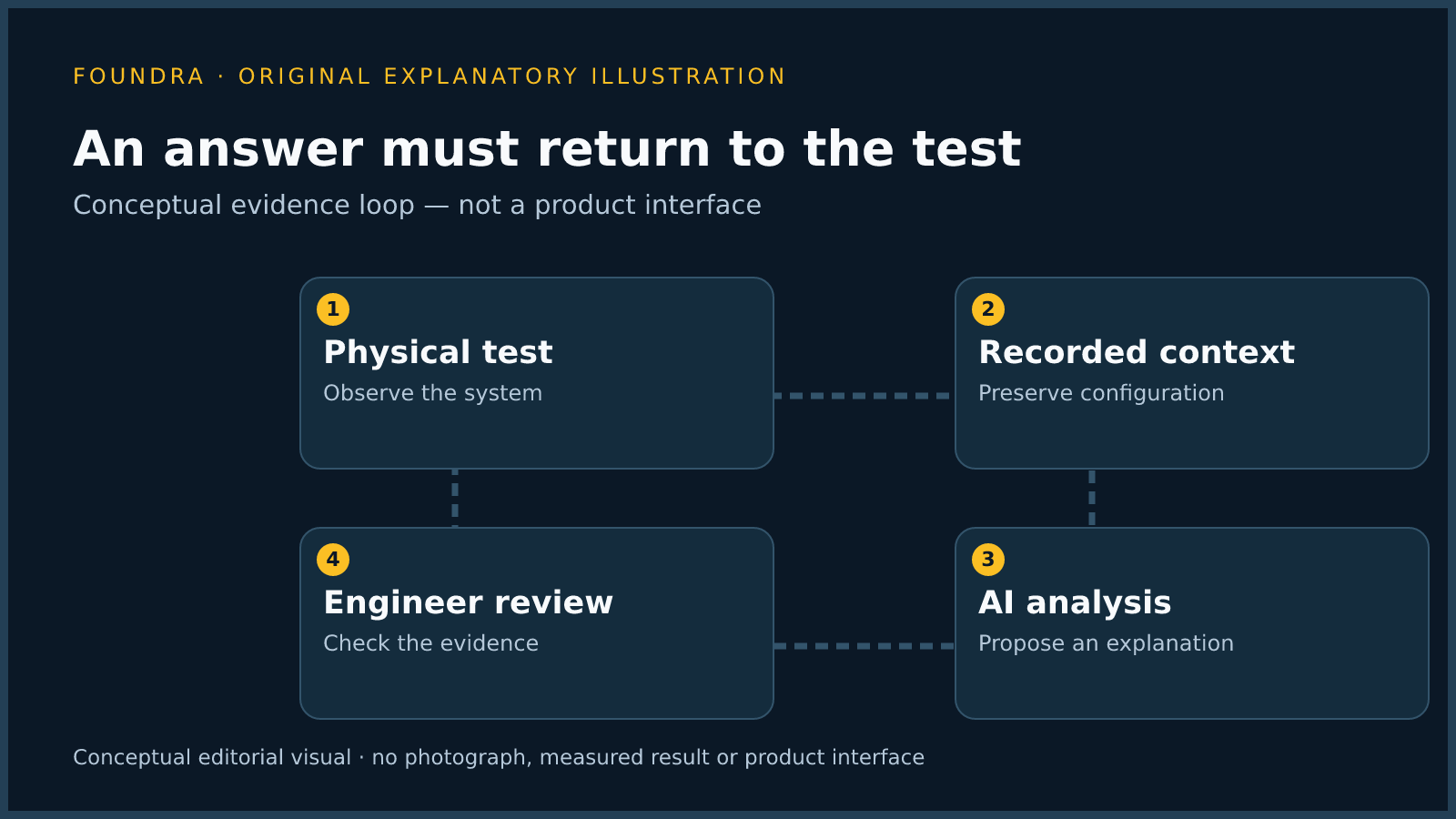
An answer must return to the test — editorial conceptual explanation
Physical test
Observe the system
Recorded context
Preserve configuration
AI analysis
Propose an explanation
Engineer review
Check the evidence
Who owns the final engineering decision?
A useful assistant does not erase the need to assign responsibility. In the example above, someone must decide whether the unexpected reading requires a repeat test, a design change or no action. That person needs to understand the evidence and the consequences. A system that organizes the investigation can be valuable without being granted authority to make the operating decision. Product evaluation should therefore examine both what the software can do and what it is permitted to do.
For Nominal, the commercial question is whether this infrastructure becomes a repeatable product rather than a succession of bespoke connections. The announcement does not disclose the implementation cost, revenue contribution or support economics of the proposed platform. Those omissions are not evidence of failure. They simply prevent the financing announcement from answering whether a customer can deploy the product predictably, maintain it over time and justify the expenditure against its own engineering needs.
The round gives the company capital for that work and establishes the valuation reported by the issuer. It does not validate every promised engineering outcome. The most persuasive next artifact would be a transparent, bounded investigation: the original test, the context retained, the analysis proposed and the decision a responsible engineer made. For software aimed at the physical world, returning to the evidence is not a limitation on intelligence. It is the point of building the platform.
Sources
- Nominal — Series C announcement ↗ Nominal — Series C announcement · 2026-11-09 · Primary source
Have additional information? Request a correction.