Spaces are an announced feature, not a Foundra-tested replacement for a business system or proof that every suggested integration works reliably.
A small tool can become a lasting dependency
Imagine a trip planner that is useful enough to become part of your routine. Its first screen matters less once you depend on it to keep the right reservation, preserve a change and show the information you need at the right time. That is a hypothetical example, but it captures the product question raised by Meta’s November 6 spaces announcement: what happens after an AI-generated experience becomes something a person repeatedly relies on?
Meta describes a space as a customizable experience inside Muse, created by telling the app what you want. The company says users can keep adjusting it, change its appearance or behavior and choose where and when it appears in the app. It offers examples including planners, games and small-business tools. These are the capabilities and use cases described by the issuer. Foundra has not used the feature, tested an integration or assessed whether a particular generated space is dependable.
The feature is distinct from an underlying model release. It concerns how a user constructs and organizes experiences within an application. A model’s technical characteristics do not establish that a generated planner handles updates correctly, just as an attractive layout does not establish that its information is current. The announcement is product news; it should not be stretched into a claim that Muse has replaced every application represented in the company’s examples.
An intention is not a permission model
Our examination uses a hypothetical freelance client hub. A user may ask for projects, deadlines and invoices in one place. That describes an intention, but it leaves several operating questions open: which data supplies the hub, what may be changed, which actions require confirmation and how mistakes can be reversed. Nothing in this example asserts that Muse currently performs those actions. It illustrates the difference between describing a desired outcome and defining the authority needed to pursue it.
A useful boundary is between presenting information and acting on it. Showing an invoice is different from editing it; organizing a message is different from sending one. An experience can be convenient while remaining deliberately read-only. If an action is permitted, the user needs a way to understand what happened and why. Those are general product-design questions, not details Foundra has verified about Meta’s implementation.
Meta’s list of possible spaces is broad, spanning personal interests and practical workflows. The breadth is part of the company’s proposition, not independent evidence that one permission model suits them all. A trivia game and a business order tracker do not have the same consequences when information is wrong. The product should therefore be evaluated against the task it is actually expected to perform rather than against the most impressive example in an announcement.
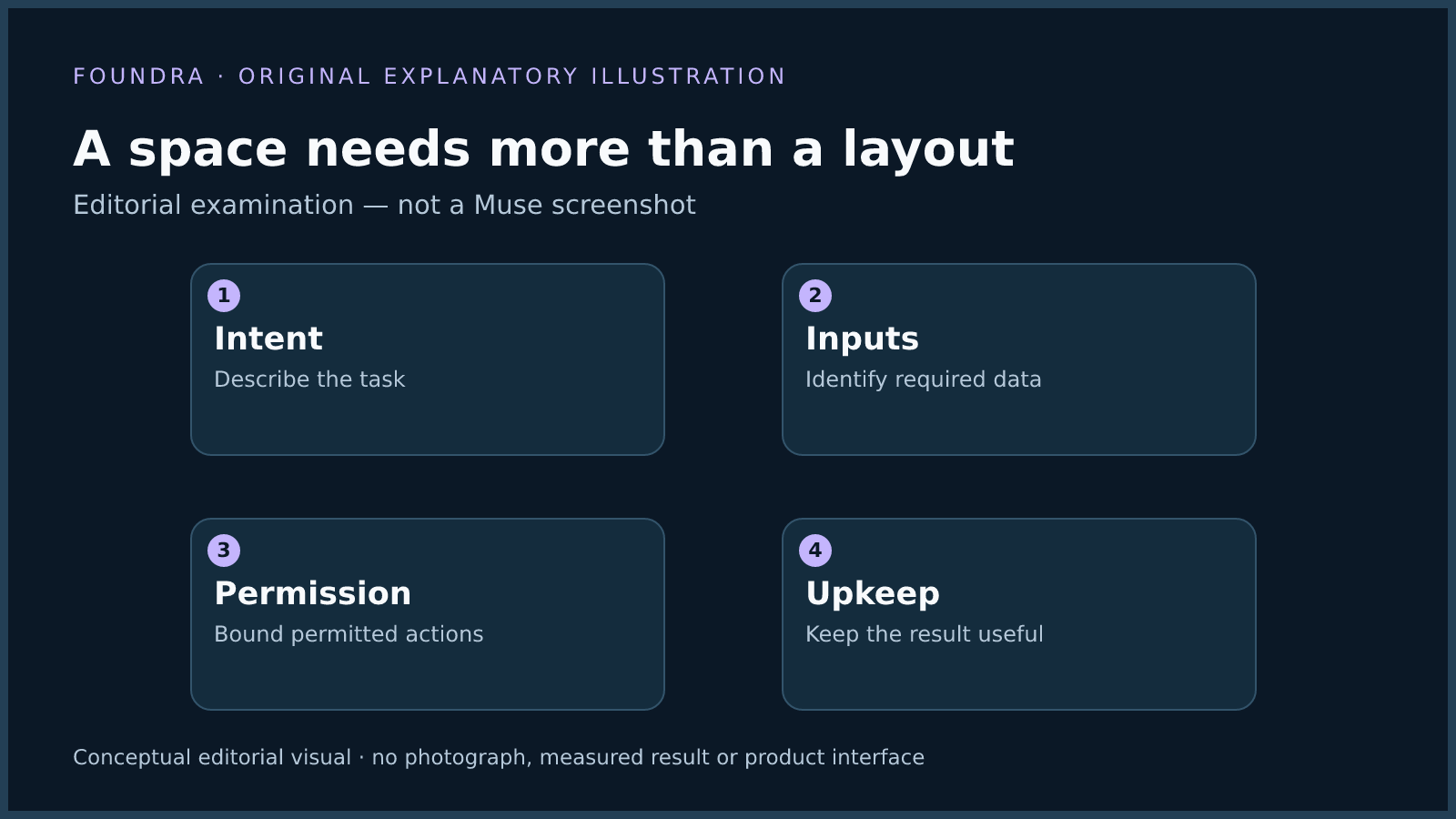
A space needs more than a layout — editorial conceptual explanation
Intent
Describe the task
Inputs
Identify required data
Permission
Bound permitted actions
Upkeep
Keep the result useful
Customization continues after the first prompt
The ability to revise a space, as Meta describes it, makes maintenance part of the experience. In the hypothetical client hub, the user might later add a collaborator or change the way deadlines are handled. A reasonable evaluation would ask whether existing information survives the change, whether the new behavior is understandable and whether the user can return to the previous arrangement. These are suggested examination criteria, not tests conducted by Foundra.
There is a commercial question here for founders building focused applications. A user-generated experience can address a small need without offering the same operating assurances as a dedicated system. That does not make either approach inherently superior. A lightweight organizer might be enough for one person; a workflow with multiple users and financial consequences might require more explicit controls. The comparison depends on the obligation the product is being asked to carry, not on whether the interface was generated.
Before a business depends on the space
Meta has announced a way to make Muse more individually configurable. The significant next question is whether a particular space remains understandable and useful after repeated changes. For a personal tool, that may be the difference between an enjoyable experiment and an enduring habit. For a business use, the bar may be higher. The launch expands what users can try; it does not remove the need to examine the resulting tool before trusting it with a consequential task.
Sources
- Meta — Muse spaces announcement ↗ Meta — Muse spaces announcement · 2026-11-06 · Primary source
- Meta Newsroom — dated official feed ↗ Meta Newsroom — dated official feed · 2026-11-06 · Primary source
Have additional information? Request a correction.