The new financing is $30 million. Enterprise buyers should test agent permissions, intervention and cost controls rather than assuming a management dashboard establishes safety.
$30 million new; $57.6 million cumulative
Kindo announced a $30 million financing on November 12, co-led by Crosspoint Capital and Forgepoint Capital. The company says this brings total capital raised to $57.6 million. The larger number in the release’s headline is cumulative funding, not the amount of a single new round.
The distinction prevents two common misreadings: reporting the total as fresh capital, or treating the new raise as the company’s valuation. The source does not disclose a valuation for this financing. It also does not supply a breakdown that would justify reconstructing every earlier round from the cumulative figure.
Kindo says the proceeds will expand its go-to-market organisation and accelerate development of its enterprise AI Control Center, Deep Hat models and add-ons. Those are stated spending priorities. The announcement does not divide the $30 million among them or establish a completion date for the resulting work.
The product sits above agent creation
Kindo describes its business as management of AI agents: discovering their use, bringing activity and spending into view, and controlling permissions. Its stated audience crosses IT, security, finance and compliance. That positioning is different from simply offering a place to build another agent.
The distinction is commercial as well as technical. A builder’s immediate customer may want a task completed. A management buyer also needs to account for what the system is allowed to do and what it costs. The same workflow can satisfy the first requirement without answering the second.
The financing backs Kindo’s attempt to serve that management layer. It does not independently establish the completeness of agent discovery or the effectiveness of a particular enforcement mechanism. Those capabilities remain vendor descriptions in this account; Foundra has not tested the platform.
This is why the control proposition should be kept separate from the model proposition. A more capable model does not, by itself, set an enterprise’s permissions, spending policy or intervention process. A management product has to connect to those decisions rather than rely on model quality as a substitute.
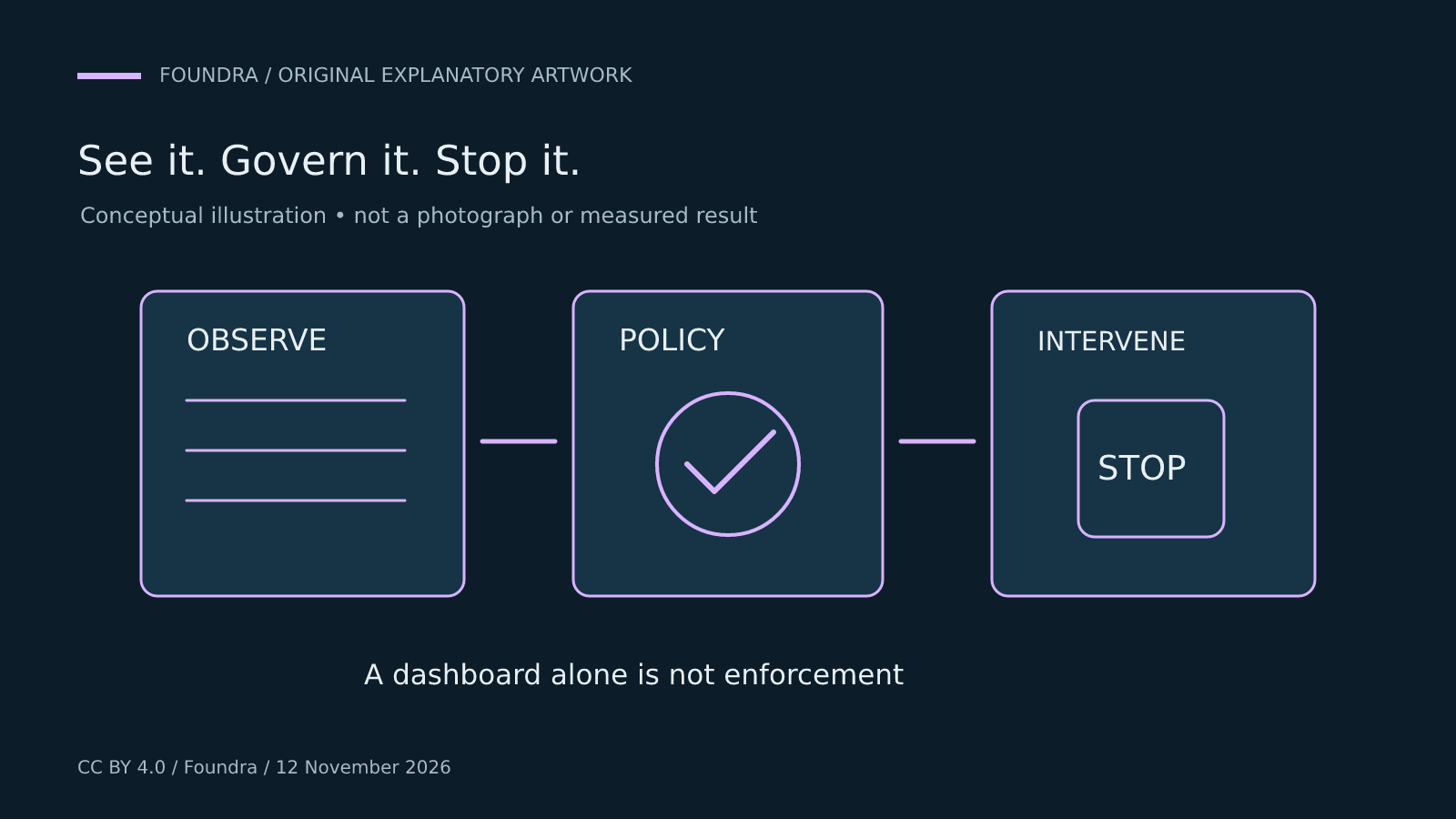
Control requires more than observation
Discover
Find which agents and integrations are in use.
Enforce
Apply permissions and spending rules to actual actions.
Intervene
Give accountable operators a usable way to stop or correct work.
The growth figure is missing a denominator
The company also reports approximately 800% year-over-year revenue growth in 2026. The supplied announcement does not disclose the starting revenue base. A percentage therefore cannot be used here to calculate sales, infer profitability or compare the business’s absolute scale with another vendor.
That limit does not contradict the reported growth. It identifies what the disclosed number can and cannot tell a reader. Revenue growth, cumulative financing and new financing are three separate measures; presenting them together should not erase their differences.
The fresh event is a $30 million raise with two named co-leads and stated plans to expand enterprise agent management. This focused financing account does not assign a valuation, estimate an undisclosed revenue figure or turn the platform’s claims about control into a security certification.
Sources
- Kindo — original financing announcement via PR NewsWire ↗ Kindo — original financing announcement via PR NewsWire · Primary source
Have additional information? Request a correction.