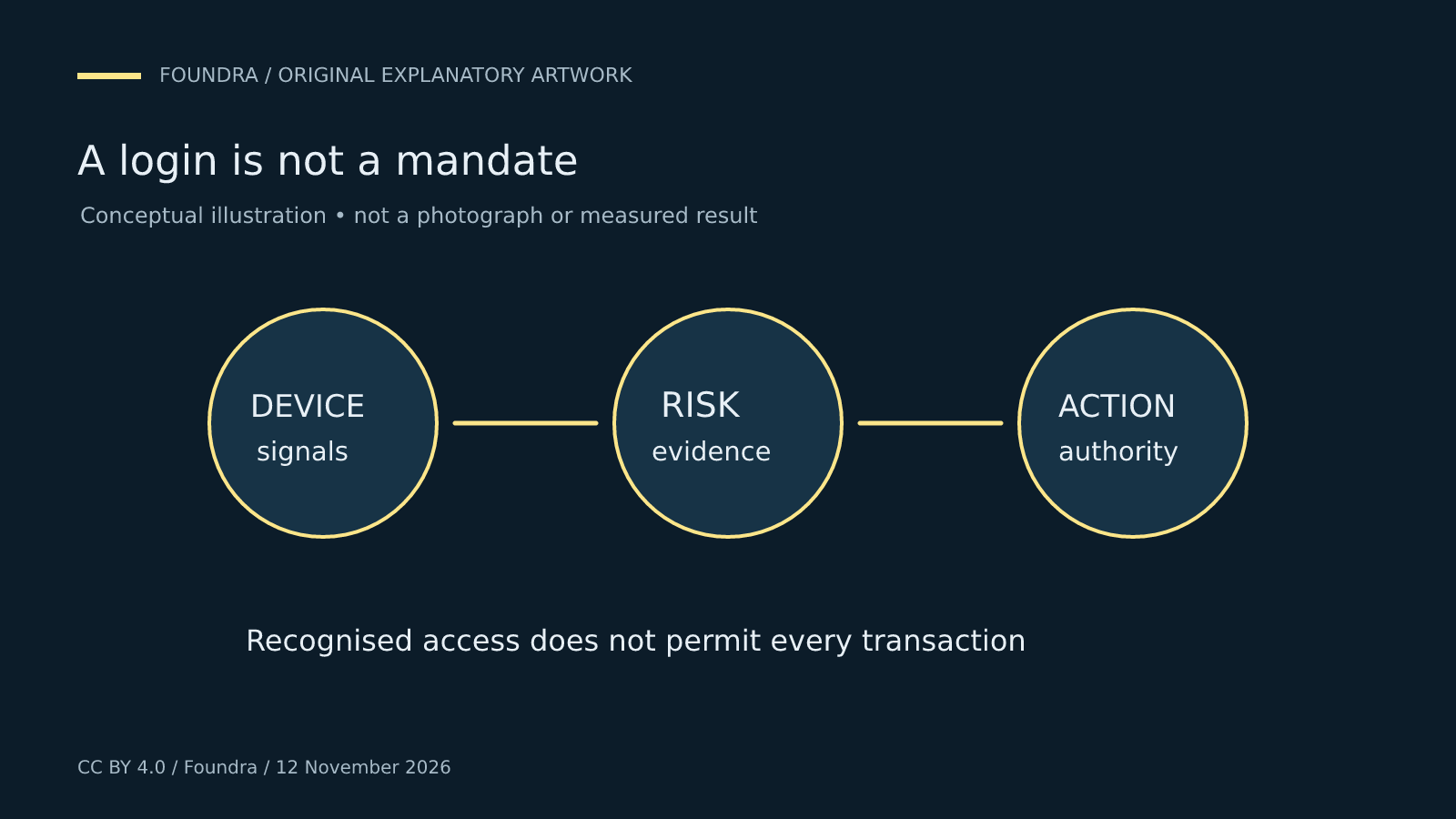
An agent can present valid credentials without having authority for every transaction. Detection, risk assessment and customer permission must remain distinct.
Successful login versus trusted session
Feedzai expanded Digital Trust on November 12 to help banks detect AI agents accessing customer accounts. The announcement centres on stronger device persistence, a risk score informed by network intelligence and cryptographic device binding. The company presents these as foundations for assessing an agent’s session, not just noticing a login.
A successful login and a trustworthy session answer different questions. Credentials can establish access without proving that every subsequent action is intended by the customer. Feedzai explicitly distinguishes customer-chosen agents from malicious ones in its explanation of the problem. Automation itself is not a complete description of authority.
This comparison is the useful way to read the update. It is neither a blanket rejection of personal agents nor independent evidence that the vendor can infer intention perfectly. The announced capabilities are described by Feedzai; no detection benchmark or controlled customer result was verified in this packet.
The product development matters because banks must decide what to do with the evidence available during a session. Identifying that software is involved is one contribution to that decision, not the entire decision.
Device recognition versus customer permission
Feedzai describes persistent recognition of returning activity and cryptographic binding between a customer, a device and a session. It also combines endpoint, behavioural and network signals. These are sources of evidence about the access context. They are not, by themselves, a description of everything a customer has permitted.
The contrast is clearest at the action level. Permission to obtain account information is not automatically permission to make every kind of account change. A system can connect a session to a known device while still needing a separate decision about the scope of an action. This is an explanation of the distinction, not a reported Feedzai deployment or a disclosed bank policy.
The release does not specify how each customer bank records task-specific consent or assigns responsibility for an exception. It therefore cannot support a claim that every permission problem has been resolved by device binding. The new technical signals and the bank’s authority rules have to meet somewhere in the actual workflow.
Keeping that boundary visible also helps readers avoid treating a reassuring identity label as a complete fraud verdict. A signal can be valuable without answering every question asked of it.
Three questions before an agent acts
Identity signals
Which customer, device and session are involved?
Risk evidence
What behaviour and network information raise or lower concern?
Authority
Is this particular action permitted, and who decides when uncertain?
A risk score versus an established outcome
The company says network-informed scoring can reveal evidence a single bank might miss. It also claims the update can reduce unnecessary authentication step-ups, cut authentication costs and strengthen protection against multi-factor authentication bypass. The supplied announcement gives those benefits as vendor claims, not controlled comparisons.
No quantified saving, false-positive rate or proven improvement is assigned here. A score and an outcome should be kept separate: one helps frame a decision, while the other is what happens when a defined policy is applied in practice. Demonstrating the first does not automatically measure the second.
The same separation applies to unwanted-agent blocking and permitted-agent access. A bank’s response has to reflect both the strength of its evidence and the consequence of being wrong. There is no single conclusion about every automated session that follows from the fact that an agent is present.
Feedzai’s expansion is a concrete addition to its Digital Trust proposition. Its significance lies in bringing agent access explicitly into session assessment. The comparison remains: recognise the session, evaluate the risk and establish authority for the action. Those jobs are related, but calling them one thing would make the account less precise.
Sources
- Feedzai — original Digital Trust announcement via PR Newswire ↗ Feedzai — original Digital Trust announcement via PR Newswire · Primary source
Have additional information? Request a correction.