Quest Global announced an acquisition, but has not disclosed a price in its release. Better testing capability is a strategic objective, not a demonstrated outcome of the deal.
The difficult part is where systems meet
A wearable product is not experienced as a collection of engineering departments. A person encounters a device that either responds appropriately or does not. A sensor can work to specification while an application misunderstands its input; software can pass a controlled test while an interaction remains awkward in a different physical setting. Those are hypothetical examples, but they explain why testing is more than a final inspection at the end of development.
Quest Global is adding a specialist in that work. In a release dated November 9, 2026, the engineering-services company announced its acquisition of Tests Assured, a US business focused on quality assurance and technology-enabled testing for immersive products, smart devices, wearables and associated hardware and software. The company describes the transaction as an acquisition, rather than merely an agreement to explore a deal. Its release does not disclose a purchase price.
The announcement puts the emphasis on capabilities in the consumer wearables market. It does not supply evidence that an integrated business has already delivered better customer outcomes. That distinction matters: acquiring expertise and turning it into repeatable improvements across client programmes are different stages of the same strategy.
A specialist inside a larger engineering organisation
According to Quest Global, Tests Assured was founded in 2018 and is headquartered in San Jose, California. The release identifies experience spanning consumer software, AI-enabled products, computer-vision data collection, human-interaction modelling, augmented and virtual reality, smart glasses and biometric validation. These are the seller’s and buyer’s descriptions of the business, not independently audited measures of its performance.
The combination is significant because the problems in that list do not all fit the same testing method. A software defect, a questionable dataset and a confusing human interaction call for different evidence. In an illustrative smart-glasses project, an engineering team might need to examine whether an image-processing component behaves consistently, whether its test data represent the intended use and whether the resulting interaction makes sense to a wearer. Passing one test would not automatically establish the other two.
A specialist can therefore bring more than additional staff. It can contribute judgement about which failure modes should be tested and how evidence should be collected. The acquisition rationale is understandable on that basis. The release does not, however, reveal enough about staffing, contracts or integration plans to calculate the additional delivery capacity Quest Global has obtained.
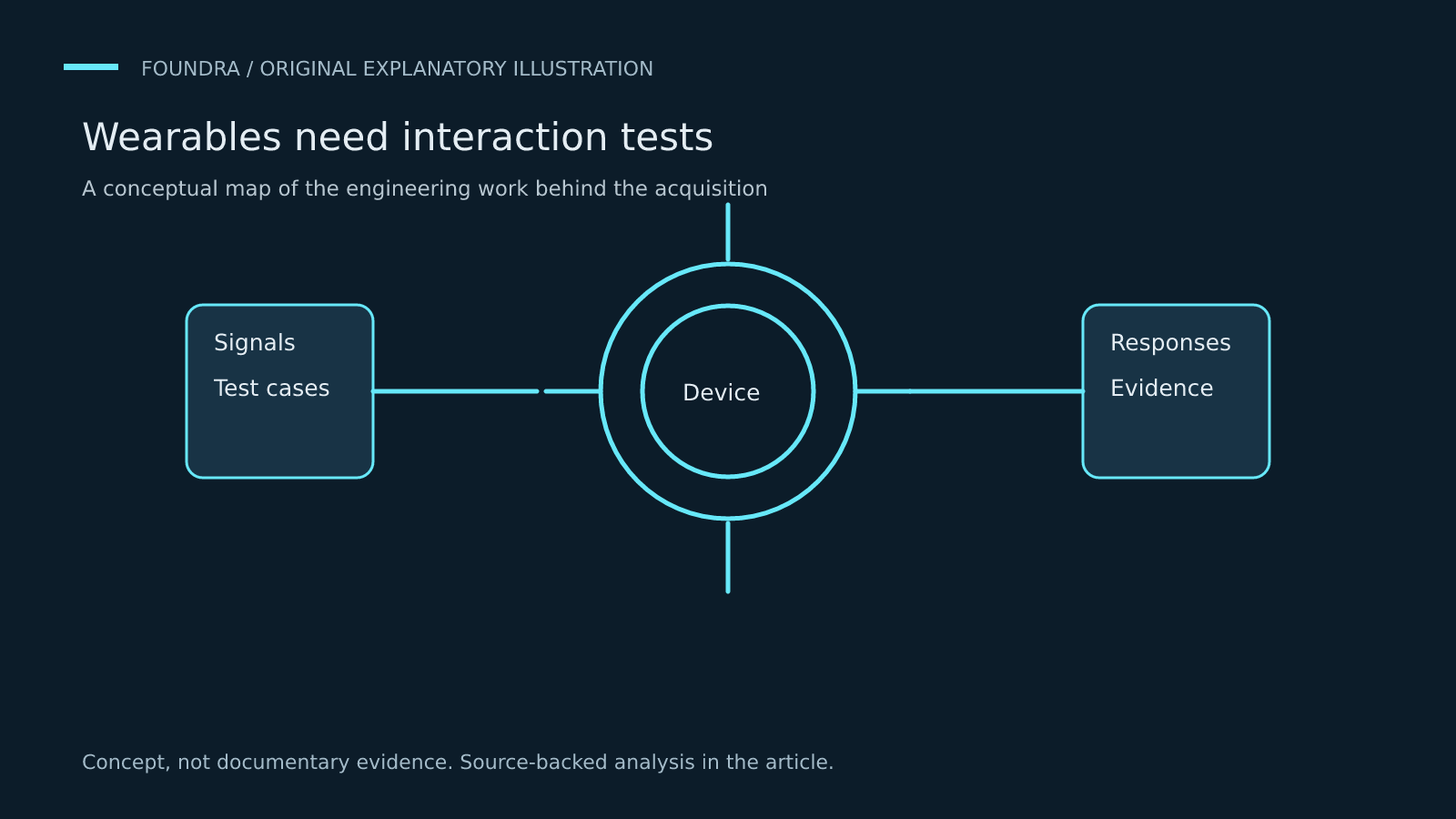
Wearables need interaction tests
Hardware
Sensors and devices
Software
Applications and systems
Human interaction
Movement and perception
What product teams should ask for
For a startup evaluating an engineering partner, the useful question is not whether an acquisition makes the provider larger. It is whether the enlarged team can define and demonstrate the tests that matter for that startup’s product. A proposal should distinguish component checks from end-to-end interactions and explain what happens when those results disagree. This is an analytical recommendation, not a report of a particular Quest Global customer engagement.
Teams should also be clear about the limits of validation. A successful lab test can support a bounded claim about the conditions examined. It cannot by itself establish that a wearable is reliable in every environment or that an AI-enabled feature is safe for every intended user. The same caution applies to biometric validation: the announcement names an area of expertise but does not certify a particular product or model.
StartupTalky’s report describes a delivery footprint including Burlingame, Redmond and New York, as well as teams operating remotely from San Jose. That suggests a distributed organisation rather than one laboratory covering every task. Geography alone does not establish how a client programme will be staffed. It does make responsibility and hand-offs useful questions for the combined business: who collects evidence, who interprets it and who decides that a requirement has been met?
The eventual value of this deal will be easier to judge through concrete evidence: how testing responsibilities are assigned, whether results are traceable to requirements and how issues found late in a programme are resolved. Quest Global has announced the addition of a testing business. The meaningful next step is making that expertise visible in the work clients can inspect.
Sources
- www.questglobal.com — November 9, 2026 ↗ www.questglobal.com — November 9, 2026 · Primary source
- StartupTalky — November 10, 2026 ↗ StartupTalky — November 10, 2026
Have additional information? Request a correction.