Xata says nothing changes for its customers in the short term and that migration will eventually follow. Teams should distinguish the live Postgres service from capabilities still being brought into it.
Code can multiply faster than its test environments
An AI agent can propose a software change without having a safe place to try it. The application’s database may contain state the change depends on, while a developer’s empty local copy contains none of that context. Sharing production data carelessly is not a solution either. This is the practical tension behind ClickHouse’s latest acquisition and database announcement.
On November 9, 2026, ClickHouse announced the general availability of ClickHouse Managed Postgres and the acquisition of Xata. The announcement links the two: the existing Postgres service supplies the transactional foundation, while Xata is intended to add capabilities such as branching, cloning and serverless operation for developers and AI agents. Neither company’s announcement supplies a transaction price.
The important product distinction is between what is generally available and what is being integrated. Xata says it is working to bring branching and an agentic tier to ClickHouse Managed Postgres. It also says nothing changes for Xata customers in the short term, new sign-ups remain open and customers will eventually migrate to the ClickHouse service. That is not the same as saying all Xata capabilities are already present there today.
What a branch changes—and what it does not
Xata describes copy-on-write branching as a way to create independent database environments without duplicating all of the underlying data at the outset. In its account, branches have their own compute and changes in a child branch do not affect the parent database. The company also makes speed and cost claims. Those have not been independently benchmarked for this article and should not be treated as guaranteed results for another workload.
Consider a hypothetical startup testing a change to its order-processing schema. An isolated branch could let a developer examine the migration against representative state without executing it against the live store. An agent could try more than one approach in separate environments. The benefit would be separation of experiments, not permission to skip review before a change reaches production.
Storage isolation also does not settle data governance. If sensitive information appears in a branch, its accessibility still matters. Teams need to decide which records an experimental environment may contain, who can connect to it and how long it should remain available. Branching can make environment creation easier while leaving those policy decisions as important as before.
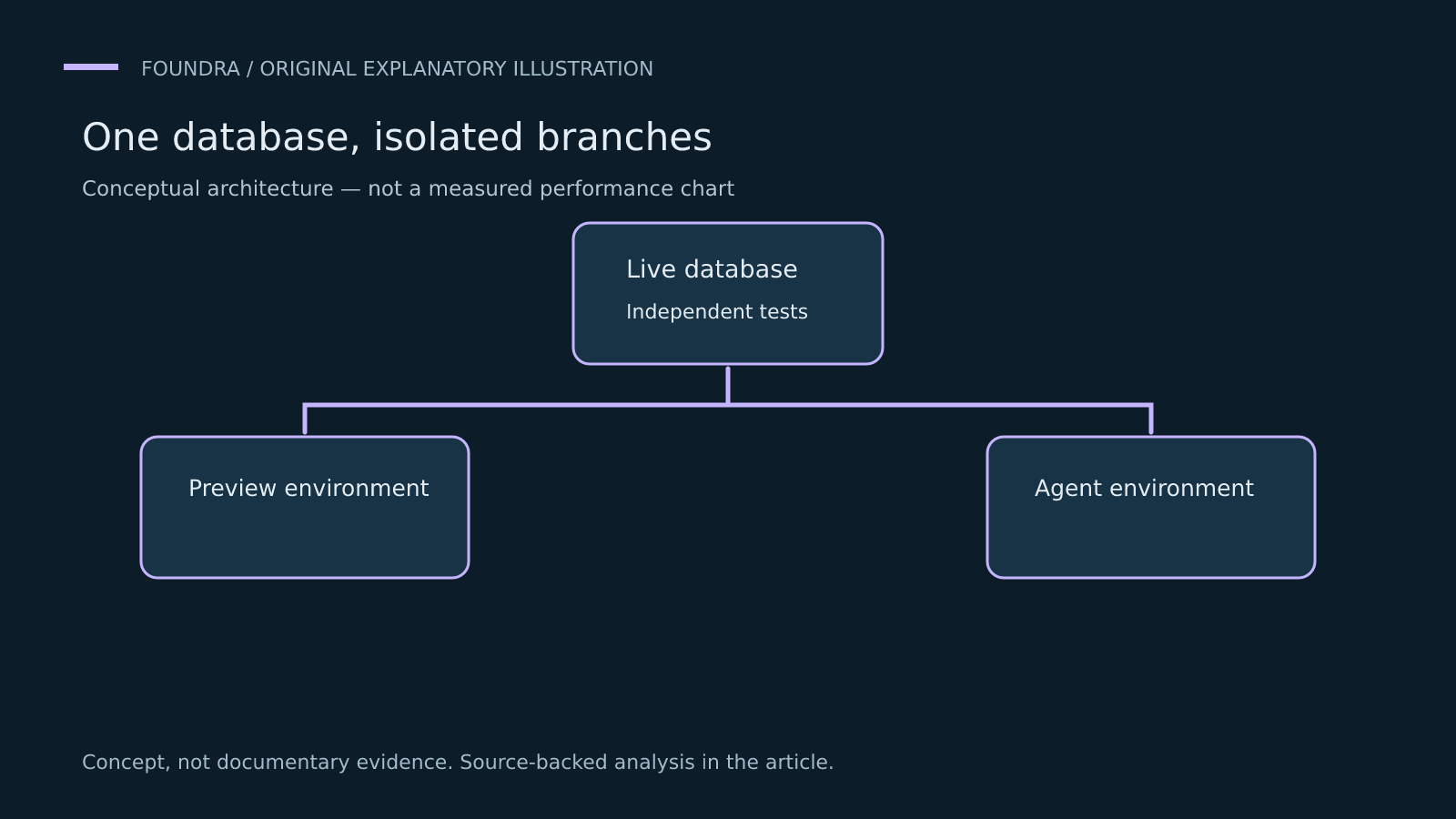
One database, isolated branches
Production
Live transactional work
Preview branch
Test a proposed change
Agent branch
Explore without writing to production
Transactions and analytics remain different jobs
ClickHouse’s announcement describes links between Postgres and its analytical database through native change-data capture and extensions. The strategic proposition is to connect operational data and analytical work without pretending the two are identical. A transactional system must handle the application’s changing state; an analytical system can serve questions over that state. The announcement is a platform direction, not proof that every combined workload will perform better.
For a buyer, a useful comparison begins with a concrete application requirement rather than a vendor’s largest performance multiplier. How are changes captured? What happens when replication falls behind? Which queries belong on which database? These are evaluation questions, not allegations of a fault in the newly available service. Their answers depend on the actual architecture and workload being tested.
Existing Xata customers have an additional question: what an eventual migration will entail for their applications. The current announcement reassures them about the short term but does not provide a detailed universal migration schedule. Planning against a date or a compatibility guarantee that has not been published would go beyond the evidence.
The acquisition thesis is easier to see than its final shape
ClickHouse is bringing together a transactional service, an analytical platform and a business built around flexible database environments. That combination has a coherent rationale for software teams whose experiments increasingly come from both people and agents. It could reduce the friction between proposing a change and testing it responsibly.
Whether it does so will depend on the integrated product rather than the acquisition headline or the number of experiments a team can generate. For now, the most actionable reading is narrow: Managed Postgres has reached general availability; Xata has announced it is joining ClickHouse; branching integration and customer migration are work still described in forward-looking terms.
Sources
- clickhouse.com — November 9, 2026 ↗ clickhouse.com — November 9, 2026 · Primary source
- xata.io — November 9, 2026 ↗ xata.io — November 9, 2026 · Primary source
Have additional information? Request a correction.