Ring has announced two products, not demonstrated universal autonomous protection. The Drone Cam is not yet authorised for sale; the Rover Cam is scheduled to ship in December.
A fixed camera has a fixed view
Putting a camera on a moving device changes a security system’s geometry. Instead of covering one view continuously, it can visit places along a route. But movement also creates a new dependency: the device has to reach the right place, at the right time, under the right rules. A moving camera is not automatically an all-seeing one.
Ring’s November 10, 2026 announcement introduces Ring Drone Cam, a flying indoor camera for homes, and Ring Rover Cam, a purpose-built security robot for businesses. Amazon says both use AI Pilot, a system combining cameras, vision models, on-device sensors and cloud processing to map spaces and navigate. These are manufacturer descriptions; this article does not claim a hands-on test or independently verified navigation performance.
Flight and patrol solve different problems
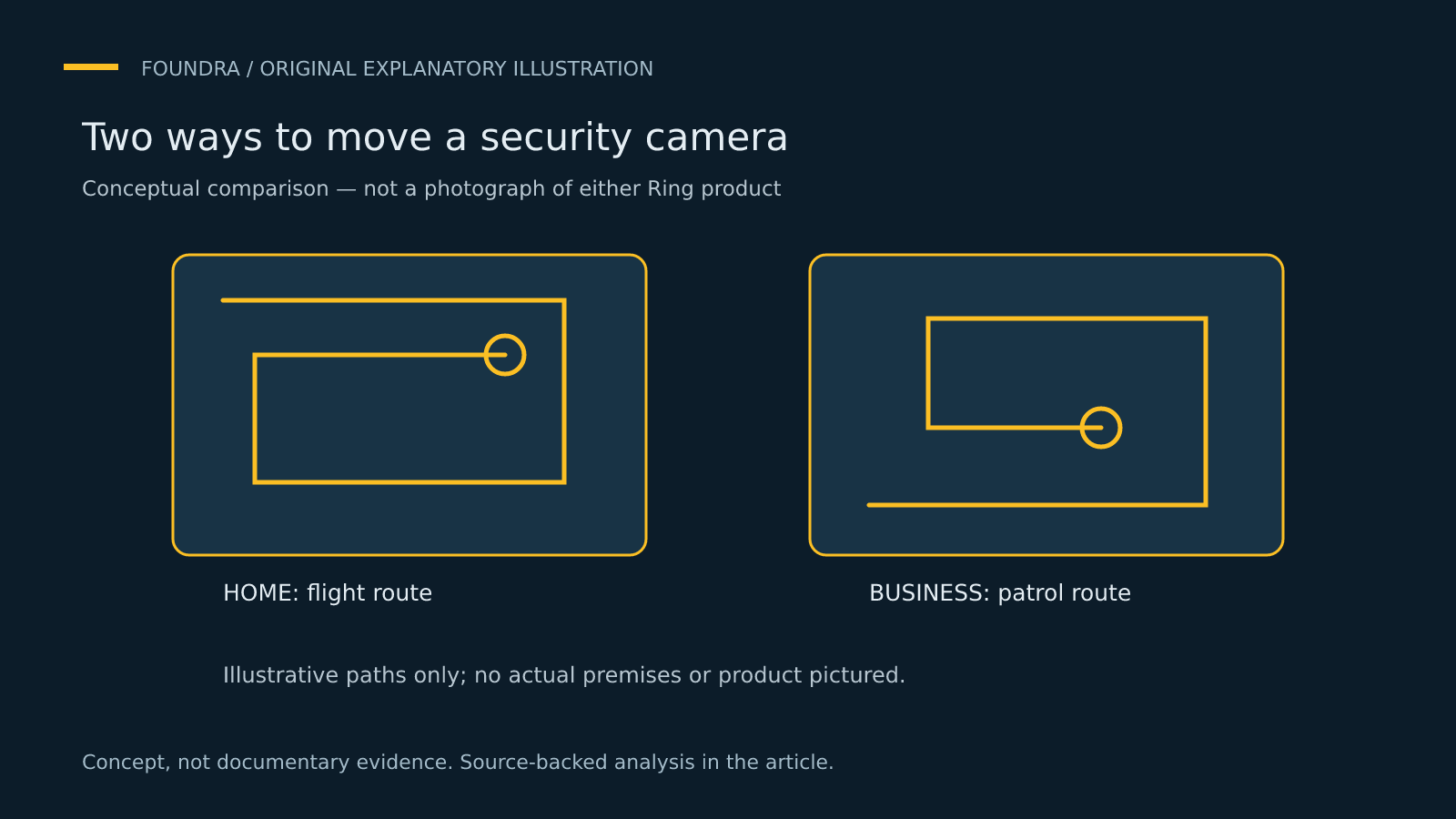
For the Drone Cam, Ring describes custom flight routes, deployment on demand and automatic investigation at preset patrol points when a connected camera, sensor or alarm is triggered. It says the camera offers 2K video and can rotate for a wider view. A route-based flight is conceptually useful when a person wants a temporary look at a location without mounting a permanent camera there. That is an explanation of the design, not proof that it works in every home.
The Rover Cam is positioned for business premises. Ring describes scheduled patrols, a camera mast with adjustable height, a siren and light tower, two-way audio and video streaming and recording at up to 4K while moving or patrolling. It also says the robot can investigate programmed patrol points after another Ring device is triggered. The manufacturer’s emphasis is on extending an existing security system rather than replacing it with a general-purpose household robot.
A hypothetical shop illustrates the difference. An elevated ground camera could examine a counter or storage area on a planned route; a flying camera could visit an indoor point from a dock. Neither example establishes that a particular floor plan is suitable. Obstructions, changing layouts and the ability to observe the relevant area should be evaluated against the actual product’s operating requirements.
Two ways to move a security camera
Indoor flight
Home route and dock
Ground patrol
Business route and sensors
Human oversight
Permissions and review
The calendar is not a footnote
Ring lists future US shipping dates: December 16, 2026 for the Rover Cam at $999.99, and January 27, 2027 for the Drone Cam at $249.99. Those are the company’s scheduled dates and stated prices, not evidence of completed customer shipments. The distinction is particularly important for the drone.
The same announcement says the Drone Cam has not received the authorisation required by Federal Communications Commission rules. It states that the device may not be offered for sale or lease, or sold or leased, until authorisation is obtained. A future shipping target therefore should not be presented as unconditional current availability. Ring links to email updates for the drone, while it offers a preorder link for the Rover Cam.
Ring also marks certain scheduled-patrol and recording features as requiring a compatible Ring Protect plan. Buyers should separate the hardware price from the requirements for the features they intend to use. The announcement does not justify assuming that every described function comes with the device without an additional compatible plan.
More coverage requires clearer boundaries
The manufacturer says the drone’s camera is off while it is docked. For the Rover, it describes a Sleep Mode that retracts the periscope and turns off the microphone, along with recording indicators. Ring also describes its Throw Away the Key encryption as the default protection for videos. These are announced product provisions, not an independent privacy or security audit.
The broader question is who decides where a device can look. A mobile camera can cross boundaries a fixed installation makes obvious. In a hypothetical workplace deployment, a responsible operator would define patrol areas, communicate recording practices and review access permissions before treating mobility as a pure benefit. The fact that a machine can navigate does not resolve those decisions.
Ring’s comparison is ultimately between two specialised ways to gather a closer view. The products could make parts of an existing security system more flexible. The evidence today supports an announcement, a feature description and a conditional availability timeline—not a conclusion that autonomous cameras prevent incidents or remove the need for human oversight.
Sources
- www.aboutamazon.com — November 10, 2026 ↗ www.aboutamazon.com — November 10, 2026 · Primary source
- TechCrunch — November 10, 2026 ↗ TechCrunch — November 10, 2026
Have additional information? Request a correction.