The $625 million cash acquisition remains a definitive agreement, not a verified close. The current partnership and reported June app integration must not be confused with universal availability or established clinical benefit.
New ownership is the proposal—not the first care interaction
Oura has entered into a definitive agreement to acquire Counsel Health, with the November 10 release describing $625 million in cash for the transaction. The companies are already working together. The acquisition announcement is therefore not the starting point of every interaction between Oura’s biometric information, Counsel’s medical AI and a human physician.
That distinction changes the story.
The official release explicitly describes the existing partnership and Oura members already using Counsel. TechCrunch’s original November 10 report says Counsel’s service was integrated into the Oura app in June. The month is attributed to that report; the primary release independently supports the fact that the relationship and member use predate the proposed acquisition.
The transaction is still an agreement. Neither the existing partnership nor the announcement’s welcoming language establishes that the acquisition has closed. This article does not adopt a closing timetable: the supplied primary and secondary sources give conflicting timing descriptions. It reports the agreement and the existing relationship without pretending that those different milestones are interchangeable.
What is already described
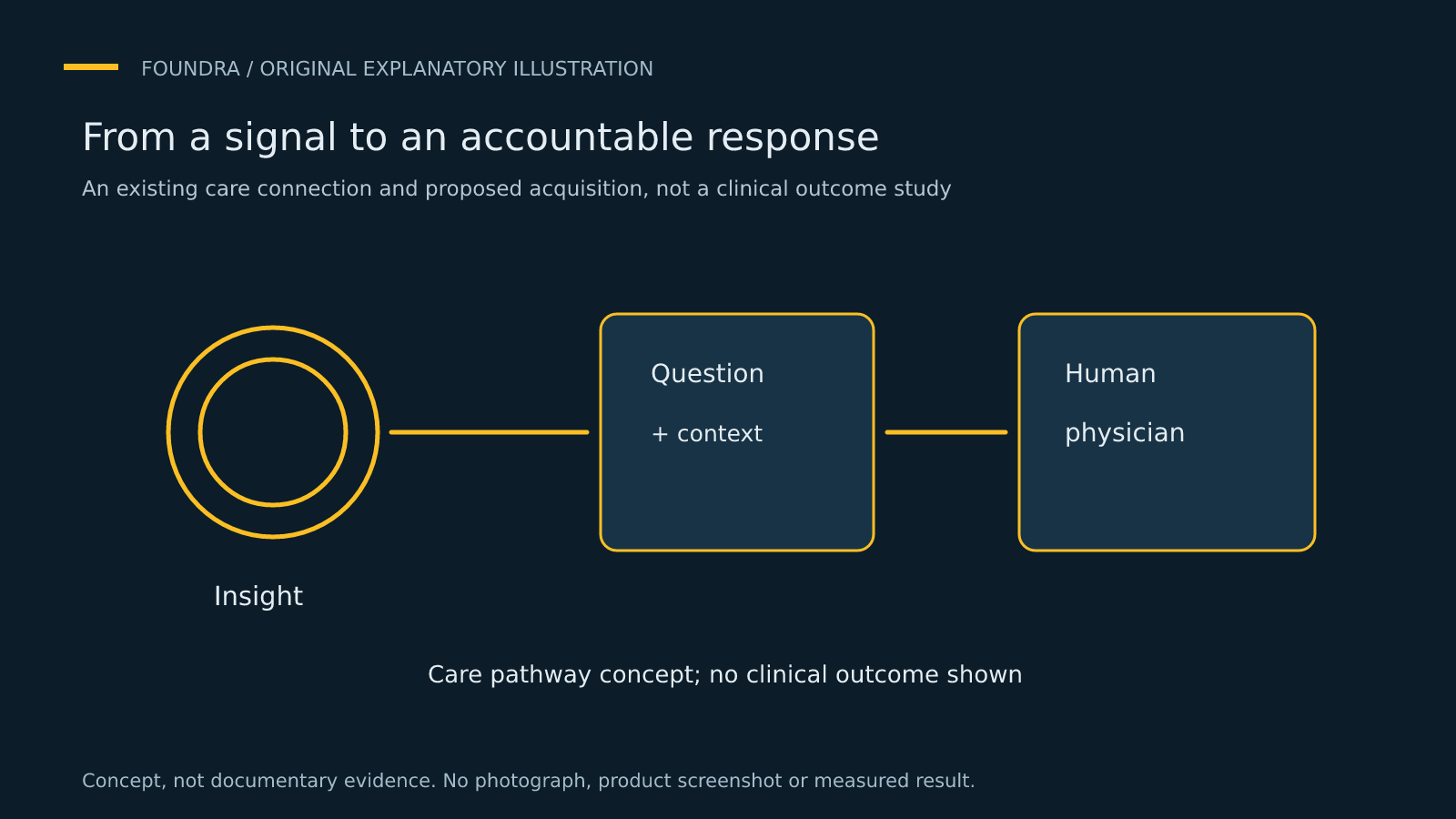
Counsel’s published release describes an Oura member beginning with an insight or a medical question, interacting with medical AI and escalating to a Counsel physician when needed. It also describes service through enterprise relationships, including health plans, health systems, consumer-health organizations and employers. These are the company’s descriptions of the service, not evidence that every member or every patient in every location has identical access.
The release presents feedback from members who have used Counsel, including a reported care-experience rating of 4.6 out of 5 among members who saw a Counsel physician. That is a company-reported satisfaction measure for a stated group. It is not an independently assessed clinical outcome, and the supplied release does not establish a representative rating for all Oura members.
The fact that some members are already using the combination matters even when those limits remain. It would be misleading to frame all integrated care as a future product that has yet to exist. It would be equally misleading to use existing participation as proof of universal availability or medical benefit. The evidence supports a present service relationship with a proposed expansion, not either extreme.
From a signal to an accountable response
Biometric insight
An Oura insight is an input, not a diagnosis.
Medical question
The release describes an existing medical-AI care partnership.
Physician involvement
The service includes human physicians; access and clinical outcomes need separate evidence.
What the acquisition is intended to add
The companies describe the proposed acquisition as a way to build on the partnership and advance a more connected, personalized model of care. Counsel is also expected to continue serving enterprise partners after the acquisition. These statements set out the intended business direction. They do not certify how many new patients, contracts or service locations the transaction will add.
Ownership and partnership can give companies different ways to organize a product. A partnership connects separately owned businesses through agreed arrangements. An acquisition, if completed, changes the corporate relationship itself. That distinction can be strategically important without implying that the customer interface must become wholly new on the day ownership changes.
For users, the relevant comparison is consequently between the care experience already described and any changes actually delivered later. A proposed broader offering is not evidence that the existing one was absent. Nor should the existing offering be presented as a guarantee that every expansion will inherit the same coverage or conditions. The release does not settle those questions for every individual.
Information, interpretation and care remain different layers
The product still joins activities with different purposes. Oura supplies biometric information and insights. Counsel’s medical-AI interaction interprets a question and available context. Human physicians participate in care. A convenient connection between those activities does not make a wearable insight a diagnosis or make an AI explanation equivalent to a physician’s assessment.
This is why satisfaction, access and health outcomes should be reported separately. A member can value an easier way to ask a question without the rating establishing that a medical outcome improved. A service can be available to a specified group without establishing access for everyone else. And a transaction can be strategically coherent without proving either type of benefit.
The distinction is not an argument that the combination lacks value. It is a way to describe the value the evidence actually supports. The existing relationship shows that the companies are not beginning with a blank product canvas. The agreement signals a larger corporate commitment. Evidence of clinical results would answer another question and should not be inferred from either fact.
The cash price and the customer experience should not collapse into one headline
The stated $625 million cash consideration attaches to a proposed business acquisition. It is not a measure of the quality of a medical interaction. The price and the existing partnership together explain why this is more than an announcement of a new chat feature, but they do not provide a clinical comparison or verify that an integration has reached every intended user.
The accurate account therefore holds three facts in view at once: Oura and Counsel already have a care relationship, Oura has now agreed to buy the company, and the promised expansion remains distinct from demonstrated outcomes. For a user, the useful starting point is the service and access that actually exist—not a false suggestion that the acquisition creates the first connection, and not an assurance that a proposed deal has already delivered everything it describes.
Sources
- www.counselhealth.com — November 10, 2026 ↗ www.counselhealth.com — November 10, 2026 · Primary source
- TechCrunch — November 10, 2026 ↗ TechCrunch — November 10, 2026
Have additional information? Request a correction.