Plurai’s launch and announced seed financing are verified from its original release. Automated fixes, better reliability and lower costs remain vendor propositions rather than independently demonstrated production outcomes.
A simulation business starts with an operating environment
Plurai announced its simulation product and a $13 million seed round led by Team8 on November 11. Its release frames the founders’ route into the business through work on autonomous-driving AI, where simulated situations can be used to examine behavior before a system encounters those conditions outside the test environment.
That background is the company’s account, not reporting from a Foundra interview.
The launch of Plurai simulation carries that idea into software agents. The company says it creates a digital representation of an agent and its environment from enterprise knowledge, tools and policies. It then populates that environment with simulated users and cases designed to expose failures. The operating environment is a central part of the proposition, not a background detail around a prompt.
Four dependencies inside one test
An agent’s tools determine which actions it can attempt. Knowledge sources affect the information it can use. Policies define boundaries around permitted behavior. A user’s requests and responses determine the path through a task. Plurai’s model of the agent’s world is intended to bring those dependencies into a controllable setting. The release supports reporting that design claim; it does not establish that every customer’s environment can be represented faithfully.
This distinguishes a simulation proposition from merely generating more questions. If a test environment makes every tool response complete and every permission uncomplicated, a large test suite can still miss consequential conditions. The useful measure is not only how much activity the test produces, but which dependencies it exercises. That is an analytical distinction, not a finding from a test of Plurai’s service.
A simulated user can also be relevant to correctness. The same opening request may lead to a different task after a clarification or an unexpected reply. An agent that answers one isolated question successfully has not necessarily handled the complete interaction. No particular failing customer conversation is reported here; the point is that the interaction, rather than only the opening text, can be the unit of evaluation.
The company says its system can identify policy violations, hallucinations, incorrect actions, broken tool calls, failed tasks and sensitive-data leaks. These are vendor-described failure categories. They should not be read as a guarantee that every such failure will be detected or that a successful simulation certifies production safety.
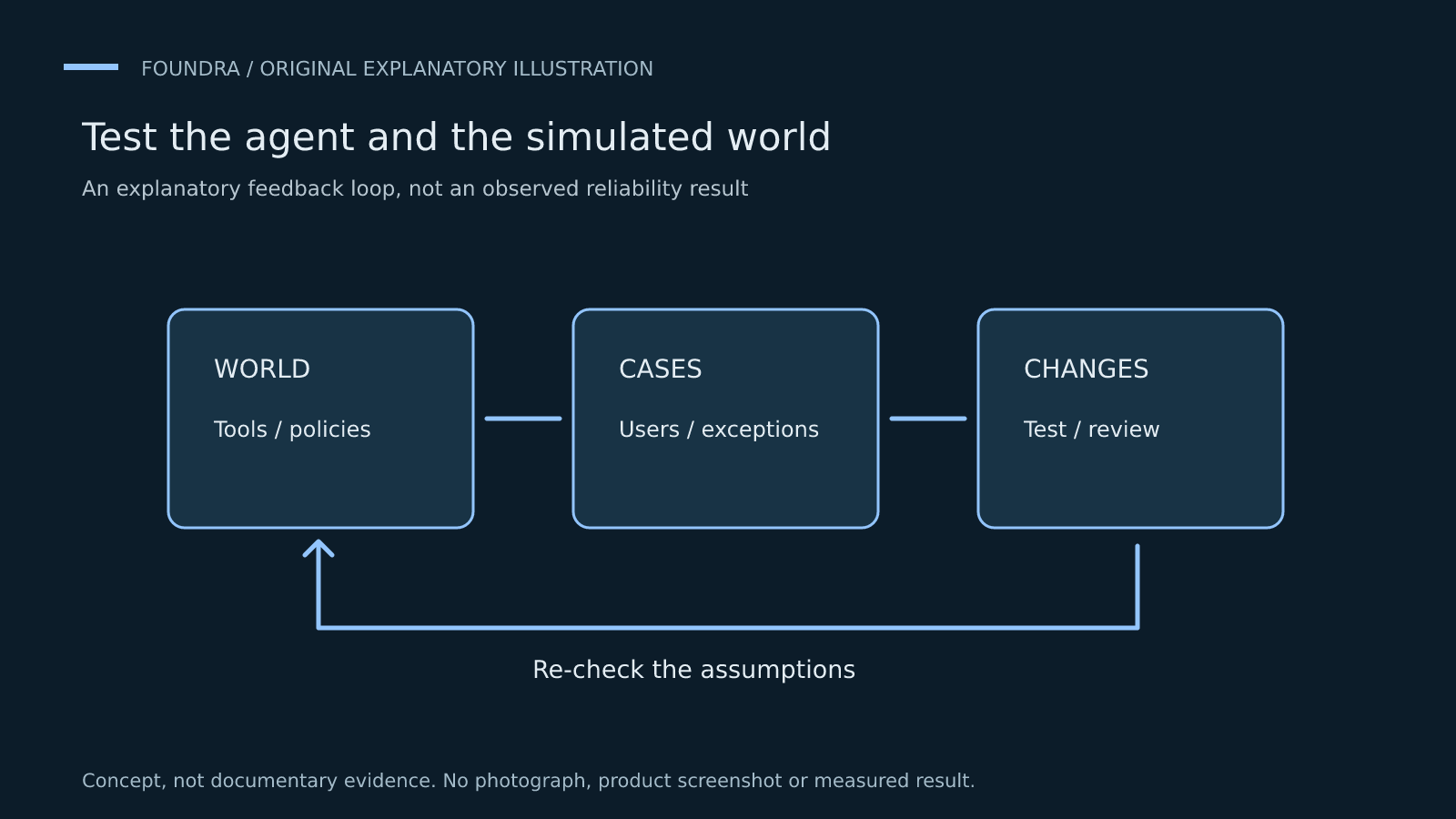
Test the agent and the simulated world
Model the workflow
Represent tools, knowledge and policies.
Exercise difficult cases
Vary users and conditions to expose failures.
Review changes
A proposed repair needs testing outside the case that produced it.
Finding a failure is different from accepting a repair
Plurai says the simulation explains failures and generates fixes. That adds a second job to the product. Detecting a problem asks what went wrong under specified conditions; generating a repair asks what should change. Accepting that repair requires another judgment about what the change does beyond the case that produced it.
The feedback loop is consequently the important part to examine. A proposed change could address one condition while altering behavior elsewhere. Retaining the original failure, exercising the proposed fix and checking related cases would make the change reviewable. Those are evaluation criteria for a buyer, not results Foundra has independently obtained from the product.
Environment changes make this a recurring problem. Updated policies, different tools and new requests can alter the task without changing the underlying model. An old simulation can remain internally consistent while becoming less representative of current operations. The provenance and freshness of the environment therefore matter alongside the behavior of the agent inside it.
The release positions simulation as the beginning of a broader self-improvement layer. That is a product ambition. The $13 million round funds development of the business; it does not establish a universal reliability gain or a measured reduction in total operating cost. No benchmark from the launch announcement is converted into an independently verified production result here.
The launch is aimed at builders’ existing tools
The original announcement says builders can start with the service for free through tools including Claude Code, Codex and GitHub Copilot, and can bring agents built on enterprise platforms such as Salesforce Agentforce. These are launch availability and compatibility statements from Plurai, not an independent certification of every configuration. The statement does not establish that all future usage or all product tiers will remain free.
The seed round is announced as raised capital, with Team8 leading. The immediate product event is the availability of the simulation proposition, not a demonstrated end to agent failures. Its distinctive claim is that builders can work on both the agent and the world used to test it. That creates a concrete buying question: does the simulated environment expose conditions the team would otherwise miss, while leaving the resulting changes intelligible to the people responsible for the agent?
Sources
- www.plurai.ai — November 11, 2026 ↗ www.plurai.ai — November 11, 2026 · Primary source
- TechCrunch — November 11, 2026 ↗ TechCrunch — November 11, 2026
Have additional information? Request a correction.