Torus announces secured growth capital and a product launch. Capacity and delivery figures are company specifications and targets, not independently observed deployments or a verified equity-only Series C.
One launch, three ways to buy capacity
Torus’s November 11 release announces Foundry, modular AI infrastructure, alongside $500 million in growth capital led by Magnetar. The company is selling more than one commercial configuration: a powered shell without GPUs, a bare-metal unit that includes GPUs, and dedicated inference capacity supplied directly to an enterprise customer.
Those are three different buying decisions, not three prices for an identical product.
The release’s labels are Strategic, Partner and Direct. The first centers on power and enclosure; the second adds compute hardware; the third offers company-described sovereign inference capacity with single-tenant hardware allocated to the customer’s workload. This article reports the configurations as Torus describes them, without certifying a legal sovereignty standard or a customer’s regulatory compliance.
The siting argument comes before the enclosure
The founder’s accompanying explanation argues for bringing compute to power already available, rather than beginning with a new campus and waiting for additional grid infrastructure. The product release describes installation behind the meter, using existing interconnections and available headroom at individual transformers. These are the company’s design and siting claims, not an independent survey of available capacity.
Torus says Foundry packages power, storage, cooling, networking and compute into a prefabricated system. It describes one to twenty megawatts per site and twelve to sixteen weeks from contract to running workloads. Those figures belong to the issuer’s product proposition. They do not establish that every location is suitable or that every customer deployment has achieved the timetable.
This is where the company’s storage and control business enters the compute story. Every Foundry is paired with Torus Reserve, according to the release. Reserve’s stated capabilities include load shaping, curtailment and ramp-rate support. The architecture is intended to manage how power is used, not simply assume that nominal connection capacity is always freely available.
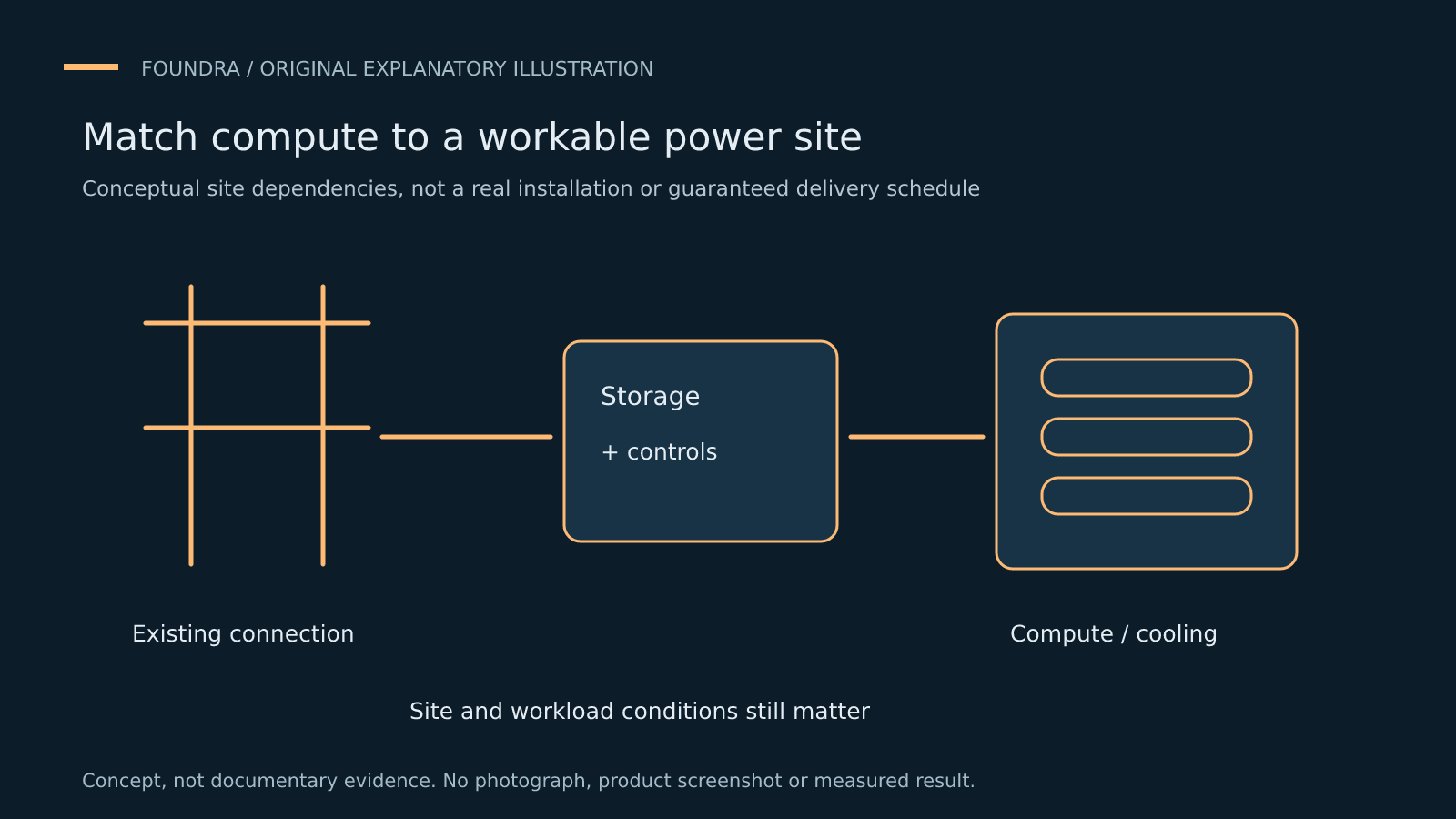
Match compute to a workable power site
Existing power connection
Assess what capacity is actually usable at the site.
Storage and load controls
The company pairs Foundry with Torus Reserve.
Modular compute
A prefabricated system still requires site-specific deployment work.
The three models distribute different responsibilities
A powered shell leaves the customer with a compute-hardware decision that the bare-metal offering includes. Dedicated inference capacity describes another relationship again: the customer is buying capacity allocated to its workload rather than the same set of physical components as the shell. The exact contracts are not supplied, but the configuration differences are clear enough to avoid treating all three offerings as interchangeable.
For a prospective buyer, the comparison should begin with what it already operates and what responsibility it wants to retain. A customer supplying its own compute equipment would need to understand the boundary between that equipment and the provided power/enclosure system. A customer choosing the fuller hardware package would be evaluating another boundary. These are analytical implications of the disclosed configurations, not additional contractual terms.
The release describes Torus as providing ongoing operations and maintenance and integrating networking and security through Torus Protect. A single-provider proposition can simplify the way a customer organizes an infrastructure purchase. It does not remove the need to identify the service boundary, operating conditions and obligations in the actual agreement.
The interaction between load management and the workload remains important in each case. The ability to adjust power demand is not proof that every application can tolerate an adjustment without consequence. A useful implementation account would distinguish the flexibility of the infrastructure from the service conditions of the workload. No particular Torus deployment failure is alleged here.
There is an existing-deployment claim, and a larger target
Torus says thousands of GPUs are already deployed in Foundry units and states a plan for more than 47,000 by the end of 2027. The first is a vendor claim about current deployments; the second is a forward-looking target. Neither is an independently verified fleet count in this article.
Acknowledging the current claim is important. The release does not present Foundry solely as a drawing of future hardware. But a launch statement containing a deployment figure is still different from a readback of individual customer sites, service quality or total cost. The evidence supports attributing the company’s claim, not certifying every installation.
The distinction also keeps the delivery proposition precise. A prefabricated system can move some work into manufacturing, while the actual site still has to meet the requirements of deployment. Torus names GigaOne in Salt Lake City as its manufacturing facility. Its release does not supply a controlled comparison showing that all site dependencies disappear.
Growth capital for an integrated infrastructure business
The $500 million is described as secured growth capital, with the company saying it will support expansion of GigaOne and Reserve and Foundry deployments in the United States. The supplied release does not establish an equity-only Series C, so this article does not add that narrower classification.
The business bet is the integration of capacity, power management and delivery responsibility. Its commercial models let buyers choose different portions of that stack. That is more informative than treating Foundry only as a container or the financing only as an AI funding total. The announcement makes the proposition visible; costs, service quality and deployment counts remain claims or outcomes to assess at their proper evidence boundaries.
Sources
- www.torus.co — November 11, 2026 ↗ www.torus.co — November 11, 2026 · Primary source
- www.torus.co — November 11, 2026 ↗ www.torus.co — November 11, 2026 · Primary source
Have additional information? Request a correction.