Sumary says the $25 million seed round has been raised. Customer names and time-saving figures in its release remain company statements; this article does not certify deployment scope, accounting accuracy or measured savings.
From a handful of firms to a larger seed round
A year ago, Sumary says, it was a small team working with a handful of accounting firms after a pre-seed round. Sumary’s November 10 announcement describes a different stage: a $25 million seed round led by Singular, with byFounders, Partech and Tenity returning. That is the company’s account of its progression, not a scene reconstructed from founder interviews.
The release says the financing has been raised. It also names Deloitte, Grant Thornton and Baker Tilly among firms it works with. Those names are attributed to Sumary; they do not establish the scope of every relationship or organization-wide adoption. The announcement does not provide this article with contracts, independently audited customer figures or an exact valuation.
What links the earlier firms and the new round is a recurring workflow proposition. Sumary says its software prepares accounting work for review and sign-off. It is not presenting the accountant’s signature as an unnecessary step. The usefulness of the preparation depends partly on whether the reviewer can understand the work arriving at that boundary.
The ledger stays, while another layer organizes the work
The company’s product description says the platform sits over existing ledgers. Its release describes month-end work, VAT-return preparation and year-end tasks across clients using different accounting systems. This is a vendor description of the intended operating model, not certification that every configuration works without integration or review effort.
That positioning is relevant to a practice whose clients do not all use one system. Replacing every ledger and organizing work across ledgers are different product propositions. The latter can be attractive because it leaves existing systems in place. It also makes the interpretation of records across those systems an important part of the software, rather than a problem that disappears.
Sumary says accountants can ask questions across financial statements and trace answers to underlying transactions. A trace helps a reviewer inspect an answer. It does not make the interpretation correct by definition. The distinction is important in accounting because an intelligible link to a record and an appropriate treatment of that record are separate things to assess.
The release specifically names the profit-and-loss statement, balance sheet and cash flow as material the platform reasons across. That is a broader claim than preparing one recurring filing. It describes another use of the same underlying records: helping an accountant explore how different parts of a client’s finances relate. An answer still needs to preserve that relationship rather than make one transaction appear to explain the whole business.
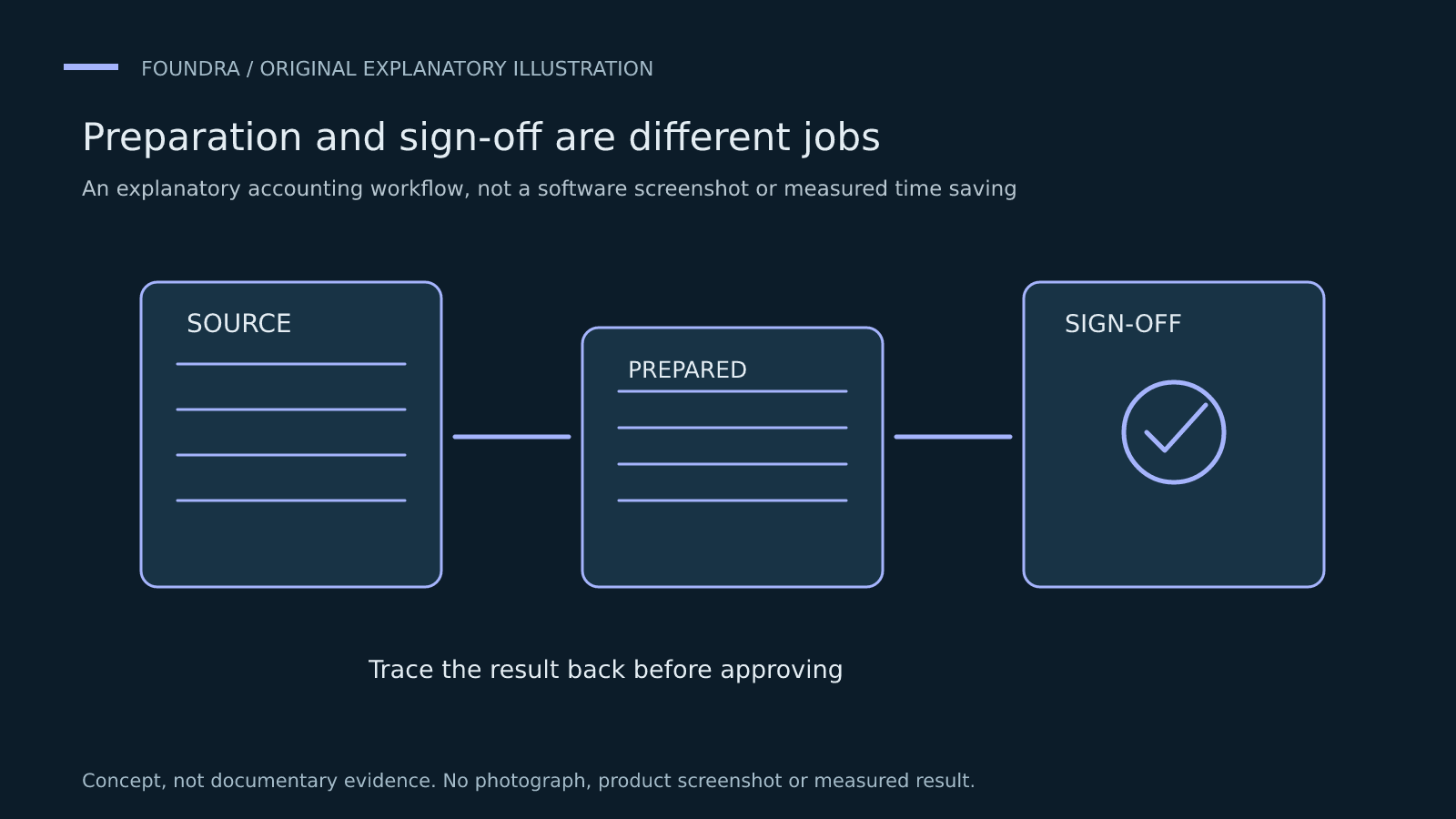
Preparation and sign-off are different jobs
Ledger evidence
Retain the source transactions and context.
Prepared work
The company describes AI-assisted workflow preparation.
Accountant review
A reviewer must be able to inspect and challenge the result.
Prepared is not the same as approved
The product’s human-signoff claim gives it a specific standard to meet. A reviewer needs more than a polished pack: the work should make consequential assumptions and exceptions discoverable. If the person approving a result cannot recover why it was prepared that way, responsibility exists on paper without enough information to exercise it well.
A system could therefore save preparation time while shifting effort into review. This is a general workflow possibility, not a reported Sumary customer experience. It is why total effort matters more than the speed of one stage in isolation. A practice assessing the product would want to include inspection and correction, rather than counting only how quickly a draft appears.
The release claims firms save more than half the time previously spent on the described work. That is a Sumary statement, not an independently reproduced result. Its meaning depends on tasks, baseline and included review effort. The same figure should not be treated as a guaranteed outcome for every practice or every client engagement.
What the $25 million makes possible—and what it does not prove
The round gives Sumary resources to bring its platform to more accountants, the company says. Capital can support development and distribution, but the fundraising event itself does not demonstrate accounting accuracy, universal compatibility or a reduction in client risk. Those questions remain attached to the actual work and the evidence supporting it.
The story is consequently not that a chat interface has replaced an accounting practice. It is that a startup with an attributed account of early customer work has raised a larger round for a preparation-and-review layer over existing systems. If the proposition works, the accountant’s role becomes more focused on interpretation without losing the ability to inspect the preparation. The signature remains meaningful only when the work behind it can be challenged.
Sources
- sumary.com — November 10, 2026 ↗ sumary.com — November 10, 2026 · Primary source
- Sumary — undated product description; read November 11, 2026 ↗ Sumary — undated product description; read November 11, 2026 · Primary source
Have additional information? Request a correction.