Metalenz announces the acquisition and does not disclose transaction terms. Its imaging and efficiency claims remain company claims, not independently tested results for a shipping combined product.
An optics company adds another kind of input
Metalenz announced its acquisition of PxE Imaging on November 11. The Israeli startup’s technology is described as capturing visible information and depth together through standard image sensors. Metalenz is positioning the deal as an expansion of its perception platform into additional consumer and machine-vision applications.
The transaction terms were not disclosed.
That short financial disclosure sits beside a much larger technical argument. Metalenz is not presenting the acquisition merely as a way to increase image resolution. It is describing additional kinds of physical information entering the system before software interprets the scene. The distinction matters: more pixels describing the same input and a new channel of information are different product changes.
The platform has a history before this deal
The company’s release says Metalenz spun out of Harvard University in 2016 and has shipped more than 300 million metasurface optics in consumer devices. That shipment figure is an issuer statement, not a manufacturing count independently audited by Foundra. It nonetheless explains the company’s own positioning: a business with a claimed volume-manufacturing record is adding another perception capability to its platform.
Metalenz describes its passive perception approach as integrating technology with CMOS image sensors. The release also describes its PolarEyes platform as capturing polarization information, which the company says can help vision systems distinguish materials. PxE contributes a different proposition, centered on visible imaging and depth. The acquisition brings these capabilities under one corporate roof; the announcement does not establish that every capability is already combined in one finished product.
The product question is consequently about combinations. A customer might need one kind of information for an image and another for a machine’s interpretation of its surroundings. A platform can be valuable because it offers appropriate combinations, not because every application must use the largest possible bundle. This is analysis of the architecture proposition, not a claim about configurations currently available to buy.
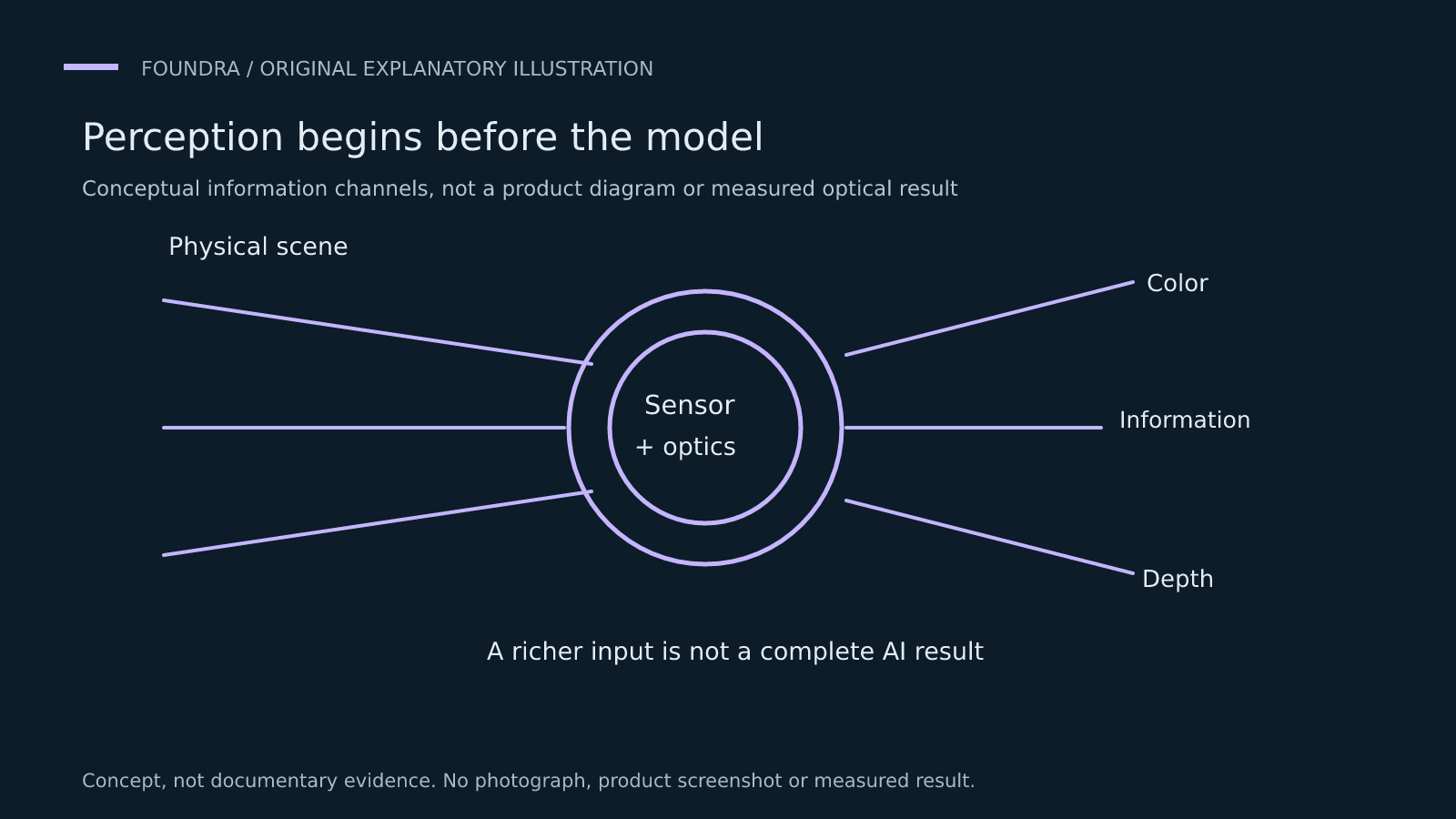
Perception begins before the model
Visible information
The source describes new ways to capture color.
Depth information
PxE’s approach is described as capturing depth alongside visible data.
Model interpretation
More input information still needs an appropriate interpretation system.
What the light figure does—and does not—say
Metalenz’s release says PxE’s method brings 2.5 times more light to the sensor while capturing visible and depth information simultaneously. That is the company’s stated technical comparison. It is not a published independent benchmark of a complete phone, and it should not be renamed a universal improvement in the quality of every photograph.
The measurement boundary matters. Light reaching the sensor describes one part of an imaging process. A finished image also reflects how the captured information is processed and which conditions the system must handle. The original release supplies an optical proposition; it does not supply a controlled comparison of all those later stages across consumer devices.
This does not make the optical claim irrelevant. It makes its meaning more precise. A hardware change can create room for a different design choice, while the manufacturer of the final device still has to determine how that room is used. A number at the sensor boundary is useful evidence about that boundary when the reference conditions are known. It is not a substitute for evaluating the finished application.
The announcement also argues that richer sensor-integrated input can reduce computational work downstream. Again, the claimed effect belongs to Metalenz. No complete-system power measurement is independently established here. An eventual customer comparison would need to count both what computation is removed and what sensing, calibration or processing is introduced.
The camera and the model solve different problems
A vision model interprets the information it receives. It can estimate properties that are not directly represented in an image, but an estimate and an additional captured signal are not interchangeable. PxE’s described depth capability is therefore relevant to the model’s input problem, rather than simply a promise that the software will reason more successfully with an unchanged picture.
The release identifies potential applications in consumer imaging, autonomous driving and machine vision. Those are application areas named by the issuer, not independently verified customer deployments of the combined technology. Their requirements can differ substantially. An image pleasing to a person and a signal useful to a machine’s particular task should not automatically be judged by the same criterion.
That difference affects product communication. A provider needs to explain what each data channel represents, what it does not represent and which conditions affect interpretation. More input can make a task easier, but it can also require software to handle distinctions that were absent from a simpler interface. The commercial product includes that interface and its limits, not only the optical component.
The same reasoning applies to a platform acquisition. Bringing capabilities together organizationally can make it easier to develop a coherent offering. It does not erase the work of deciding how components interact or how an application developer uses the result. The release describes the strategic direction; it does not disclose an integration deadline or a quantified revenue contribution.
A different place to look for progress
The AI significance of this deal sits upstream of the model. Metalenz is buying another way to observe a scene, with the aim of making its perception platform useful in more settings. That is a distinct route to capability from changing a model’s size or prompt. It asks what information the system can acquire in the first place.
The acquisition itself is the verified business event. The quality of any combined application remains an application-specific question. Keeping those statements separate lets the hardware story stand on its own: a platform can become strategically broader before a particular product has demonstrated a complete-system gain. The sensor is not the whole intelligence stack, but neither is it merely a passive opening through which an AI system looks.
Sources
- metalenz.com — November 11, 2026 ↗ metalenz.com — November 11, 2026 · Primary source
- WIRED — November 11, 2026 ↗ WIRED — November 11, 2026
Have additional information? Request a correction.