The declaration supports reporting a shared policy agenda. It does not establish a newly enacted law, a mandatory global certification scheme or proof that signatories have already delivered every commitment.
Who signed, and what the document is
Six governments, ten AI companies and four civil-society organizations are listed in Canada’s published account of the Paris call for AI safety and security. The statement displays November 9 and Ottawa, Ontario, and says the declaration was signed on Monday, November 9. It remains open to further endorsements and updates.
The governments listed are Bahrain, Canada, Finland, France, Norway and the Netherlands. Company signatories include Cohere, Hugging Face, Anthropic, Microsoft, Mistral AI and OpenAI. Their presence establishes support for the declaration; it does not certify the safety of every product they supply.
The document is a cooperation declaration, not evidence that a new universal AI law has taken effect. Its publication records an agreed agenda. Whether every commitment has been implemented is a separate factual question, not something established by the signature list.
The commitments combine evaluation and accountability
The statement calls for a common evaluation framework and risk-management approach for frontier models, supported by technical standards, tools and methods. It also describes publishing non-sensitive evaluation findings in a standardized format and creating a shared public repository. These are commitments and proposed arrangements, not a verified inventory of a repository already operating for all signatories.
The declaration links responsibility to an actor’s role in the AI ecosystem and discusses oversight by competent national authorities. Its broader agenda includes transparency, incident information and coordinated risk responses. Reading it as one new worldwide certificate would flatten those distinctions and give the document a legal effect that the supplied evidence does not establish.
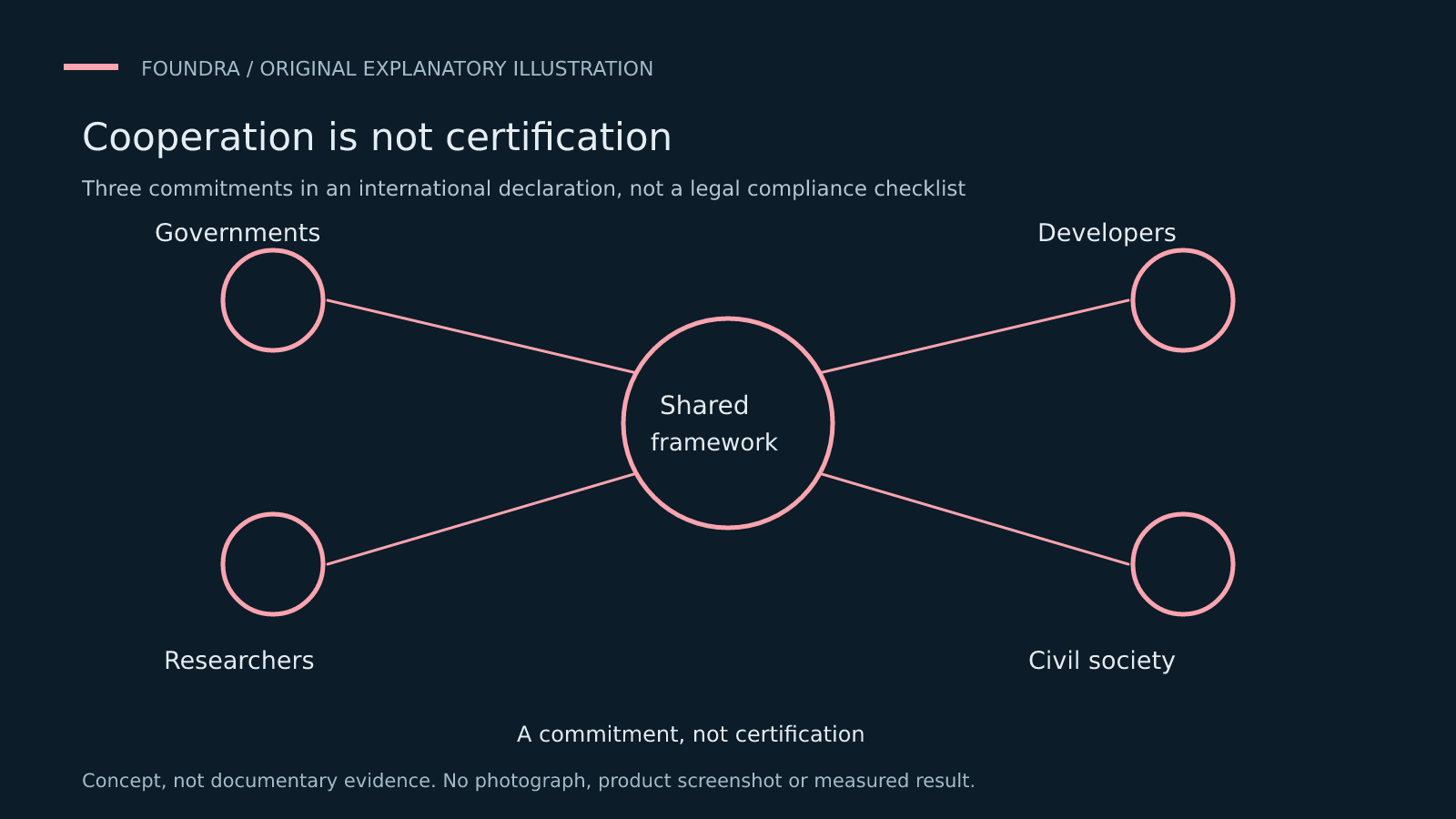
Cooperation is not certification
Shared evaluation
The statement calls for a common evaluation framework.
Risk information
Its agenda includes transparency and incident reporting.
Coordinated response
Cooperation must be distinguished from evidence of implementation.
A useful policy signal, without a fabricated compliance promise
For founders, the consequential signal is an effort to make methods and risk information more comparable across institutions. Common formats could make evidence easier to interpret. That is an analytical possibility, not a measured reduction in a startup’s compliance costs or an assurance that a customer will accept a particular test.
Nor does the statement establish that an evaluation vendor’s product is mandatory, that a signatory’s service is compliant everywhere or that a reported incident will automatically trigger the same response in every country. Those claims would require other authoritative evidence.
The near-term news is the signed cooperation agenda itself. It gives later implementation a set of commitments against which to be reported, while leaving implementation unproven. A declaration can be important without being promoted into a law, a certification or a result that has not yet been demonstrated.
Sources
- www.pm.gc.ca — November 9, 2026 ↗ www.pm.gc.ca — November 9, 2026 · Primary source
- BetaKit — November 10, 2026 ↗ BetaKit — November 10, 2026
Have additional information? Request a correction.