The financing is announced as raised, but the full $176 million is not necessarily new operating cash: BetaKit reports an undisclosed secondary component.
An answer is not the deliverable
A tax question can be answered without the underlying client job being finished. Someone still has to apply the answer to documents, explain the reasoning and decide what can be sent or filed. That distance between a useful response and accountable professional work is the market Blue J is trying to occupy with its latest financing.
The Toronto company announced on November 10, 2026 that it has raised US$176 million in a Series E led by JMI Equity. Existing investors Oak HC/FT and Sapphire Ventures participated, alongside Intrepid Growth Partners. Blue J says the round values the business at more than US$700 million and that it will use capital to expand its Workflows product and develop its presence in the United Kingdom and other international markets.
The headline figure needs a qualification. BetaKit reports that the financing includes a secondary component buying shares from existing holders, with its size undisclosed. Money paid to selling shareholders is not new cash available to run the business. It would therefore be inaccurate to describe the entire US$176 million as money landing on Blue J’s balance sheet for product development.
Where the product boundary is moving
In its funding announcement, Blue J describes Workflows as agentic AI for tax work. Its examples include reviewing returns before filing, preparing responses to IRS notices, analysing agreements, assessing multistate nexus and drafting client communications. The company says supporting sources and workflow steps can be inspected and that practitioners remain responsible for review and judgement. Those are descriptions of the intended product experience, not a Foundra test of its accuracy.
The distinction between research and workflow software is consequential. A research tool helps a user find and interpret material. A workflow tool also proposes what to do with it. Each additional step creates an opportunity to save effort, but also another place where an incorrect assumption might propagate. A hypothetical client memo could look polished while depending on a fact that was never established in the client file.
That means inspectability is not just an attractive interface feature. A reviewer needs to know which materials informed the output, which assumptions were made and where an unresolved question was treated as settled. Without that trail, faster production can leave the professional with a larger review burden rather than a smaller one.
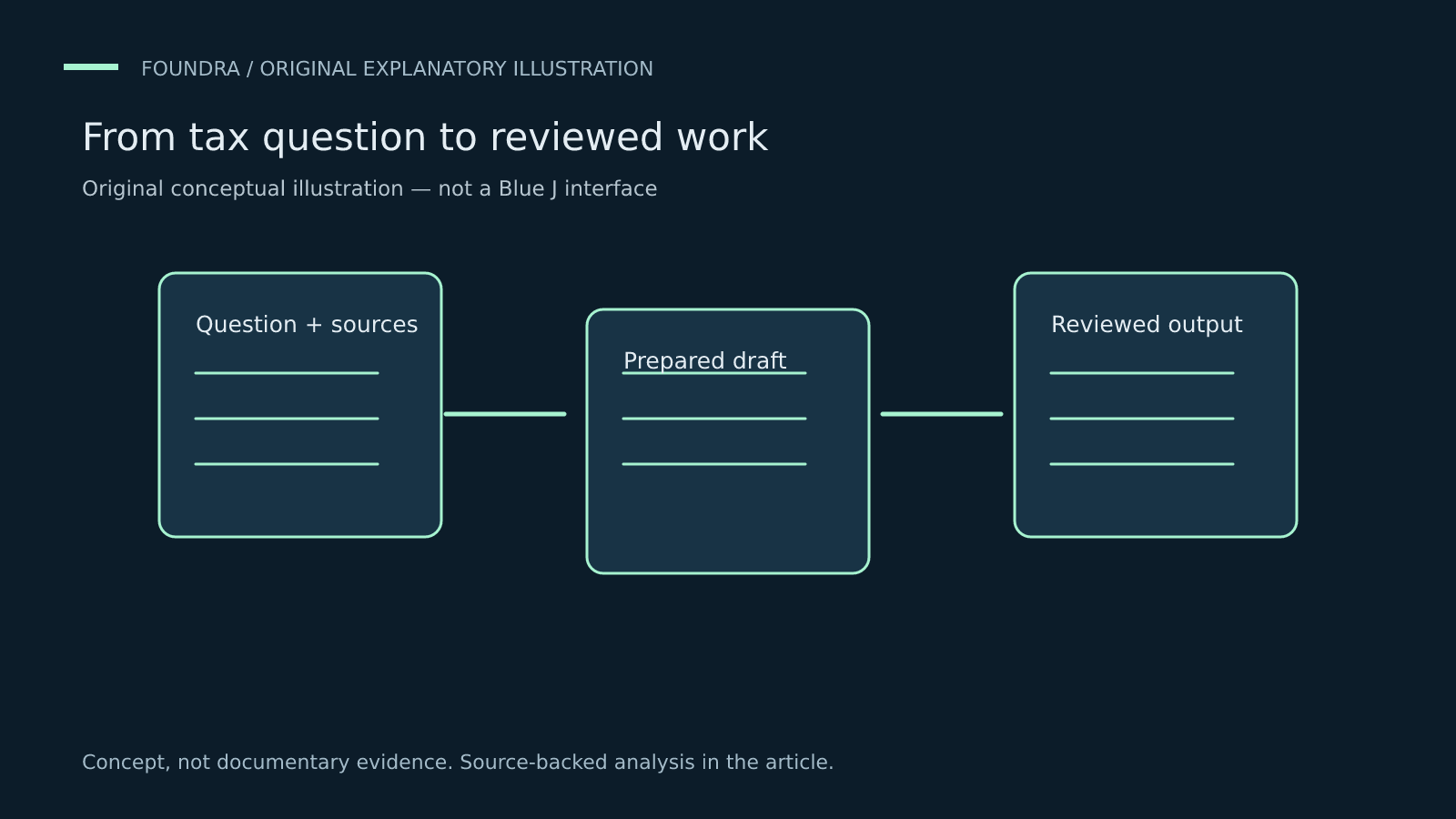
From tax question to reviewed work
Research
Sources and context
Draft work
Traceable workflow
Professional review
Judgement and responsibility
A growth story with an evidence boundary
Blue J reports 165 percent growth in annual recurring revenue over the 15 months after its Series D and says more than 6,500 organisations use the product. These are company-reported figures. They support an account of the growth narrative presented to investors, but do not independently establish profitability, retention or the quality of any individual tax answer. The release does not provide the data needed to make those deductions.
International expansion adds another analytical challenge. A workflow that is useful in one jurisdiction cannot simply be assumed to transfer unchanged to another. Sources, procedural requirements and the intended professional audience matter. Blue J’s stated UK and international plans should be read as expansion intentions, not evidence that a new office or a fully localised service has already been delivered everywhere it wants to operate.
The release also says JMI Equity principal Jack Duane will join Blue J’s board. That is a concrete, separately identifiable governance consequence of the investment, separate from the product roadmap. It does not establish how the board will prioritise expansion against quality controls. A useful operational measure would distinguish work produced from work accepted after professional review, because volume alone can obscure correction effort. No such acceptance-rate evidence is supplied in the announcement.
The financing backs an effort to move from helping professionals locate answers to helping them prepare work. That is a substantial change in product responsibility. The next useful evidence will not be a broader promise that AI can handle tax: it will be whether professionals can reliably follow an output back to its sources, correct its assumptions and decide that it is ready for a real client.
Sources
- www.bluej.com — November 10, 2026 ↗ www.bluej.com — November 10, 2026 · Primary source
- BetaKit — November 10, 2026 ↗ BetaKit — November 10, 2026
Have additional information? Request a correction.