Anthropic says Fable and Mythos share an underlying model but differ in safeguards and access. Its performance claims remain issuer-reported, not independently established results.
The decision is not just which name scores higher
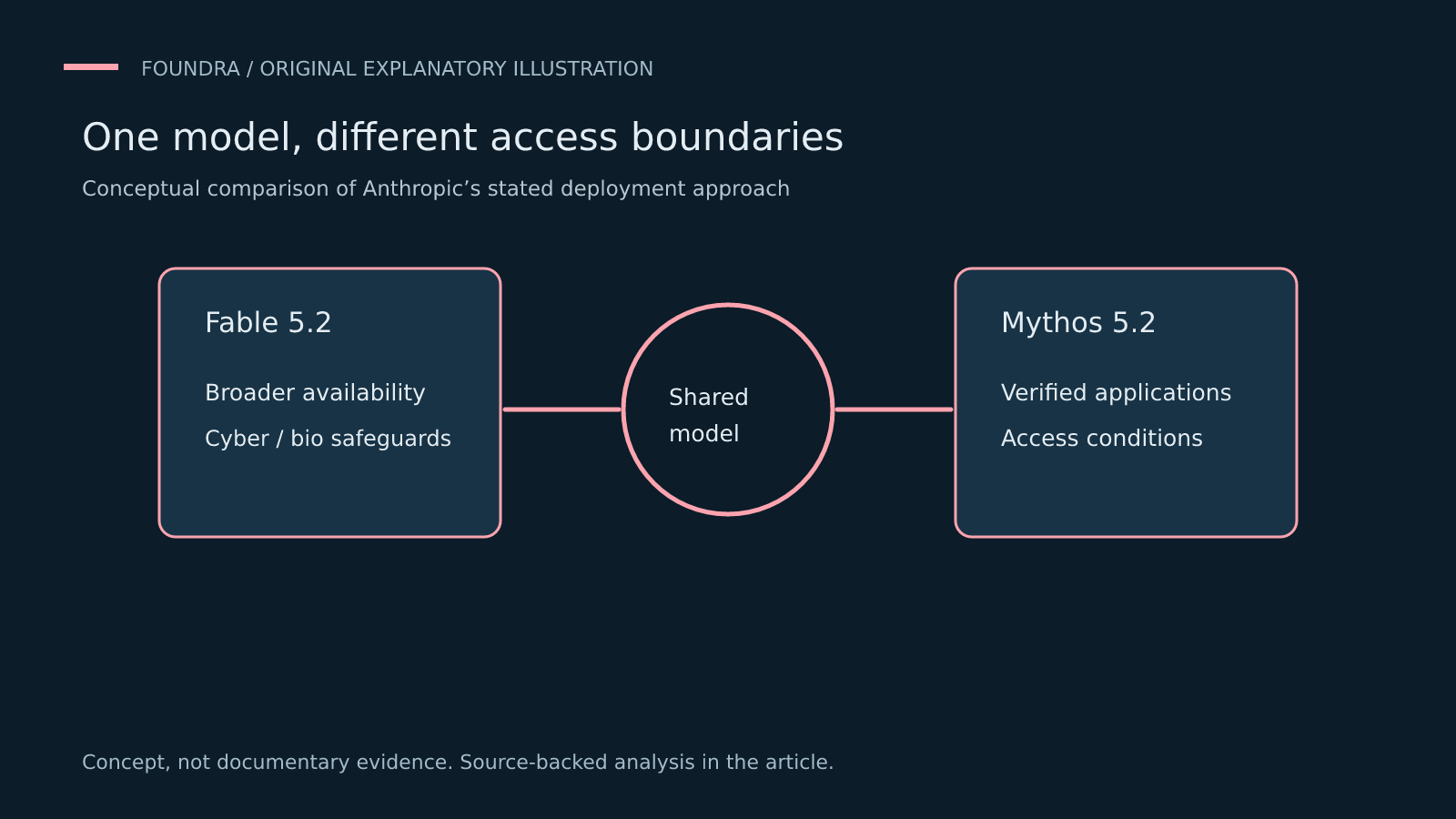
Comparing two AI products can sound like a contest between separate engines. Anthropic’s latest release makes that framing incomplete. The company says Claude Fable 5.2 and Claude Mythos 5.2 are the same underlying model, with differences in safeguards and the conditions under which users can obtain access.
The original announcement is dated November 9, 2026, even though some coverage appeared the following day. Anthropic describes improvements in coding, reasoning and vision. It also presents examples from prerelease use across software engineering and science. Those examples are the developer’s account of its testing, not independent evidence that another team will obtain the same results.
For a startup, the immediate question is therefore not simply which model sounds more capable. It is whether the accessible version can perform the required task under the right constraints, and what evaluation would establish that. Capability, permissions and product design belong in the same comparison.
The shared foundation has two operating boundaries
Anthropic says Fable includes strong cybersecurity and biology safeguards that allow it to be available to all users. It directs organisations pursuing beneficial cybersecurity or biomedical applications to apply for Mythos access through its verification programmes. That description should not be read as an assurance that every organisation will receive Mythos access or that every request is permitted.
This creates a practical distinction for teams handling sensitive work. A hypothetical security startup might need to determine whether its legitimate evaluation is supported by the broadly available product, or whether the verified-access programme is appropriate. A biomedical team would face its own task-specific questions. The correct path depends on the actual use case rather than a general preference for fewer restrictions.
Access differences can also shape the surrounding workflow. A team needs to know which model configuration was evaluated, which safeguards were present and which result it is trying to reproduce. Comparing an unrestricted research setting with a constrained production task without acknowledging the difference can give a misleading impression of capability.
One model, different access boundaries
Fable 5.2
Broader access and safeguards
Shared foundation
Same underlying model, issuer says
Mythos 5.2
Verified beneficial-use access
Prices are inputs, not a cost-per-outcome verdict
The announcement lists standard pricing of $8 per million input tokens and $40 per million output tokens. It describes an optional fast mode priced at $16 and $80 respectively. These are Anthropic’s announced prices at the time of the release. They do not establish the total cost of integrating, testing or supervising an application.
Anthropic says the models generate output up to 30 percent faster than their 5.1 predecessors, with fast mode increasing generation speed by up to 2.5 times. Both are issuer claims. A faster stream of tokens is not necessarily a faster completed business process if a result needs extensive correction or if the application requires several attempts.
An evaluation should consequently look at cost per acceptable task alongside latency. In a hypothetical coding workflow, a team could record how often a change passes its own tests and how much review remains. That would be more decision-useful than multiplying a published speed claim by the number of engineers and calling the result a productivity gain.
A release invites testing; it does not replace it
Anthropic says it performed extensive prerelease safety testing, including evaluations concerning sandbox escapes, and points readers to a system card. The announcement also says its safeguards produce fewer unnecessary blocks. Those statements provide the company’s safety narrative; this article does not claim to have audited the models or established that they are safe for every deployment.
Teams should preserve the distinction between a benchmark result, a selected demonstration and the requirements of a real product. A model that performs well on a published task can still be unsuitable for a particular integration. Conversely, a narrowly designed application may not require every capability highlighted in a release. The business decision should begin with the actual task and its failure consequences.
The November 9 update is noteworthy because it couples a capability release with explicit access boundaries. A useful comparison of Fable and Mythos 5.2 should keep those boundaries visible. The next step for a prospective user is a controlled, permitted evaluation—not treating a striking vendor example as a guaranteed outcome.
Sources
- www.anthropic.com — November 9, 2026 ↗ www.anthropic.com — November 9, 2026 · Primary source
- StartupTalky — November 10, 2026 ↗ StartupTalky — November 10, 2026
Have additional information? Request a correction.