AI-generated proofs can be machine-checked, but people still decide what must be proved. That specification boundary is central to interpreting this research.
Start with the promise being tested
A security proof does not begin with a blanket declaration that a product is safe. It begins with a statement about what must hold under particular assumptions. That difference is essential to reading Google DeepMind’s new account of AI-assisted verification of Signal’s cryptographic code.
On an official page dated November 10, 2026, DeepMind introduces AlphaProof Code, an agentic framework for formal verification. WIRED’s account of the same work was published earlier that day, at 12:01 a.m. EST. The researchers say they used it to prove key security properties of the implemented code underlying the Signal protocol, rather than stopping at an analysis of the protocol’s design. The result is presented as a research milestone. It is not a claim that every component of a messaging app, operating system or user device has been proved secure.
The implementation focus makes the work interesting to software businesses. A design can have desirable properties while a real implementation fails to preserve them. The researchers’ stated goal is to narrow that gap. This article evaluates the implications of their account; it does not claim to have rerun or independently reproduced the proofs.
People set the target; agents construct the argument
DeepMind describes a workflow in which researchers worked with models to turn security goals into mathematical specifications, with human experts reviewing those specifications. Agents then generated proofs in Lean, a language and system used for formal mathematical work. The announcement says the effort produced more than six million lines of Lean and that machine checking allowed people to concentrate on areas requiring additional judgement.
The company reports a four-week verification process and presents this as a substantial acceleration. That is a reported project duration, not a general estimate for the time needed to verify another company’s codebase. The announcement does not provide grounds for converting it into a universal cost-saving percentage or a promise that startups can reproduce the same result without specialist expertise.
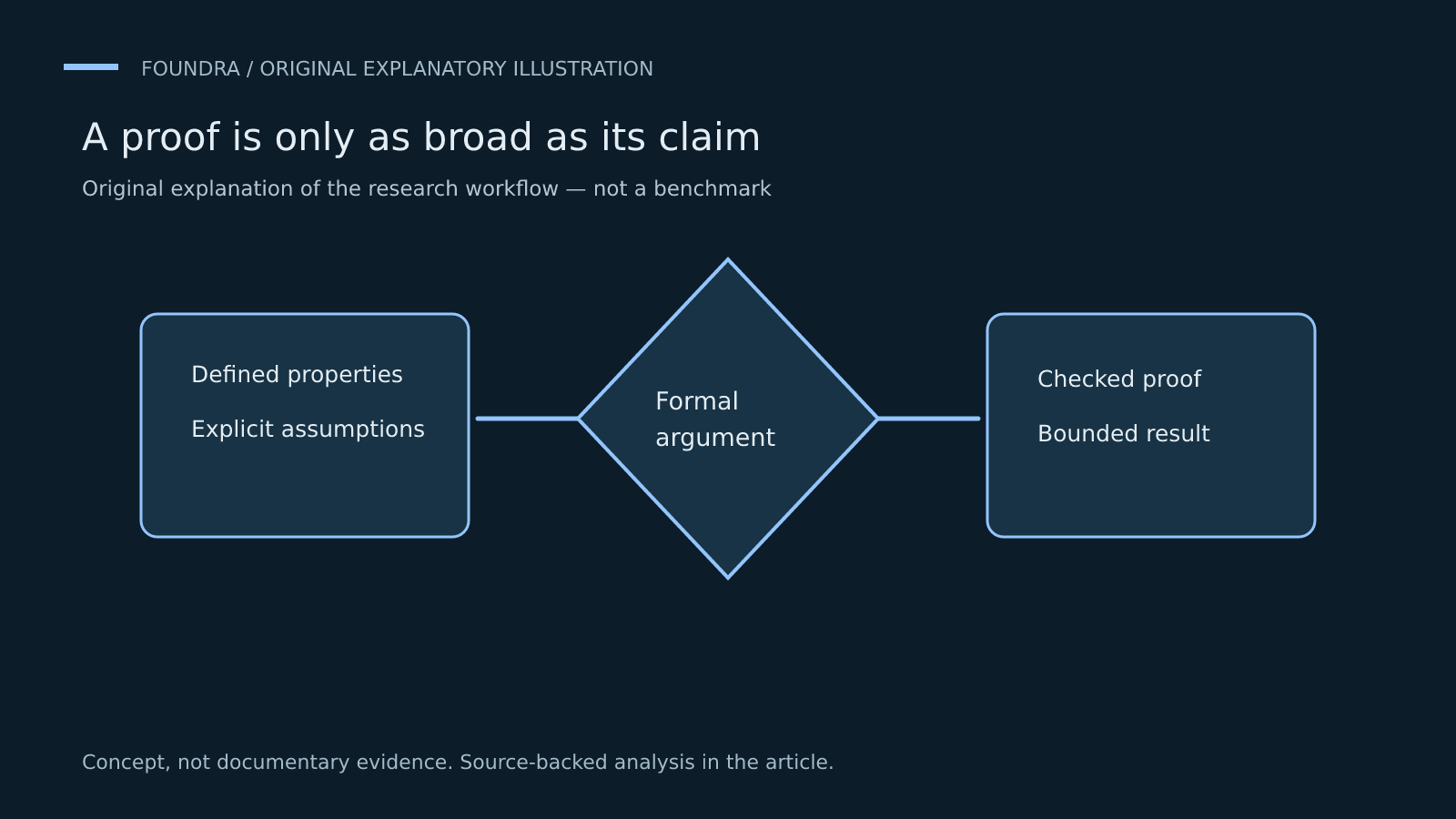
The most useful conceptual division is between creating an argument and checking one. An AI-generated argument need not be trusted merely because it reads convincingly. In formal work, a machine checker can test whether the argument satisfies the rules of the proof system. But a successfully checked argument still needs to be connected to the right specification, implementation and assumptions.
A proof is only as broad as its claim
Specification
People define properties
Proof generation
Agents build formal arguments
Checked result
Machine checks and focused review
Why the boundary matters commercially
Imagine a hypothetical startup building a secure communications feature. Proving that a core cryptographic routine preserves specified properties could be valuable. It would not settle whether the application manages permissions correctly, whether an endpoint is compromised or whether users are deceived into revealing information. Those are illustrative limits of scope, not claims that this research found a defect in Signal.
That is why a buyer should ask for the exact property being established before accepting a broad assurance claim. Which code is covered? Under which conditions does the result hold? What remains outside the proof? A narrow result with a clear boundary can be more useful than a sweeping statement that has no inspectable basis.
The same approach applies to claims about agentic automation. DeepMind’s account includes human collaboration, specification review and focused expert inspection. Describing the result as AI alone certifying an entire security system would erase work that the researchers themselves identify as part of the process.
A research direction, not a universal seal
DeepMind says it is open-sourcing formal-verification artifacts for community use and that further research is needed to scale the techniques. Its announcement discusses possible relevance to other important software, including medical-device firmware and power-grid systems. Those are prospective applications, not evidence that those systems have already been verified by this project.
For founders, the significance is an emerging separation of labour: people define the assurance they need, agents help build the formal argument and checkers test that argument within a specified system. That could make more ambitious verification projects practical. Whether it does so for a particular product depends on the available code, the properties required and the expertise needed to connect them.
The right conclusion is neither that AI has made security automatic nor that machine-assisted proofs are irrelevant. This announcement describes a serious attempt to verify implemented cryptographic properties at larger scale. Its value rests on being precise about the claim—and refusing to let the word proof expand beyond it.
Sources
- deepmind.google — November 10, 2026 ↗ deepmind.google — November 10, 2026 · Primary source
- WIRED — November 10, 2026 ↗ WIRED — November 10, 2026
Have additional information? Request a correction.