A research assistant should make its assumptions, alternatives and limits inspectable—not turn a well-fitting output into a claim of scientific understanding.
Two curves, one unresolved question
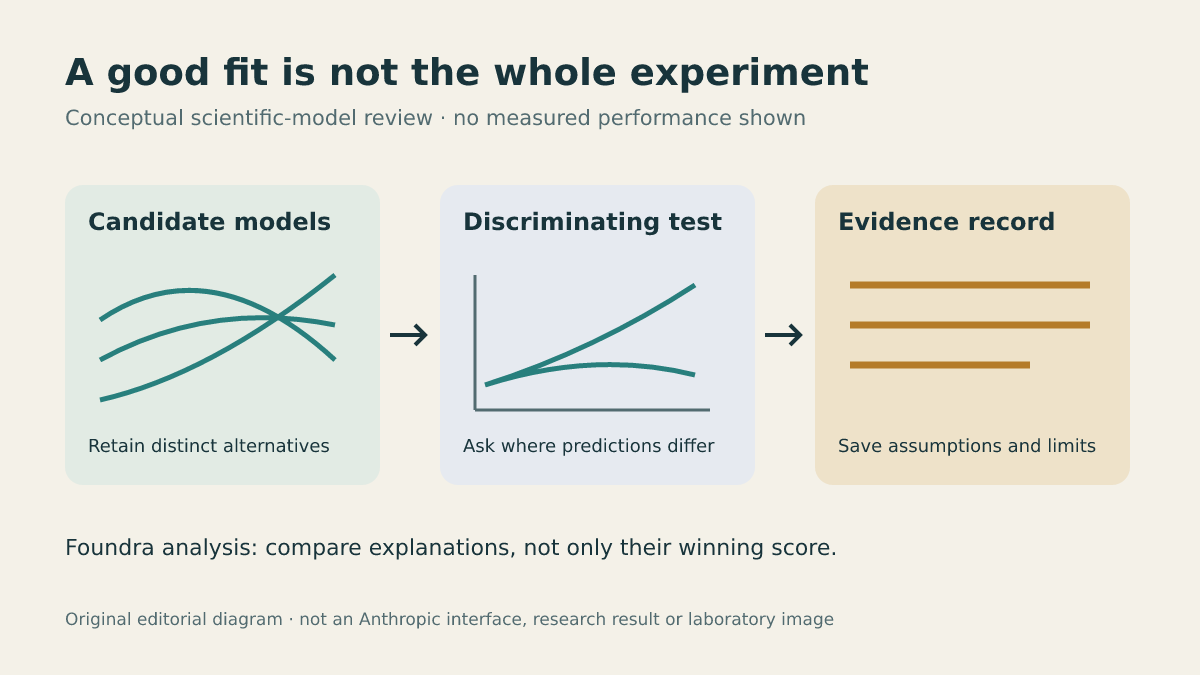
Imagine a research-tool demonstration with an unusually persuasive chart. A generated model traces the measurements almost perfectly. The presenter moves straight to the conclusion: the software has explained the system. Now imagine asking for another model that fits the same observations but predicts something different when a condition changes. If the product cannot produce or retain that alternative, the demonstration has answered a narrower question than the conclusion suggests. This is a hypothetical evaluation, not a test Foundra conducted.
The November 6 guest essay, “Teaching AI to build scientific models,” was published by Anthropic. Its authors, AI for Science grantees Jakob Macke, Daniel Gedon and Stefan Wahl, discuss building models, constraining their parameters and interpreting them. The essay argues for considering plausible alternatives rather than accepting a single best fit. It also cautions that evidence for AI model-building systems on problems without a known answer remains sparse; much testing has concerned rediscovering established models. These are the authors’ account and assessment, not an independently measured result from Foundra.
The publication is an essay about a research direction, not an announced commercial release, a funding close or proof of a new scientific discovery. Its discussion of interpreting models raises a product-design question for founders: what would a scientific assistant need to preserve so that a researcher can challenge its answer? The rest of this article develops that question as Foundra analysis, without treating the host company’s involvement as a performance endorsement.
Design the handoff around disagreement
Consider a hypothetical startup selling software to a laboratory. It could deliver a proposed model, a numerical score and a written explanation. A more demanding handoff would also identify the supplied observations, the assumptions allowed during the search and the alternatives considered. The point would not be to swamp the customer with every discarded attempt. It would be to retain enough of the decision trail to show which conclusions depend on which choices.
A useful evaluation could begin by changing the question rather than admiring the chart. Ask what the model predicts outside the observations used to construct it. Ask whether a materially different candidate predicts the same thing. Ask which proposed measurement would separate them. Those are suggested questions for a product assessment, not claims that a particular application currently supports them or that any one test can certify a discovery.
That last distinction matters to product scope. A tool might help arrange a comparison without being authorized to select the next laboratory experiment. The latter choice could depend on feasibility, safety, expense and the researcher’s objectives. A founder could therefore define a narrower deliverable: a reviewable set of candidate predictions, accompanied by the assumptions behind them. The customer would retain the decision about what to investigate.
The interface could express disagreement directly. Instead of displaying one confident answer at the top and hiding the alternatives, it might show where candidates agree, where they diverge and which inputs each requires. A reader should be able to tell the difference between a model’s calculated output and an explanatory passage generated about it. In this proposed design, clarity about uncertainty is a deliverable, not an admission that the product has failed.
A proposed buyer’s evaluation—not a performance benchmark
Inspect the candidates
Ask which distinct explanations were retained and what assumptions each uses.
Compare predictions
Identify a proposed changed condition where candidates would disagree.
Keep the decision trail
Save inputs, versions and limits; do not confuse a fitted output with an established discovery.
What belongs in the acceptance test
For a hypothetical buyer, the acceptance test should follow the promised task. If the vendor promises help organizing model comparisons, the buyer could check whether the saved record permits a colleague to repeat that comparison. If it promises reliable predictions under changed conditions, that is a different claim requiring appropriate evidence. Passing the first test should not quietly become a testimonial for the second.
There is also a practical question about continuity. Suppose a researcher returns to the work after changing an input file or updating the assistant. Can the earlier result still be identified, along with its assumptions and the version that produced it? This is not a report of a defect in Anthropic’s tools. It is a proposed procurement question for any product whose outputs might become part of a scientific decision trail.
The guest essay offers a reason to ask harder questions about AI research software, but it does not answer those procurement questions for a specific commercial system. A founder can make the boundary explicit: this product proposes models, this part compares them, and this conclusion still needs human interpretation or additional evidence. That is a more useful pitch than suggesting that a polished fit has settled the science. The next demonstration should leave the buyer with something to inspect—not merely something to believe.
Sources
- Anthropic: Teaching AI to build scientific models — guest essay by AI for Science grantees ↗ Anthropic: Teaching AI to build scientific models — guest essay by AI for Science grantees · 2026-11-06 · Primary source
Have additional information? Request a correction.
Updates & corrections
November 8, 2026: Restored two contextual links to the original guest essay and its interpretation section. The underlying reporting and analysis are unchanged.