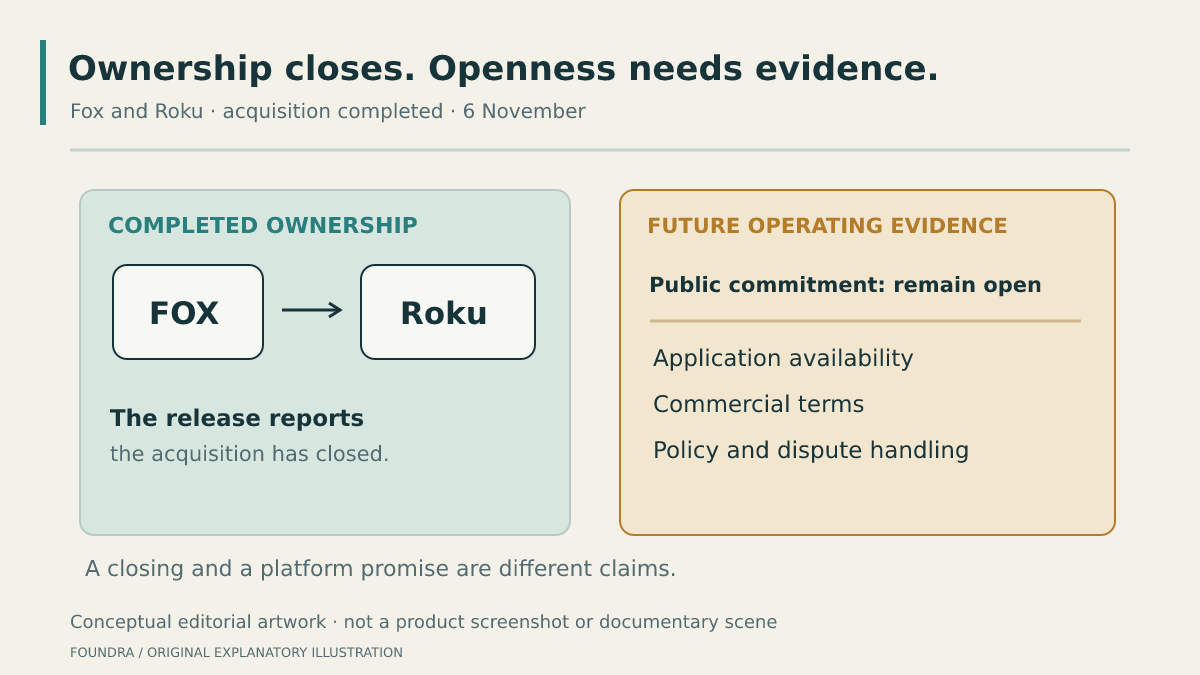
Completed ownership and continued platform openness are different claims; the closing establishes the first, not the future performance of the second.
The transaction has crossed the line
The difference between agreeing to buy a platform and owning it is consequential for the businesses that depend on it. Fox’s November 6 announcement says its acquisition of Roku has completed. This is coverage of that closing, not a new announcement of the earlier agreement or a claim that every integration task is finished.
Fox’s closing release also says Roku founder Anthony Wood will join its board and serve as co-chair of a newly formed digital-platforms division. That division includes Roku, Tubi and FOX One, among other businesses. The disclosed organizational arrangement places a distribution platform and streaming services inside the same wider corporate structure.
Wood’s continuing role is relevant to a founder-led exit, but it should not be translated into a claim that Roku remains independently controlled. Joining a parent board and sharing leadership of a division describe particular roles inside the acquiring company. They do not, without further governance evidence, establish a founder veto over platform policy or a guarantee that commercial priorities will never change. The announcement supports continuity of involvement, not continuity of every decision right.
The release emphasizes continued openness for Roku’s content partners. That is an important commitment to record accurately, but it remains a statement of intended operation. Foundra has not tested post-acquisition partner access, reviewed a change in ranking or verified how future commercial disputes will be handled. A completed transaction and an unchanged partner experience are not interchangeable facts.
The platform promise from three seats
A viewer, a streaming founder and the new owner may read the same commitment differently. A viewer could care about continuing access to a chosen service. A founder could care about distribution, commercial terms and the ability to reach an audience. The owner could care about combining technology and media assets. These are analytical perspectives, not interviews or evidence of changes that have already occurred.
For the founder, “open” needs a more operational meaning than a reassuring adjective. A hypothetical partner assessment could ask whether a service can still distribute its application, what information it receives about performance, how commercial terms are applied and which process resolves a disagreement. The answer would have to come from current rules and experience, not from inference about the new owner’s motives.
The corporate combination does not by itself prove that an independent service will be disadvantaged. Nor does a public commitment prove that it cannot be. Treating either proposition as settled would substitute a theory for evidence. The useful approach is to retain the commitment and identify observable conditions against which it can later be assessed.
That approach also avoids making founders choose between alarm and complacency. A distribution relationship can warrant careful monitoring even when there is no verified adverse change. A team can document its present terms and performance, keep its own customer and content records organized and decide which future changes would trigger a review. Those are proposed precautions, not recommendations based on a defect Foundra has discovered at Roku.
Ownership and operating promises need different evidence
Completed event
Fox’s November 6 release says the Roku acquisition has completed.
Stated intention
Fox commits to preserving an open distribution platform for partners.
Later assessment
Future platform operation and anticipated cost savings require separate evidence.
Closing is not the integration scorecard
Fox expects approximately $400 million in run-rate cost synergies within two years after the close. Its release presents that as a forward-looking expectation. It is not money already saved, and a run-rate figure is not the same as cumulative savings collected over the period. Any later assessment should preserve both distinctions.
The integration’s financial objectives and the platform’s operating commitments would also need different evidence. A cost-savings measure cannot establish that content partners receive equivalent treatment. Conversely, continued application availability would not establish that the anticipated financial benefits have been realized. An account of the deal should not let one successful measure stand in for all the others.
The closing gives the startup ecosystem a concrete new ownership fact around which to make those assessments. Streaming businesses that use a platform do not need a prediction of inevitable harm or automatic opportunity; they need accurate transaction status and a clear view of what remains untested.
The supported ending, for now, is deliberately unfinished. Fox owns Roku, and Fox has publicly committed to preserving an open distribution platform. The first statement is a reported completed event. The second will acquire its meaning through the way the platform is operated after it.
Sources
- Fox Corporation via PRNewswire — November 6 acquisition closing release ↗ Fox Corporation via PRNewswire — November 6 acquisition closing release · Primary source
- TechCrunch — Fox–Roku acquisition completion report ↗ TechCrunch — Fox–Roku acquisition completion report
Have additional information? Request a correction.