A research roadmap needs an explicit route into product decisions; neither a promising experiment nor more scale establishes that route on its own.
A departure account, with a September chapter
John Langford’s November 6 personal post ends with a departure and an assessment of the organization he helped build: he says he left Microsoft and that AI Frontiers is over. The post is a fresh public account of that experience. It is not an official corporate announcement, an independently established headcount report or evidence that Microsoft has stopped all AI research.
The sequence in his telling begins after ChatGPT’s release, when he helped organize AI Frontiers within Microsoft Research. It continues with a move into Microsoft AI in early September and his subsequent decision to leave. The November 6 personal post does not make the September reorganization a new event this weekend. Foundra has not independently established the full internal sequence or Microsoft’s organization-wide position.
Langford describes coordinating research efforts rather than relying only on isolated projects. He also says he could not get innovation into use or serious consideration after the move. His account of the research-to-use obstacle is his explanation, not a controlled comparison of management systems. It does not establish which internal decisions caused particular technical or commercial outcomes.
Read this as a participant-account feature. Its value for founders lies in the decision problem it exposes, not in assigning a winner to an internal dispute: a team may produce work it considers promising while the organization receiving that work sees no reason to change what it builds. The following comparison is Foundra’s analysis, not additional reporting about Microsoft.
Two teams can be right about different questions
For a hypothetical research team, the important question might be whether an approach improves on a baseline. For a hypothetical product team, it might be whether that improvement survives the service’s reliability, cost and integration constraints. A result can be interesting on the first test and insufficient on the second. Treating the product team’s response as automatic hostility would skip the actual evaluation.
The opposite mistake is just as consequential. A current roadmap can be efficient while excluding a worthwhile alternative from serious examination. Treating that roadmap as conclusive evidence that a different approach lacks value would also skip the evaluation. Neither a research demonstration nor an existing commercial plan settles the comparison by itself.
These are different burdens of proof, not inevitable enemies. Research should make its comparison understandable; product evaluation should identify the constraint that matters. If a meaningful test cannot be run with the available resources, that limit belongs in the decision. None of this demonstrates that another reporting line, more compute or more staff would have changed Langford’s experience.
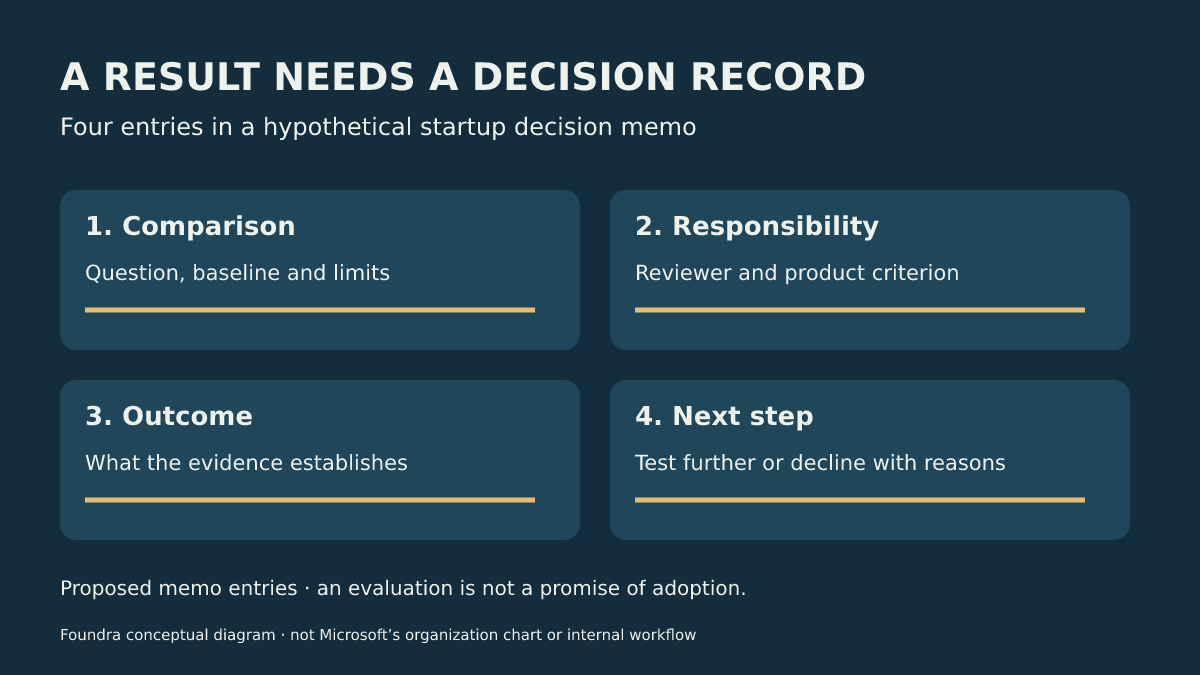
Four entries in a hypothetical decision memo—not Microsoft’s internal process
Comparison
State the experiment, baseline and limits.
Responsibility
Name the reviewer and the product criterion.
Outcome
Record what the evidence does and does not establish.
Next step
Specify further testing or a reasoned decision not to proceed.
The missing artifact could be a decision memo
Imagine an internal memo written before a startup’s experiment begins. This is a proposed process, not a document observed at Microsoft or another company. It would be short enough to revisit when the result arrives, and specific enough that neither team can silently substitute a different question.
Its first entry would state the comparison: what is being tested, against which baseline and under what limits? That entry would separate an ambitious research direction from the particular result the team can produce now. An idea may remain interesting even if one experiment fails, but the memo should not disguise that failure as confirmation.
Its next entry would name the reviewer and the product criterion. Who can assess the work, and what would make further integration testing worthwhile? Naming that responsibility is different from promising adoption. The reviewer should be able to explain both a decision to proceed and a decision not to proceed.
The final entries would preserve the outcome and the next step. A positive result might lead to a limited integration test; an ambiguous result to another measurement; a negative result to closing the investigation. Those are hypothetical options, not a prediction of commercial success. Recording a reasoned rejection matters as much as recording an approval.
That gives a founder something concrete to inspect the next time a promising experiment stalls: not another argument about whether research or scale deserves respect, but a missing comparison, owner or decision. Langford’s account cannot tell every startup how to organize. A completed memo could at least show whether a result received an evaluation—and why the company did or did not act on it.
Sources
- John Langford: The End of AI Frontiers, personal first-person account ↗ John Langford: The End of AI Frontiers, personal first-person account · 2026-11-06T10:59:51-06:00 · Primary source
Have additional information? Request a correction.