A funded acquisition strategy still has to pass separate ownership, operational and capacity milestones.
Two original reports, with a defined evidence boundary
Two November 9 reports describe a $300 million Series A for Amsterdam-based Onodrim. Sifted’s accessible introduction gives the round, amount and a plan to acquire defence, space and industrial manufacturing startups. EU-Startups separately describes a closed financing and an acquisition programme. Foundra did not obtain an original company financing release. The account here is attributed to those reports, not presented as independently audited financial information.
Sifted’s remaining body is access-restricted and has not been decoded or used. Onodrim’s own homepage supplies background: it describes a technology-driven platform for scaling Europe’s defence and industrial foundations. That is not first-party corroboration of the financing. Valuation and investor details are excluded from this bounded brief because they are not needed to explain the verified development.
The target descriptions are not identical
The two publications describe the acquisition strategy at different levels. Sifted’s introduction refers to startups. EU-Startups describes controlling stakes in established European businesses, particularly small and medium-sized founder-led family companies. This brief does not collapse those descriptions into a claim that every intended target belongs to one category. Neither report, as used here, gives Foundra a completed portfolio inventory.
EU-Startups says Onodrim expects to announce its first acquisitions in the coming months. That is an expectation for future announcements, not a complete transaction-status record. It does not justify declaring that a named business has been bought, that an agreement has completed or that a factory has expanded. No unnamed target is reconstructed from the financing story.
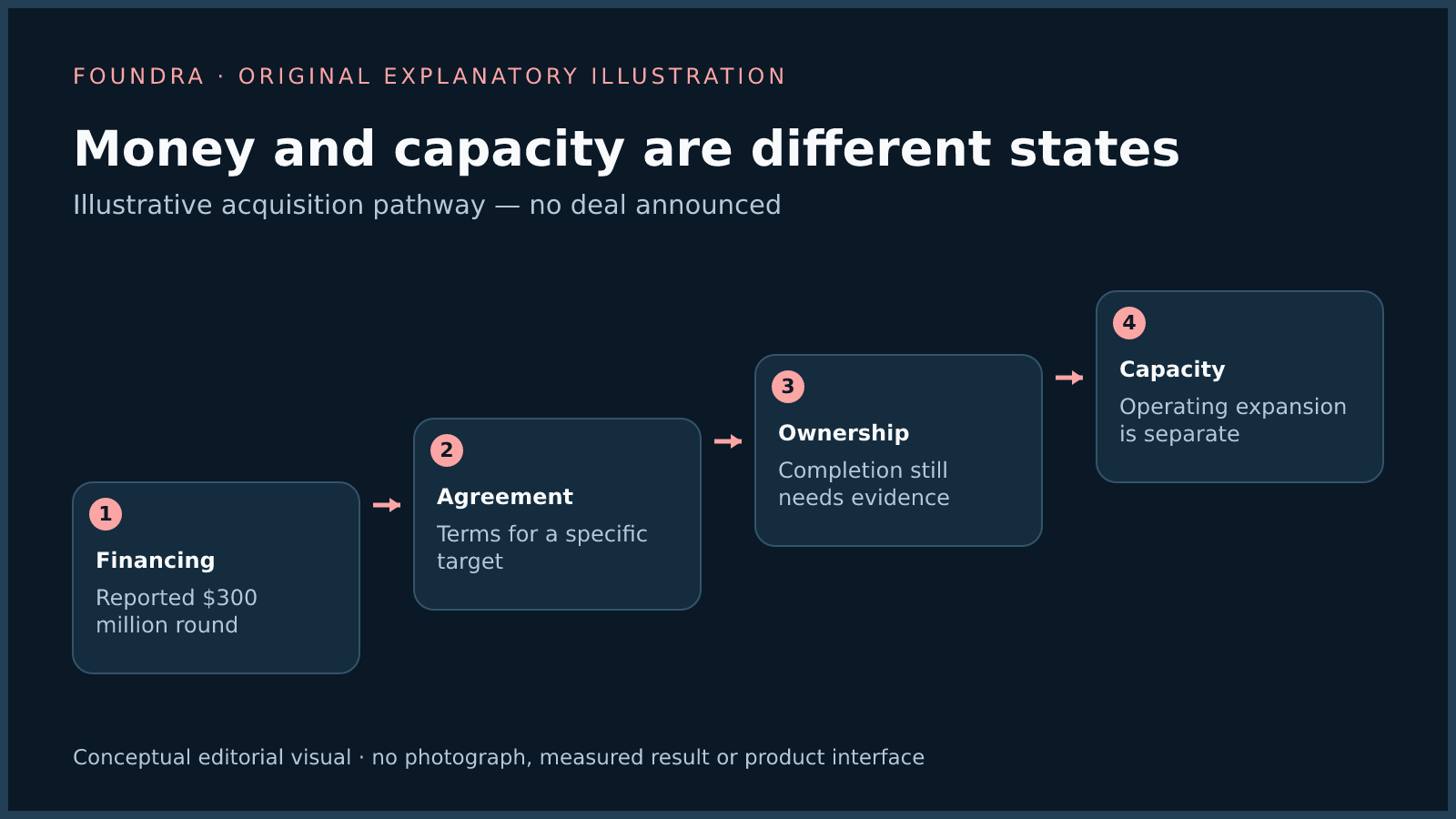
Money and capacity are different states — editorial conceptual explanation
Financing
Reported $300 million round
Agreement
Terms for a specific target
Ownership
Completion still needs evidence
Capacity
Operating expansion is separate
A round and a purchase answer different questions
The useful operating distinction is between providing capital for an acquisition strategy and showing what a specific acquisition changes. An agreement establishes terms; completion establishes ownership; an expansion requires its own operating evidence. Those categories should remain separate even when they ultimately form part of the same strategy. The financing amount alone cannot establish the production capacity of a future portfolio.
For a founder reading the announcement, the next relevant transaction would have its own scope: which business, which stake, which obligations and which stage. Until such a development is reported and verified, the news is the reported Series A and the strategy it funds. This is a substantial financing event with an intentionally narrow account—not a forecast of acquisitions, output or government orders.
Sources
- Sifted — Onodrim Series A, accessible introduction ↗ Sifted — Onodrim Series A, accessible introduction · 2026-11-09
- EU-Startups — Onodrim financing report ↗ EU-Startups — Onodrim financing report · 2026-11-09
- Onodrim — undated company background ↗ Onodrim — undated company background · Primary source
Have additional information? Request a correction.