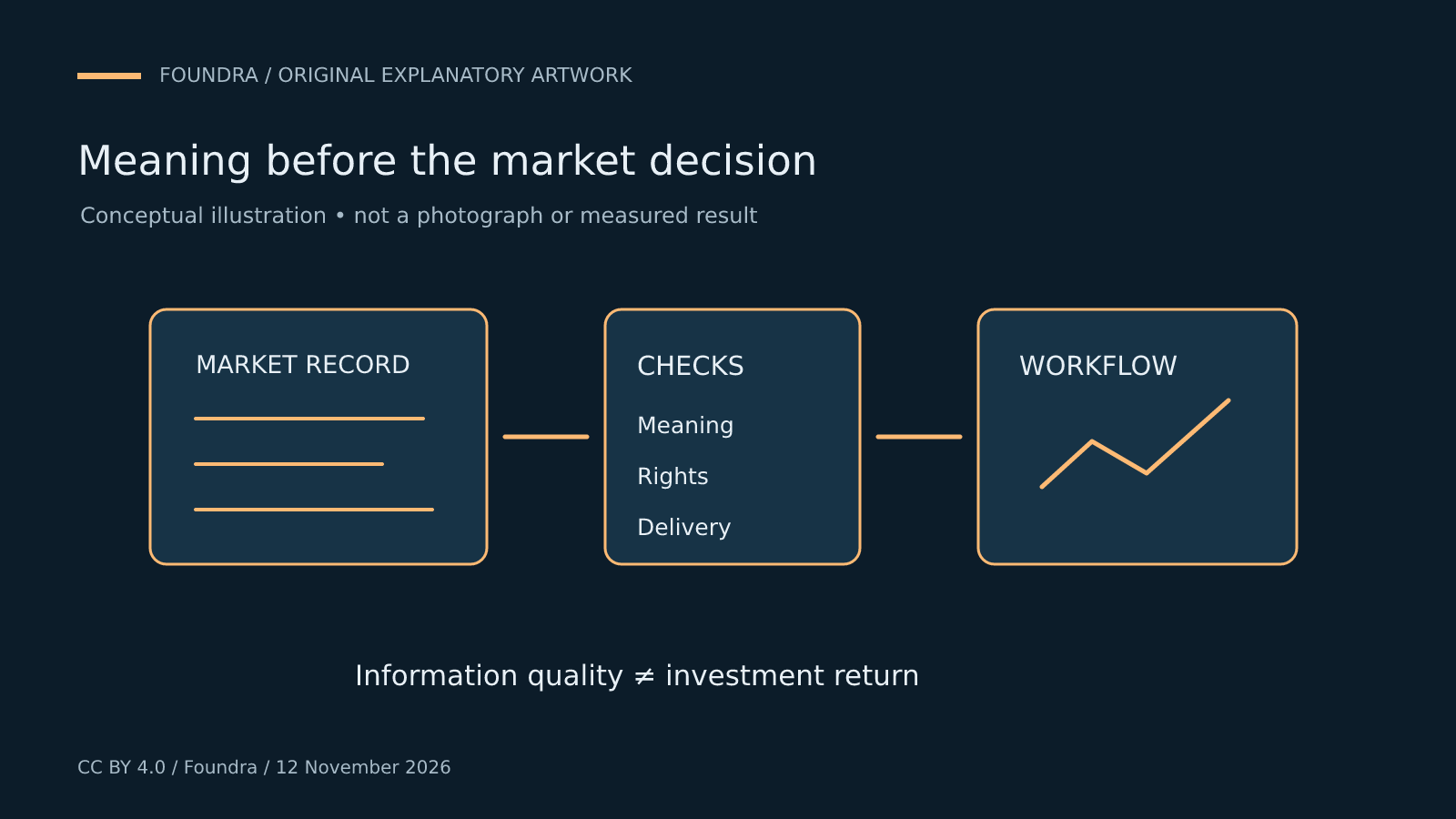
The investment and the AI-performance thesis need separate evidence; acquisition volume alone does not settle customer outcomes.
The funding event and the operating thesis
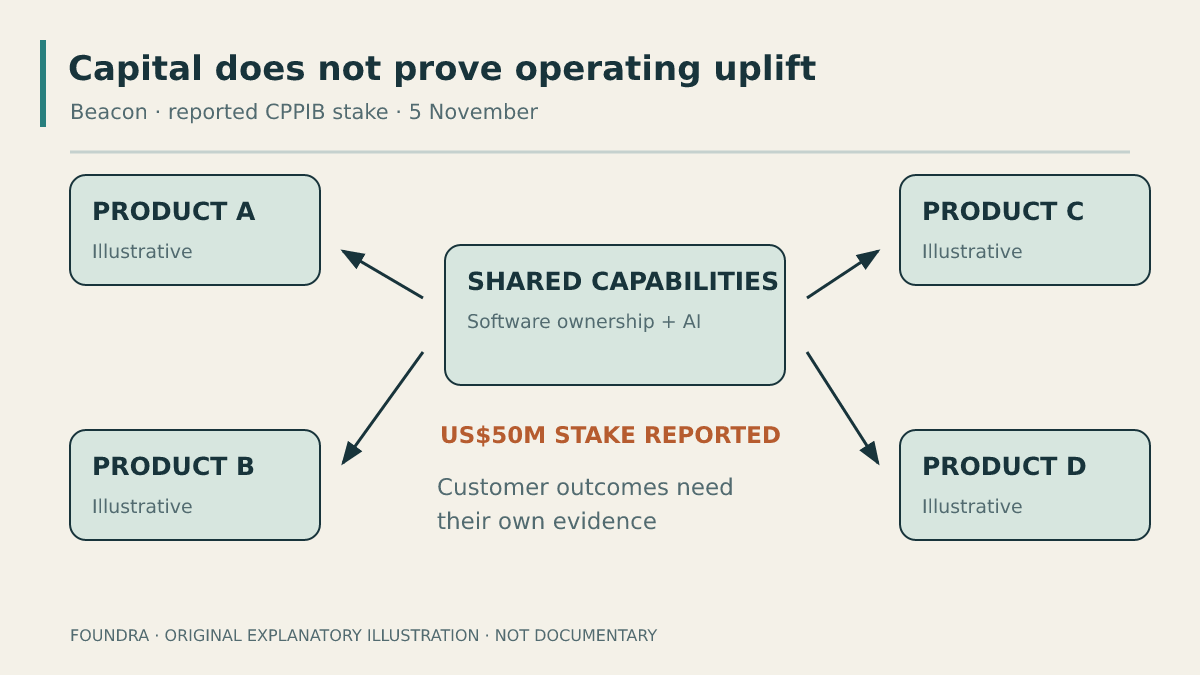
There are two propositions in the Beacon Software story, and only one is a financing event. The Globe and Mail's November 5 report says Canada Pension Plan Investment Board bought a US$50 million stake in the Toronto company. The larger proposition is that AI capabilities can make a portfolio of acquired software businesses work better. The investment does not independently prove that second proposition.
Beacon's own newsroom acknowledges the report with a November 5 entry describing the CPPIB investment. BetaKit's follow-up discusses the same development and explicitly cites The Globe and Mail. It is useful context, but it should not be represented as a separate independent verification of the transaction. Foundra read the original accessible report, not just its headline or a later feed entry.
The original report places the investment within an expanded financing. This article does not reconstruct the financing's legal terms or treat a stake purchase as a future fundraising target. The supported news is the reported purchase of the US$50 million stake, with the company's public acknowledgment, rather than an inference that every part of the operating strategy has now been validated.
Buying software is different from improving it
Beacon describes a model of software ownership combined with shared AI capabilities. The Globe's reporting discusses businesses serving specific, conventional customer workflows. The analytical attraction is understandable: a shared capability could potentially help more than one acquired company avoid building the same operational tool independently.
But an acquisition and a product improvement remain different events. A software company can change owners without its customers immediately receiving a better product. Conversely, an effective shared tool could help an acquired business in a way that is not visible in the number of acquisitions. A useful evaluation would therefore identify what changed for each business, rather than using portfolio size as the outcome measure.
Foundra is not adopting the performance metrics quoted from company leaders in the original reporting as independently verified results. The financing announcement does not provide a controlled comparison of customer outcomes, employee productivity or product reliability. Those would need evidence suited to the relevant claim, especially when changes differ across businesses.
Separate financing from operating proof
Investment report
The Globe and Mail reports CPPIB bought a US$50 million stake.
Consolidation
Beacon’s model combines ownership of software businesses with shared AI capabilities.
Customer outcomes
Improvement in an acquired product requires product-level evidence.
Repeatability
A useful operating model must work beyond one selected example.
The same agent, different workflow
Shared AI infrastructure can sound like a single product that transfers cleanly between companies. In practice, the relevant analytical question is how much of a workflow is genuinely shared. A hypothetical invoicing tool might have reusable components while still needing different data definitions, approval rules and exception handling for different businesses. The common label does not resolve those differences.
The adaptation work
That makes implementation evidence more useful than an abstract claim of AI integration. A prospective customer should be able to understand which task changes, what the system can do and how errors are handled. An investor should distinguish the cost of building a shared capability from the cost of adapting and maintaining it across the portfolio. No such cost model is established here.
There is a further question about product priorities. Acquired businesses may serve customers whose needs are highly specific to their industries. A shared operating approach should not be assumed to make those differences disappear. Whether centralization improves or weakens a particular product is something to examine through actual changes and customer evidence, not a conclusion to import from the financing headline.
What would make the thesis easier to assess
Follow-up disclosure could become more informative by separating acquisition growth from changes within existing businesses. Examples of deployed tools, their operating limits and the effects on specific workflows would help readers understand the model. A well-documented result in one business would be valuable while still leaving open how widely it can be repeated.
The CPPIB stake is consequential because the original reporting identifies a substantial investment in a young software-consolidation company and Beacon publicly acknowledges it. There is no need to attach unverified productivity gains to make the event newsworthy. The financing and the business thesis can both be discussed without pretending they have the same evidentiary status.
For SaaS founders, the question is not simply whether an AI rollup can raise capital. It is whether shared capabilities can improve an acquired product while preserving the customer relationships that make the business useful. Beacon's new reported investment supplies more attention to that question; the answer will come from the software and the operating evidence, not the stake size alone.
Sources
- The Globe and Mail ↗ The Globe and Mail
- Beacon company newsroom ↗ Beacon company newsroom · Primary source
- BetaKit ↗ BetaKit
Have additional information? Request a correction.